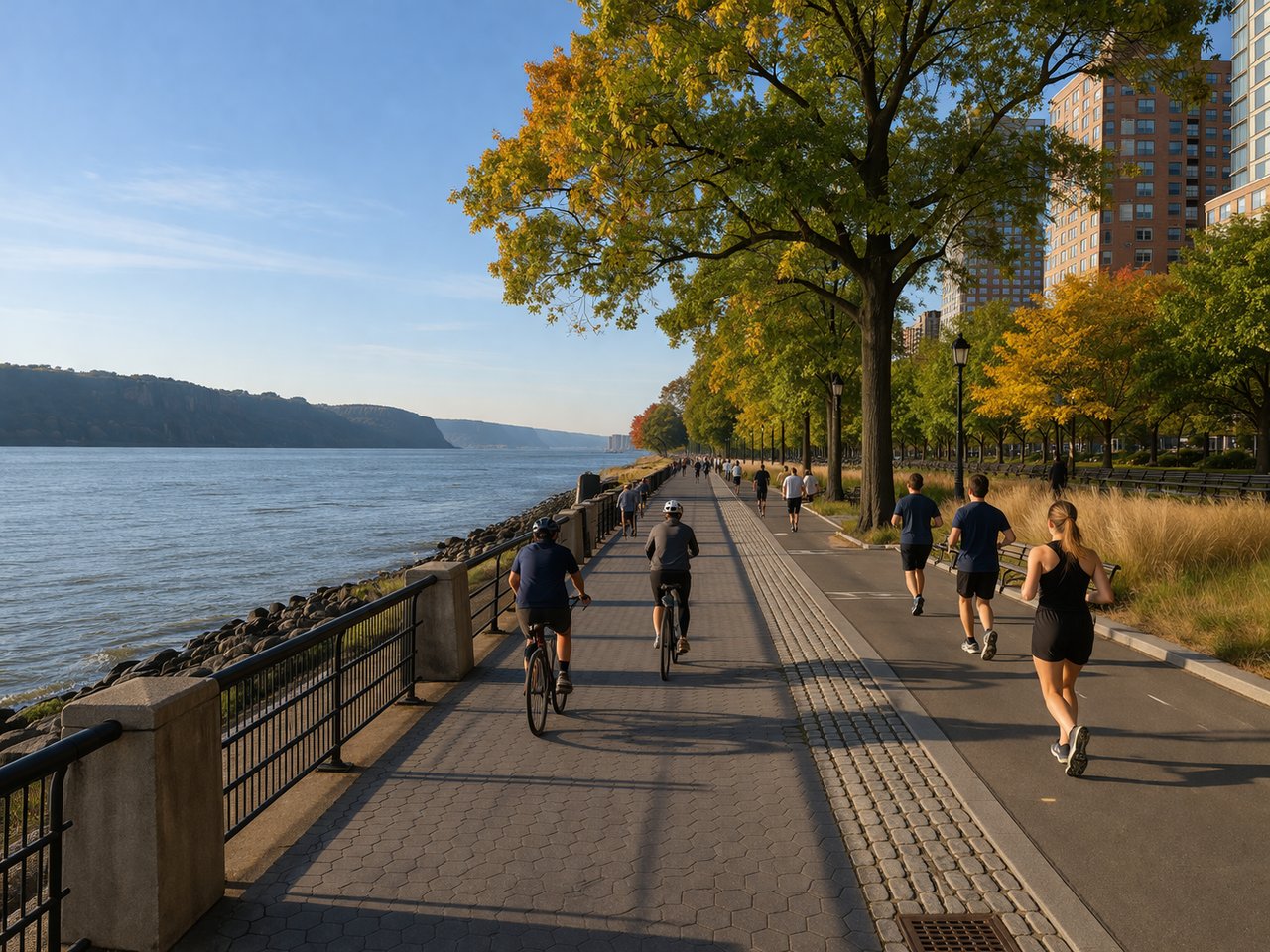
BATTERY PARK CITY: THE WATERFRONT LIFESTYLE
Battery Park City occupies 92 acres of landfill on the western edge of lower Manhattan—created, in a geological coincidence of history, largely from the material excavated when the original World Trade Center was built. It is the most deliberately planned residential neighborhood in Manhattan, developed under the governance of the Battery Park City Authority, a state public benefit corporation that continues to hold ownership of the land on which all Battery Park City buildings sit.
That planning foundation produces a residential environment unlike any other in the city: wide, maintained esplanade paths along the Hudson River, consistent landscaping and public space, ground-floor retail calibrated to neighborhood needs rather than tourist traffic, and a physical coherence that most Manhattan neighborhoods—assembled organically over centuries—simply do not possess. For buyers considering a waterfront address in lower Manhattan, understanding what Battery Park City offers—and what its legal and financial structure means for ownership—is essential.
THE ESPLANADE AND PUBLIC SPACE
The Battery Park City Esplanade runs approximately 1.2 miles along the Hudson River, connecting the neighborhood's northern and southern ends and providing continuous waterfront access for residents. This is not a narrow path alongside a highway—it is a designed public promenade with benches, public art installations, playgrounds, and continuous water views. North Cove and South Cove provide distinctive waterfront environments at each end of the neighborhood, and Rockefeller Park, a four-acre park at the northern end of Battery Park City, offers lawns, athletic facilities, and children's play areas. The Hudson River Park Trust manages the broader park corridor that Battery Park City connects to, extending the accessible waterfront well beyond the neighborhood's boundaries.
For families and buyers who prioritize outdoor access, Battery Park City's public space infrastructure is singular in lower Manhattan. No other downtown neighborhood places residents within steps of a maintained waterfront esplanade at this scale. This is infrastructure that cannot be replicated by a building terrace or a rooftop pool, and it is reflected in the pricing premium that Battery Park City commands relative to immediately adjacent Financial District addresses.
THE GROUND LEASE STRUCTURE
The most important legal distinction in Battery Park City real estate is the ground lease. Because the Battery Park City Authority owns the land, all residential buildings—whether co-op or condominium—sit on leased land rather than fee-simple ownership. Individual apartments are sold with traditional ownership rights, but the building's land interest is governed by a long-term ground lease with the Authority.
Buyers must understand the terms and remaining duration of the specific ground lease for any building under consideration. Ground leases in Battery Park City were originally structured with terms running through the 2060s and 2080s, but individual building leases vary. As ground leases approach their expiration dates, lenders become more restrictive about financing, and the resale market narrows. This is not an imminent concern for most Battery Park City buildings today, but it is a variable that buyers should confirm with their attorney and review in detail. The New York State Attorney General's guidance on co-op and condo purchases provides the legal framework for evaluating offering plans and ground lease terms.
CO-OPS AND CONDOS IN BATTERY PARK CITY
Battery Park City's residential inventory includes both co-operative and condominium buildings. The neighborhood's older building stock, developed in the 1980s and early 1990s, is predominantly co-op. More recent development has produced condominium product with contemporary amenity packages and condo ownership flexibility. Buyers comparing the two structures will find the standard trade-offs apply: co-ops offer lower purchase prices with more board oversight and financing restrictions; condos offer flexibility and ownership portability at a higher price per square foot.
In Battery Park City specifically, the ground lease applies to both structures, which means the fundamental distinction of land ownership is consistent across building types. The primary variables in the co-op versus condo decision are therefore the financial requirements—most Battery Park City co-ops require 20 to 25 percent down and post-closing liquidity reserves—and the flexibility each structure provides for subletting and financing. Buyers should model total cost of ownership including ground lease rent obligations, which in some buildings are passed through to individual owners as a component of monthly carrying costs.
SCHOOLS AND FAMILY INFRASTRUCTURE
Battery Park City has developed into a genuine family neighborhood, and its public school infrastructure reflects that evolution. P.S. 276 The Battery Park City School serves the neighborhood and has earned a strong local reputation. The school is zoned for Battery Park City residents, and the DOE's Find a School tool allows buyers to confirm zoning by specific address. For buyers with children or families planning ahead, the school zone is a meaningful consideration that has sustained Battery Park City's appeal as a family address.
Beyond the school, the neighborhood's pedestrian character—no through traffic, wide sidewalks, continuous park access—produces a quality of daily family life that parents consistently cite as Battery Park City's most irreplaceable feature. Children can move through the neighborhood with a safety and freedom that few Manhattan addresses provide. This is not a peripheral consideration. It is infrastructure of a different kind, and it is part of why Battery Park City maintains strong demand from families who might otherwise choose the Upper West Side or Park Slope.
PRICING AND THE MARKET
Battery Park City pricing reflects both the waterfront premium and the co-op versus condo distinction. One-bedroom co-ops typically range from approximately $700,000 to $1.2 million. Two-bedroom co-ops extend from $1.2 million to $2 million depending on floor height, river views, and building quality. Condo product commands a meaningful price-per-square-foot premium, with two-bedroom units in newer buildings reaching $2.5 million and beyond.
River and harbor views are the most significant pricing variable within the neighborhood. A high-floor unit with unobstructed Hudson River views and New Jersey Palisades in the background commands a premium of 20 to 40 percent over a comparable interior or street-facing unit. For buyers evaluating that premium, the question is whether the daily experience of those views—and the status of being a waterfront address—justifies the incremental cost over a useful ownership horizon. Complete transaction history for Battery Park City buildings is searchable through the ACRIS system.
TRANSIT AND CONNECTIVITY
Battery Park City is served by the 1 train at Rector Street and Cortlandt Street, placing residents within minutes of the West Side subway spine and Midtown. The neighborhood is also within walking distance of the Fulton Center hub, providing access to multiple additional lines. The NY Waterway Ferry operates from the North Cove Marina, providing an alternative commute to Midtown West—one of the more pleasant transit options in the city for residents who work in that corridor. For downtown workers, the commute from Battery Park City is among the shortest in Manhattan.
THE BOTTOM LINE
Battery Park City offers a residential experience that is genuinely distinctive in Manhattan: maintained waterfront infrastructure, planned public space, strong school zoning, and a pedestrian environment calibrated to family life. The ground lease structure requires careful legal review, and buyers should model that variable with full attention to lease terms and remaining duration. For buyers for whom waterfront access and neighborhood quality are non-negotiable priorities, Battery Park City delivers both at a level no adjacent downtown address can replicate.
For buyers navigating this market, Daniel Blatman provides the neighborhood expertise and building-level analysis that Battery Park City purchases demand. The buyer's guide at danielblatman.com addresses the full framework of due diligence relevant to ground lease buildings.