BEST BUILDINGS FOR REMOTE WORKERS IN MANHATTAN
Remote work has not just changed where people work. It has fundamentally changed what buyers need from the buildings they live in, and in Manhattan specifically, it has exposed a gap between what most residential buildings were designed to support and what a full-time or hybrid remote worker actually requires to be productive, comfortable, and professionally effective from home.
WHY REMOTE WORK CHANGES THE BUILDING EVALUATION ENTIRELY
A buyer who commutes to an office five days a week and returns to their apartment in the evening to sleep, eat, and relax has a fundamentally different relationship with their building than one who spends eight to ten hours a day in the same space working, taking calls, attending video meetings, and managing the full operational demands of a professional life. For the remote worker, the building is not a place to recover from work. It is the environment in which work happens, and every characteristic of the building, from its acoustic profile to its internet infrastructure to the quality of its natural light at different hours of the day, affects professional output and daily quality of life in direct and continuous ways.
This means that buyers who work remotely must apply a more rigorous building evaluation than buyers who use their apartment primarily as a residence. The standard checklist of doorman, finishes, floor level, and view remains relevant, but it must be supplemented by a set of work-specific criteria that most listing descriptions do not address and that most brokers do not surface unless specifically prompted.
Buyers beginning this evaluation in the Manhattan market through buying a condo in Manhattan who approach the search with an explicit work-from-home framework from the outset will identify buildings that support their professional life more efficiently than those who treat work-from-home compatibility as a secondary consideration to be confirmed after other criteria have been satisfied.
THE HOME OFFICE SPACE: WHAT REMOTE WORKERS ACTUALLY NEED
The most fundamental building requirement for a remote worker is a unit that provides genuine dedicated workspace: a room or alcove that can be configured for focused professional work, closed off from household activity, and used consistently for the professional purpose without competing with other household functions.
In Manhattan apartments, this is more specific than it sounds. A one-bedroom apartment where the living room doubles as a workspace creates chronic tension between professional and personal life that compounds over months of use. A buyer whose work involves frequent video calls needs a space where the visual background is appropriate and the ambient household sounds are not audible to meeting participants. A buyer whose work requires deep concentration needs acoustic separation from household activity that an open-plan studio or a living room workspace cannot provide.
The minimum configuration that most remote workers report as sustainable for full-time work is a two-bedroom apartment where one bedroom functions as a dedicated home office, or a unit with a dedicated alcove, den, or bonus room that provides genuine separation from the living and sleeping areas. In Manhattan's inventory, this configuration requires explicit searching rather than assumption, because the two-bedroom designation covers a wide range of layouts that vary significantly in their actual capacity to support dedicated workspace.
A common question is whether a home office alcove or den is a satisfactory substitute for a full second bedroom. For many remote workers, yes, provided the alcove or den has a door or a meaningful physical separation from the primary living space. An open alcove in a living room provides visual separation but not acoustic separation, which is the more consequential requirement for professional call-heavy work.
BUILDING INTERNET INFRASTRUCTURE
Internet connectivity is the operational infrastructure of remote work, and in Manhattan buildings, the quality of that infrastructure varies significantly in ways that are not visible in listing descriptions. Building-level fiber infrastructure, the availability of multiple competing internet service providers within the building, and the physical condition of the building's data wiring all affect what internet performance a remote worker can actually achieve at a given address.
Buyers often ask whether all Manhattan buildings have acceptable internet service for professional remote work. Most do, but the quality varies. Older buildings that have not been upgraded with modern fiber infrastructure may have limited provider competition, aging in-building wiring that constrains achievable speeds, and limited ability to install dedicated business-grade connections without significant coordination with building management.
Newer buildings constructed in the past decade typically have more modern data infrastructure, including fiber connections and in some cases dedicated high-speed business service options. Buildings that have been specifically upgraded for technology connectivity, a feature that some buildings in Manhattan now explicitly market, represent the highest tier of internet infrastructure available in the residential market.
Buyers who require specific internet performance for their professional work should research the internet service providers available at any specific building address before making a purchase decision. The Federal Communications Commission's broadband availability tool and provider-specific coverage maps can confirm which services are available at a specific address, but confirming actual performance requires speaking with current residents rather than relying solely on availability data.
ACOUSTIC QUALITY FOR PROFESSIONAL USE
The acoustic quality considerations discussed in the context of quiet living apply with amplified importance to remote workers. A building that is acceptably quiet for a resident who works away from home may be entirely inadequate for one who conducts client calls, participates in multi-party video meetings, and requires focused work concentration for extended periods during business hours.
The specific acoustic concerns for remote workers extend beyond the general residential noise considerations. The quality of sound transmission through the floor from the unit above is particularly consequential for call-heavy remote workers, because impact noise from footsteps or furniture movement in the unit above is audible to meeting participants in ways that most residents do not notice unless they are specifically listening for it during working hours.
Buildings with specific provisions for floor covering in upper-floor units, established renovation protocols that require acoustic underlayment, and strong enforcement of quiet hour policies provide a meaningfully better acoustic environment for professional remote work than buildings where these standards are absent. As discussed in the quiet buildings context of this series, prewar masonry construction generally outperforms postwar and contemporary construction on inherent acoustic quality, all else being equal.
BUILDING AMENITY SPACES THAT SERVE REMOTE WORKERS
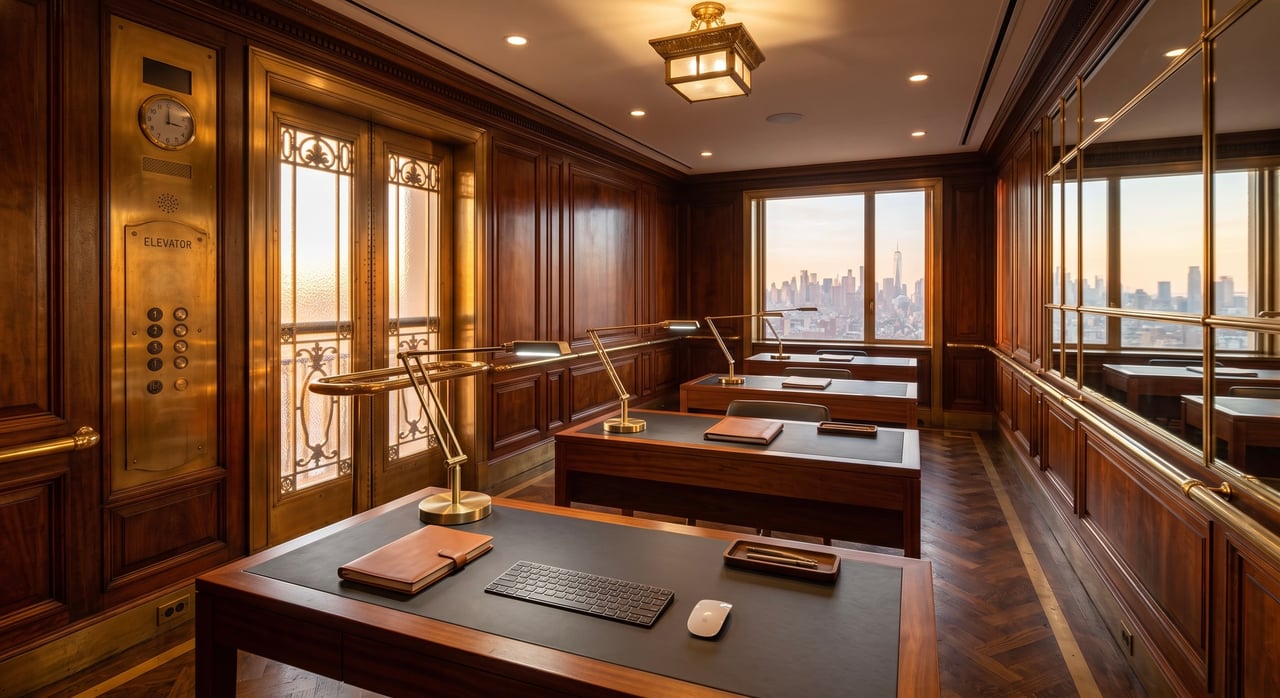
A growing number of Manhattan residential buildings have responded to the shift toward remote work by incorporating dedicated co-working spaces, business lounges, conference rooms, and library areas into their amenity programming. These spaces serve remote workers in two distinct ways: as alternative work environments for days when the home office requires a change of setting, and as professional meeting spaces for occasions when hosting a client or colleague in a residential apartment is not appropriate.
For buyers who work primarily from home but occasionally need to host professional meetings or work in a different environment, a building with well-programmed co-working amenities provides a meaningful professional infrastructure that has no equivalent in a building without these spaces. The availability of a professional-grade conference room within the building eliminates the need to book external co-working spaces for periodic client meetings and provides a degree of professional flexibility that compounds in value over an extended period of residence.
Not all building co-working spaces are created equally. A business lounge with reliable fast internet, appropriate furniture for extended working, adequate lighting that does not create screen glare, and acoustic treatment that supports phone and video calls is a genuine professional amenity. A lounge with comfortable seating and a decorative design but poor acoustic performance and standard residential wireless internet is an aesthetic amenity that functions poorly as a work environment. Buyers should visit any building co-working space at working hours, test the internet connection, and assess the acoustic environment before treating it as a professional resource.
OUTDOOR SPACE AND THE MENTAL HEALTH DIMENSION OF REMOTE WORK
Remote workers who spend extended periods in their apartments without commuting, outdoor activity breaks, or the social interactions that office environments provide are at greater risk of the isolation and sedentary patterns that represent the primary wellness challenges of full-time remote work. Buildings and neighborhoods that support easy access to outdoor space, walking environments, and the incidental social interactions of urban life partially offset these challenges in ways that buyers who intend to work remotely should weigh as a genuine quality of life consideration.
Buildings with accessible outdoor amenities, including roof terraces, courtyard gardens, or immediate proximity to a park entrance, provide remote workers with the ease of access to outdoor space that encourages the regular breaks and movement that sustain productivity and wellbeing over extended work-from-home periods. The proximity of the building to Central Park, Riverside Park, the High Line, Hudson River Park, or any significant green space is a practical quality of life consideration for remote workers that is more important than it would be for buyers who spend the majority of their waking hours in an office environment.
Neighborhoods that combine residential building quality with walkable commercial streets, coffee shop density, and the texture of daily urban life provide remote workers with the environmental variety that sustains productive work over time. The isolation of working in a purely residential building in a neighborhood with limited street life and walkability is a factor that remote workers from outside New York City sometimes underestimate until they have experienced the difference between a Manhattan neighborhood that supports daily engagement with urban life and one that does not.
UNDERSTANDING THE PRACTICAL LIMITATIONS OF BUILDING INTERNET INFRASTRUCTURE
One of the most commonly overlooked practical considerations for remote workers evaluating Manhattan buildings is the difference between the internet service available at the building's address and the internet service deliverable to a specific unit within the building. Building-level fiber connections that terminate at a central equipment room and are distributed through the building's internal wiring may be constrained by the quality of the in-building distribution, particularly in older buildings where data wiring has not been upgraded since original construction.
Buyers whose professional work involves video conferencing, large file transfers, cloud-based collaboration tools, or any other internet-intensive activity should ask building management specifically about the internet infrastructure within the building, confirm which providers serve the building, and if possible speak with current residents about their actual internet performance rather than relying on the speeds advertised by providers at the building's address.
The Federal Communications Commission maintains a broadband availability map that shows which providers offer service at specific addresses, which can serve as a starting point for assessing internet options at any building under consideration. This information should be supplemented by direct confirmation with providers about in-building wiring quality and installation options before a purchase decision is made.
NEIGHBORHOODS THAT SUPPORT REMOTE WORK LIFESTYLE
The neighborhood a remote worker chooses affects not only their daily commute, which may be minimal, but the rhythm and texture of their daily working life. Neighborhoods with a strong concentration of independent coffee shops and alternative work venues, access to parks for midday breaks, proximity to fitness options for the midday workout that replaces the commute, and enough commercial street life to support the errands and incidental social interactions that punctuate a productive remote work day are materially different environments for a remote worker than neighborhoods optimized primarily for residential quietness or transit access.
The West Village, Chelsea, and Flatiron area represent neighborhoods where the density of coffee shops, casual work venues, parks, and fitness options creates an environment that supports the remote worker's daily life particularly well. The Upper West Side offers similar advantages in the context of Central Park access and a dense commercial corridor on Broadway and Amsterdam Avenue that provides the daily environment variety remote workers benefit from.
Understanding how specific neighborhoods' daily rhythms align with the remote worker's lifestyle requirements is as important as evaluating building-level characteristics, and the current Manhattan real estate market trends in each submarket provide context for how these neighborhoods are currently attracting and serving the growing population of Manhattan remote workers.
For buyers who want to identify specific buildings that combine dedicated home office space, strong internet infrastructure, acoustic quality, and the neighborhood amenities that support productive remote work over the long term, the building-level and neighborhood-level knowledge available through Daniel Blatman's NYC real estate expertise provides the targeted guidance that makes this specific buyer profile's search more efficient than a general market search would be.