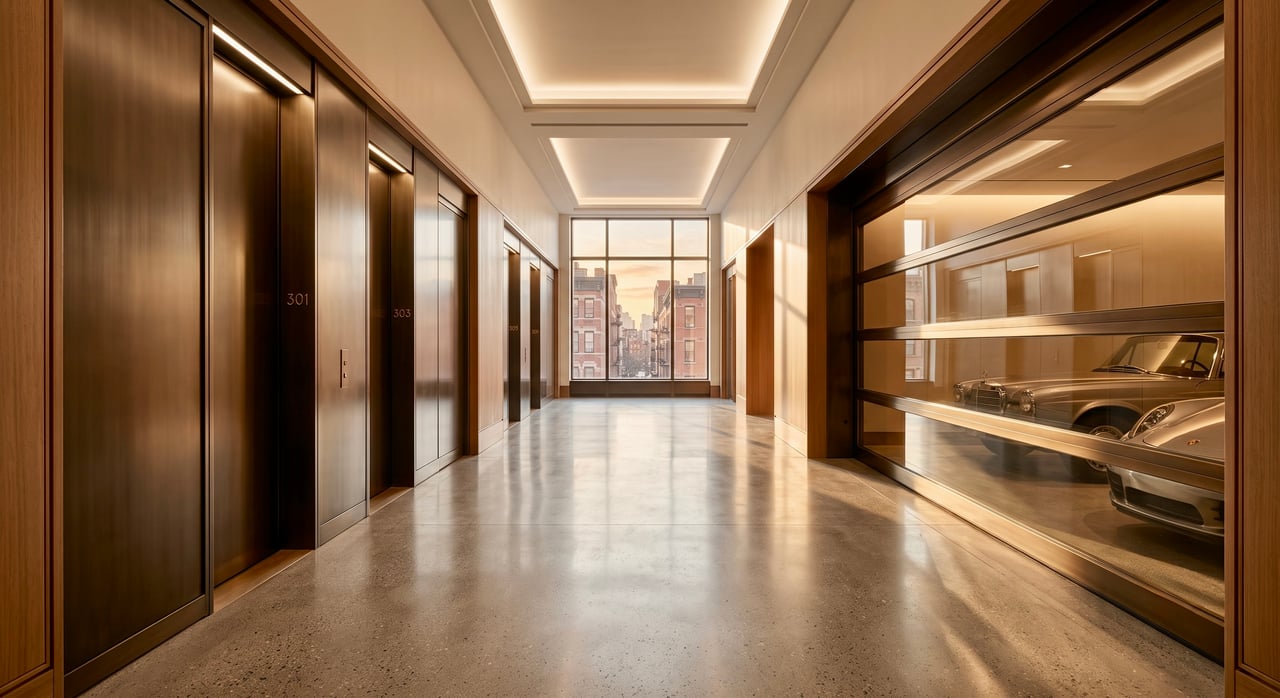
Best Manhattan Buildings with Private Storage and Parking: What Actually Conveys
Quick Answer: Do private storage and parking add real value in a Manhattan building? In most cases, yes, and both are genuinely scarce, but the premium depends almost entirely on whether the space is deeded to your unit or merely licensed to you by the building. Deeded space typically conveys with the apartment and carries transferable value, while a licensed or waitlisted space usually does not follow you or your buyer, which is the distinction that determines whether you are buying an asset or renting a convenience.
Deeded, Assigned, or Licensed?
This is the question that governs everything else, and listings rarely make the answer obvious. There are three arrangements, and they behave very differently at resale.
A deeded space is real property attached to your ownership. In a condominium it may be its own unit or a defined limited common element permanently allocated to your apartment, which means it conveys when you sell and typically carries its own share of common charges and, where separately assessed, its own property taxes. This is the version that holds value.
An assigned space is allocated to your unit by the board or managing agent under the building's rules. It usually comes with a monthly fee and can, in some buildings, be reassigned or reallocated over time. Its permanence depends on the governing documents, not on custom or on what the seller tells you.
A licensed or waitlisted space is the most common arrangement in older co-ops, where storage bins and garage spots are frequently distributed by seniority. A seller who has held a storage cage for fifteen years may have no ability to transfer it, and the buyer may join the bottom of a waitlist that moves slowly. This is the single most common misunderstanding in this category.
Because these distinctions live in the governing documents rather than the marketing, confirm the arrangement in the offering plan and its amendments, which sponsors file with the New York State Attorney General's real estate regulation division, and have your attorney confirm in the contract exactly what conveys.
Why Is Parking So Scarce in Manhattan?
The scarcity is structural rather than incidental, which is part of why the premium tends to hold. Under the zoning that governs off-street parking in the Manhattan Core, which the New York City Zoning Resolution sets out for the borough's central districts, no parking is required in new residential development, and accessory parking is capped, with additional capacity generally requiring a discretionary special permit from the City Planning Commission. In practice, that means the supply of resident parking in the densest parts of Manhattan is limited by design and expands slowly, so buildings that already have enclosed garages hold an advantage newer neighbors often cannot replicate.
That same framework contains a provision worth knowing. Where an accessory space in a building has been made available to the public, a resident of that building can generally request the space by written notice, with the space made available within thirty days. If a building tells you its garage is full, it is worth asking your attorney whether that provision applies before you assume the answer is permanent.
What Will It Cost to Own or Use?
Storage and parking carry costs that buyers routinely leave out of their monthly modeling. A deeded space typically carries its own common charges and may be separately assessed for property taxes, so it raises your carrying cost even though it adds no living space. Assigned and licensed spaces carry monthly fees that boards can and do raise, and garage operations are labor-intensive, which means those fees tend to rise with the building's broader cost base rather than staying flat.
There is also a tax detail specific to this borough that meaningfully changes the math for anyone renting rather than owning a space. As the NYC Department of Finance explains for the Manhattan Resident Parking Tax Exemption, the tax on rental parking spaces in Manhattan is 18.375%, and qualifying residents can reduce that by 8%, bringing it to 10.375% on a long-term space. Eligibility depends on the vehicle being individually owned, registered to the owner's primary Manhattan residence, parked for a month or more, and used personally rather than commercially. It is a straightforward filing that many new residents simply never make.
Due Diligence Before You Are in Contract
Ask your attorney to confirm four things in writing. First, whether the storage or parking space conveys, and under which document. Second, whether the building has a waitlist, how long it currently runs, and whether the board can reassign existing spaces. Third, whether the garage is operated by the building or leased to a third-party operator, since an operator agreement affects both pricing and availability to residents. Fourth, what the building's reserve position looks like, because enclosed garages and below-grade storage sit in the parts of a building most exposed to waterproofing, drainage, and mechanical work, and deferred maintenance there tends to surface as an assessment rather than a gradual increase.
It is also worth confirming how the building insures stored property, since most buildings disclaim liability for items in storage and expect residents to cover contents under their own policy.
Which Buildings Tend to Have It?
Two profiles account for most Manhattan inventory in this category. Newer full-service condominiums are the likeliest to offer deeded or clearly allocated storage and, where zoning permitted it, an enclosed garage, because the space was designed in from the start. Converted loft and warehouse buildings are the other strong source, since their floor plates and below-grade areas often accommodated storage that later conversions formalized. Tribeca is a useful area to study for that second profile, and our Tribeca lifestyle guide gives a sense of the building stock and pace before you start touring. Once you know which profile fits, pair that with real inventory by browsing active and coming-soon Manhattan listings, and see our guidance for Manhattan buyers for how to build these requirements into a search rather than treating them as a bonus you hope to find.
Common Missteps
Watch for paying a premium for a space that turns out to be licensed rather than deeded, accepting a seller's assurance that a storage bin transfers without confirming it in the documents, and underestimating how much a deeded space adds to the monthly. Each is easy to catch before contract and expensive to discover after.
Private storage and parking are among the more durable amenities in a Manhattan purchase, provided the space genuinely conveys and the building is funded to maintain it. If you are weighing your options, you can see how we approach buying a condo in Manhattan, follow Manhattan real estate market trends to understand where amenity premiums sit today, and learn more about Daniel Blatman's NYC real estate expertise and how it helps buyers evaluate exactly these trade-offs.