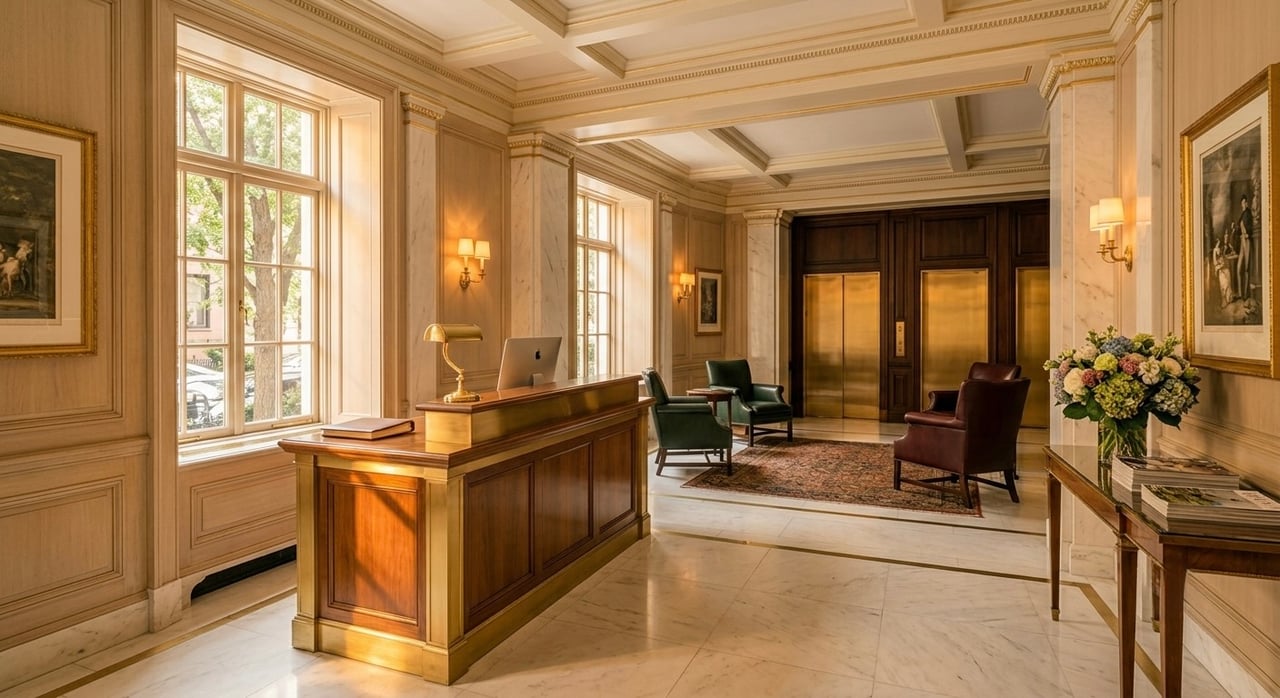
BEST DOORMAN BUILDINGS UNDER $2M
The assumption that full-service doorman buildings in Manhattan require a price point well above two million dollars is one of the most consistently mistaken beliefs buyers bring to the New York City market. The reality is that some of the most enduring value in Manhattan residential real estate exists precisely in the full-service buildings that the luxury market has overlooked, in the neighborhoods where the under-two-million price point delivers not a compromise but a genuinely well-operated building with professional management, round-the-clock service, and the structural characteristics that support long-term value retention.
WHY THE DOORMAN BUILDING MATTERS AT THIS PRICE POINT
A doorman is not merely a convenience. In the context of a Manhattan residential building, full-time doorman service represents a package of operational functions that affect daily quality of life in compounding ways. Package reception, visitor management, building access control, emergency response coordination, and the daily logistics of urban living all flow through the doorman infrastructure in ways that residents of non-doorman buildings manage entirely independently at personal cost in time and attention.
At the under-two-million price point, the choice between a doorman building and a non-doorman building is frequently not as expensive as buyers assume. The premium paid per square foot for doorman service in this tier is often more modest than in the luxury segment because the doorman buildings in this price range are typically older, larger buildings in established neighborhoods whose construction predates the escalating cost structures of contemporary development. These buildings offer full service at maintenance levels that reflect their age and scale rather than the amenity programming costs of new luxury development.
Buyers beginning their search in this tier through buying a condo in Manhattan who include doorman status as a primary search criterion alongside price will find that the Manhattan market at this level is more accommodating than buyers from other markets typically expect.
WHAT DOORMAN SERVICE ACTUALLY PROVIDES
Before evaluating specific buildings, buyers should understand precisely what doorman service means in a Manhattan residential building and how the quality of that service varies. Not all doorman buildings provide the same level of service, and the operational quality of the doorman team is as important as its mere presence.
Full-time doorman service means the lobby is staffed twenty-four hours a day, seven days a week. This is the standard that most full-service buildings in Manhattan maintain and the standard that buyers who value the full functionality of the amenity should require. Part-time doorman buildings, which are staffed only during daytime and evening hours, provide many but not all of the operational benefits of full-service buildings and typically command a lower price premium reflecting the reduced service level.
A concierge service, which some buildings provide in addition to or in place of a traditional doorman, focuses more on resident assistance, service coordination, and package management and less on building access control. The distinction matters in buildings where security is a primary concern, because a concierge-only building without a dedicated door attendant may have less consistent access control than a traditional doorman building.
The operational quality of the doorman team, their responsiveness, their familiarity with residents, and the consistency of their service standards, is shaped by building management and cannot be assessed from the listing description. Speaking with current residents during the buying process, visiting the building at different times of day, and observing how the doorman team actually operates are the most reliable ways to assess service quality before purchase.
NEIGHBORHOODS WHERE DOORMAN BUILDINGS UNDER $2M CONCENTRATE
Manhattan's under-two-million doorman building inventory concentrates in several neighborhoods where the combination of building scale, age, and neighborhood demand dynamics has preserved access to full-service living at this price tier.
Murray Hill and Kips Bay on the east side of Midtown represent the deepest inventory of doorman buildings under two million in Manhattan. These neighborhoods developed primarily in the mid-twentieth century with large-scale residential buildings, many of which are cooperatives with full doorman service, at price points that remain accessible compared to the neighborhoods immediately to their north and south. The neighborhoods' transit connectivity, proximity to Midtown employment, and established residential infrastructure create sustained buyer demand that has supported consistent pricing without the dramatic appreciation that has pushed comparable buildings in adjacent neighborhoods above this threshold.
The Upper East Side above Eightieth Street and extending toward Yorkville and Carnegie Hill offers doorman building inventory at the under-two-million price point with proximity to Central Park, strong school zone positioning in certain blocks, and a residential character that has attracted long-term family residents. This segment of the Upper East Side is consistently among the most interesting value propositions in the Manhattan market for buyers who prioritize service building quality within a defined budget.
Washington Heights and Inwood on the northern tip of Manhattan represent emerging segments of the doorman building market where the under-two-million price point accesses buildings with significant architectural quality, some with Manhattan's iconic prewar construction character, at prices that would be categorically impossible in the same building type further south. These neighborhoods are undergoing meaningful investment in retail, restaurant, and community infrastructure that is gradually compressing the pricing gap with more established neighborhoods.
EVALUATING DOORMAN BUILDING QUALITY BEYOND THE LOBBY
The presence of a doorman is the visible surface of a building's service character. The building's financial health, management quality, and physical condition are the underlying factors that determine whether the doorman building delivers on its value proposition over the long term.
A doorman building with a poorly funded reserve, chronic maintenance deficits, and inadequate management is a doorman building in name only. The doorman service will be present, but the building will impose costs through special assessments and deteriorating physical conditions that erode the value of the service amenity. The evaluation framework that applies to all Manhattan buildings, reserve fund adequacy, operating budget health, board governance quality, and physical condition of common areas and mechanical systems, applies equally to doorman buildings and should be applied specifically.
A common question is whether the presence of a doorman is worth a higher maintenance charge. In most cases, yes, when the overall building quality justifies the carrying cost. A doorman building with strong financials, a well-funded reserve, and competent management is a building where the carrying cost reflects genuine value delivery. A doorman building where the service infrastructure is supported by chronic maintenance deferrals and underfunded reserves is one where the apparent value premium is subsidized by risks that will eventually materialize as costs.
Building financial health standards are assessed against benchmarks maintained by organizations including the Community Associations Institute, and buyers should review the specific building's reserve fund balance, operating budget, and recent capital expenditure record during the attorney review period before committing.
CO-OP VERSUS CONDO DOORMAN BUILDINGS AT THIS PRICE TIER
At the under-two-million price point in Manhattan, the majority of doorman building inventory is co-operative rather than condominium. This is a significant structural consideration for buyers at this price tier that shapes not only the purchasing process but the flexibility of ownership going forward.
Co-op buildings at this price range offer the most accessible entry point to full-service Manhattan living, but they impose the board approval process, the financial disclosure requirements, and the subletting restrictions discussed elsewhere in this series. For buyers who intend to occupy the unit as a primary residence indefinitely, these restrictions are manageable and the co-op structure at this price tier often delivers significantly more building quality per dollar than condominium alternatives.
For buyers who intend to rent the unit at some point or who are purchasing as an investment, the co-op restrictions make this inventory largely unavailable as an investment vehicle, as discussed in the investor-oriented segment of this series. Condominium doorman buildings under two million exist in Manhattan but are less common, particularly in the neighborhoods where this price tier is most prevalent, and represent a smaller fraction of available inventory.
The purchasing process for co-op buildings, including the financial package preparation and board interview, is governed by each building's specific requirements and the cooperative corporation's approval standards. Buyers navigating this process for the first time benefit from working with a broker who has experience managing co-op board packages and can guide the preparation to meet the specific standards of the building in question.
WHAT THE CARRYING COSTS LOOK LIKE
Doorman buildings at the under-two-million price point carry maintenance and common charges that reflect the cost of staffing the building's service infrastructure. For co-op buildings in this tier, monthly maintenance typically ranges from one thousand to two thousand five hundred dollars for a one-bedroom or two-bedroom unit, with the specific level reflecting the building's size, the staffing model, and the inclusion or exclusion of utilities in the maintenance calculation.
A common question is whether high maintenance makes a lower-priced doorman building more expensive on a monthly basis than a higher-priced non-doorman building with lower carrying costs. In some cases, yes. Buyers at this price point should model the total monthly cost of ownership, including mortgage, maintenance, and any applicable tax obligations, for both doorman and non-doorman alternatives before concluding that the doorman building represents a better value in total cost of ownership terms.
Tax deductibility of the co-op maintenance component is relevant for buyers who itemize deductions. Co-op shareholders may deduct their proportionate share of the building's real estate tax and mortgage interest payments from their personal federal income tax return, subject to applicable limits. Current guidance on these deductions is available from the Internal Revenue Service, and buyers should model their specific deductibility with a tax advisor before finalizing the carrying cost comparison.
HOW TO IDENTIFY THE BEST VALUE IN THIS SEGMENT
The strongest doorman buildings under two million in Manhattan share characteristics that buyers can screen for before investing significant time in the due diligence process. Buildings with stable maintenance histories, adequate reserves, long-term resident ownership profiles, competent management, and physical common areas that reflect consistent investment over years represent the best value propositions in this segment.
Buildings where the maintenance has increased significantly faster than inflation in recent years, where the reserve fund is thin relative to the building's capital needs, or where turnover among residents is high relative to comparable buildings warrant more careful scrutiny before commitment. These signals do not necessarily indicate a failing building, but they indicate a building where the buyer's due diligence should be more comprehensive rather than less.
Understanding where the current Manhattan real estate market trends are creating the strongest value opportunities in the doorman building segment, which neighborhoods are offering the best building quality per dollar at this price tier, and how specific buildings have been valued historically relative to their peers provides the market intelligence that turns a general search in this segment into a targeted identification of the genuinely best available opportunities.
For buyers ready to begin identifying specific doorman buildings that meet this standard, the building-level knowledge available through Daniel Blatman's NYC real estate expertise provides the perspective that distinguishes buildings worth pursuing from those where the service promise exceeds the building quality that supports it. The best doorman buildings under two million in Manhattan are not hard to find. They require knowing what to look for once you are looking in the right places.