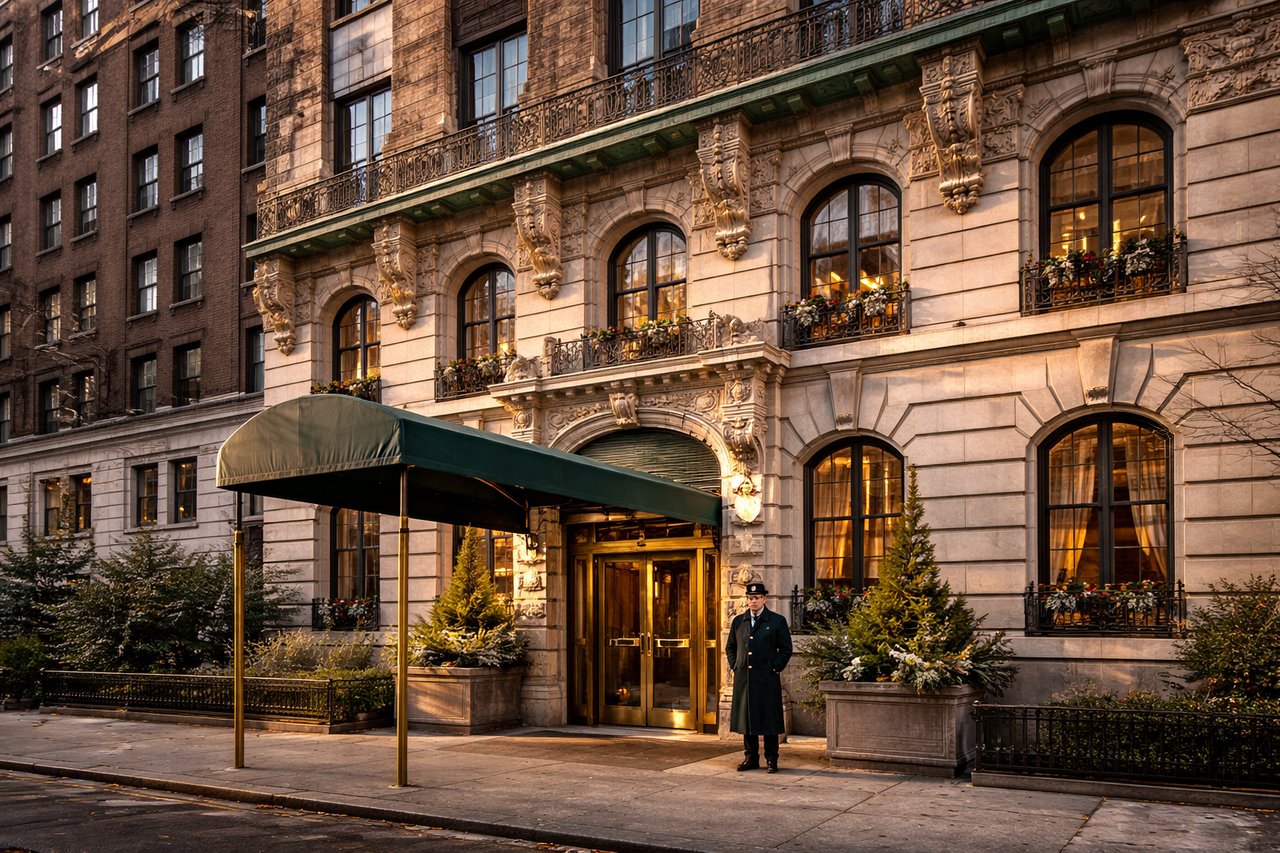
CARNEGIE HILL: THE MOST UNDERRATED LUXURY MARKET
Carnegie Hill occupies the stretch of the Upper East Side between 86th and 96th Streets, from Fifth Avenue to Lexington Avenue — a compact residential enclave that combines some of Manhattan's finest prewar architecture, proximity to Central Park and Museum Mile, top-tier public and private schools, and price points that remain meaningfully below the Gold Coast blocks to the south. For buyers who understand what they are looking at, Carnegie Hill represents one of the most compelling value propositions in Manhattan luxury real estate.
The neighborhood is named for Andrew Carnegie, whose 64-room mansion at Fifth Avenue and 91st Street — now the Cooper Hewitt Smithsonian Design Museum — catalyzed the area's transformation from a modest residential district into one of the city's most prestigious addresses at the turn of the twentieth century. That architectural heritage endures, protected by the Carnegie Hill Historic District, designated by the NYC Landmarks Preservation Commission in 1974 and expanded in 1993 to encompass approximately 400 buildings across the neighborhood.
THE ARCHITECTURE: MANHATTAN'S BEST-PRESERVED RESIDENTIAL STREETSCAPE
Carnegie Hill's building stock is exceptional in both quality and preservation. The side streets between Fifth and Madison Avenues contain intact rows of neo-Federal and Georgian Revival townhouses from the early twentieth century — many designed by distinguished firms like Delano & Aldrich, Mott Schmidt, and Cross & Cross — that create a streetscape of remarkable coherence and refinement. The avenues are lined with prewar luxury apartment buildings, including some of the finest co-ops on the Upper East Side.
The historic district protections ensure that this character endures. Any exterior alteration requires approval from the Landmarks Preservation Commission, a constraint that also functions as a permanent guarantee of neighborhood integrity. For luxury buyers accustomed to evaluating the long-term stability of their investment environment, this regulatory framework is an asset.
WHY CARNEGIE HILL IS UNDERVALUED
Carnegie Hill's value proposition becomes clear in comparison to the blocks immediately south. Between 60th and 86th Streets on the Upper East Side's Fifth and Park Avenue corridors, prewar co-ops routinely trade at $2,500 to $4,000 per square foot. In Carnegie Hill, architecturally comparable apartments in buildings of similar quality trade at $1,500 to $2,500 per square foot — a discount of 30 to 40 percent that reflects the market's perception of a neighborhood boundary rather than any fundamental difference in building quality, lifestyle amenity, or long-term value.
Buyers frequently ask: Why is Carnegie Hill priced below the lower Upper East Side? The answer is largely psychological. The 86th Street boundary serves as a market dividing line, assigning premium status to addresses south of it and moderate status to those north of it. But the buildings, the streetscape, the park access, and the school quality in Carnegie Hill are equal to — and in some respects superior to — what the lower Upper East Side offers. For buyers willing to look past the arbitrary boundary, the discount represents genuine opportunity.
Transaction history is publicly searchable through the NYC Department of Finance's ACRIS system, which allows buyers to verify pricing trends and identify properties trading below their fundamental value.
SCHOOLS AND FAMILIES
Carnegie Hill is one of Manhattan's strongest family neighborhoods, with access to both exceptional public schools within NYC DOE District 2 and some of the city's most prestigious private institutions. The Dalton School, Brearley, Nightingale-Bamford, and the Brick Church School all operate within or adjacent to Carnegie Hill, and the Chapin School, Spence, and Lycée Français are a short walk south.
For families evaluating the co-op market, Carnegie Hill's prewar buildings offer the room proportions, service entrances, and storage that growing households need — often at prices that make three- and four-bedroom apartments accessible to buyers who would be priced out of comparable space south of 86th Street.
THE CO-OP MARKET
Carnegie Hill's inventory is overwhelmingly cooperative, with prewar buildings ranging from intimate six-story walk-ups to grand full-service towers on Fifth and Park Avenues. Board requirements are typical of the Upper East Side — down payments of 25 to 50 percent, strong post-closing liquidity, and conservative debt-to-income ratios.
Buyers should verify the Cooperative and Condominium Property Tax Abatement status for each building and review the NYC Department of Finance's Property Tax Benefits page for additional exemptions. Co-op buyers benefit from avoiding the NYC Mortgage Recording Tax, a saving that adds meaningful value at Carnegie Hill price points.
The neighborhood profiles at danielblatman.com provide current Carnegie Hill pricing data and market context.
THE BOTTOM LINE
Carnegie Hill is a neighborhood that rewards buyers who can see past market convention to fundamental value. Its architecture is among the finest in Manhattan. Its landmark protections are comprehensive. Its school access is exceptional. And its pricing reflects a perception gap rather than a quality gap — one that informed buyers can exploit to acquire luxury-quality residential space at a meaningful discount to comparable addresses south of 86th Street.
For buyers ready to act on that opportunity, Daniel Blatman provides the market intelligence, building-level analysis, and negotiation discipline that Carnegie Hill purchases reward.