CARNEGIE PARK VS. PARK AVENUE: A PRICING STUDY
Carnegie Hill is one of Manhattan's most established luxury markets — a residential enclave between roughly 86th and 96th Streets on the Upper East Side where prewar Park Avenue co-ops have defined prestige for generations. But within this submarket, a fundamentally different product type has emerged: Carnegie Park, the 325-unit condominium at 200 East 94th Street, originally completed in 1986 and converted to condominiums in 2014 by Related Companies with amenity spaces redesigned by Robert A.M. Stern Architects.
For buyers evaluating the Carnegie Hill market, the comparison between Carnegie Park and the Park Avenue co-ops that surround it is not merely academic. It is a pricing study that reveals how ownership structure, building age, amenity packages, and buyer flexibility create materially different value propositions within the same six-block radius. Understanding the gap — and what drives it — is essential for any buyer making a decision in this part of the Upper East Side.
THE BUILDINGS: WHAT YOU ARE COMPARING
Park Avenue between 86th and 96th Streets is lined with prewar co-ops built primarily in the 1920s and 1930s — buildings designed by architects including Rosario Candela, Emery Roth, and Schwartz & Gross. These buildings offer the physical characteristics that define classic Upper East Side luxury: high ceilings, formal room sequences, herringbone floors, original plaster detailing, and the proportions of a residential era that valued grandeur over efficiency.
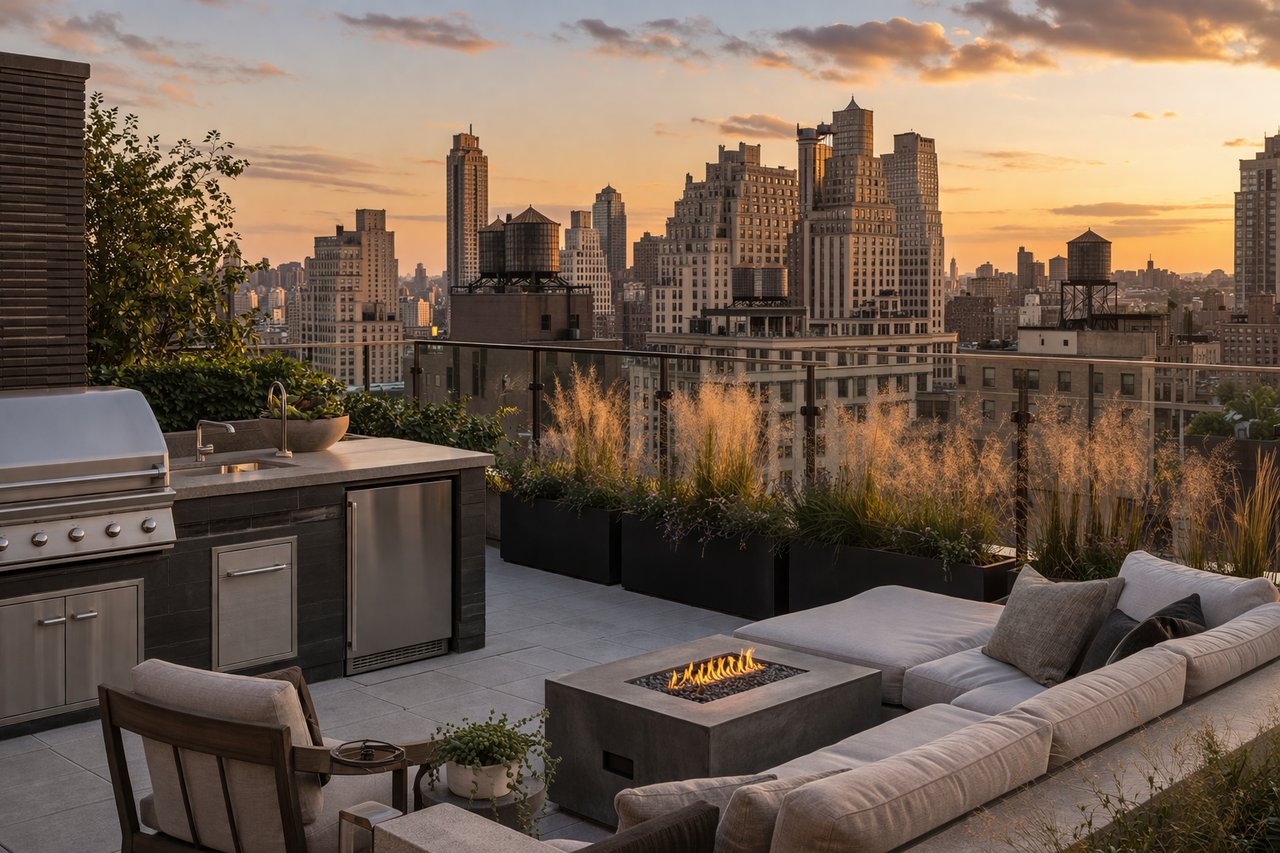
Carnegie Park occupies a different position. The 31-story red-brick tower at 200 East 94th Street was built as a rental in 1986, converted to condominiums nearly three decades later, and renovated to a contemporary luxury standard. Units feature five-inch wide-plank oak flooring, Viking and Sub-Zero appliances, marble bathrooms, and floor-to-ceiling windows — many of them the building's signature curved bay windows that deliver panoramic Upper East Side views. The amenity package includes a three-lane swimming pool with an outdoor sun deck, a half-acre private park and playground, a fitness center with yoga studio, a rooftop terrace with grills and entertainment lounge, a children's playroom, and 24-hour doorman and concierge service.
These are two fundamentally different residential products — one defined by architectural heritage and co-op governance, the other by modern amenities and condo flexibility — competing for the same buyer in the same neighborhood.
THE PRICING GAP: WHAT THE DATA SHOWS
Carnegie Park trades at an average of approximately $1,600 per square foot, based on recent closed sales searchable through the NYC Department of Finance's ACRIS system. A renovated two-bedroom at Carnegie Park typically closes between $1.4 million and $2.2 million. Three-bedrooms range from $2.2 million to $3.5 million.
Park Avenue co-ops in Carnegie Hill trade across a wider range, but prime prewar apartments in the best buildings command $1,800 to $2,800 per square foot — and significantly more for high-floor units with direct avenue exposure. A comparable three-bedroom Park Avenue co-op in a white-glove building may trade between $3 million and $6 million depending on floor, condition, and building prestige.
The gap is substantial: Carnegie Park delivers modern finishes, full amenities, and condo ownership flexibility at a 20 to 40 percent discount to comparable Park Avenue co-op pricing on a per-square-foot basis. The question every buyer must answer is whether the factors driving that gap align with their priorities — or whether they represent a value opportunity.
WHAT DRIVES THE DISCOUNT
The pricing differential is not random. It reflects specific, identifiable structural differences between the two product types.
Buyers often ask: Why is Carnegie Park cheaper than Park Avenue? The answer involves several converging factors. First, address prestige: Park Avenue carries a brand premium that no cross street or secondary avenue address can replicate, regardless of building quality. Second, architectural character: the physical presence of a 1920s Candela building — the lobby, the proportions, the materials — commands a premium that modern construction does not. Third, co-op governance: ironically, the very restrictions that make co-ops harder to buy into — board approval, down payment requirements, subletting limitations — function as a price support by constraining supply and ensuring a financially stable owner base.
Carnegie Park's discount reflects its position as a newer, amenity-rich building on a secondary block rather than the avenue itself. It also reflects the condo ownership structure, which allows greater buyer diversity — including investors, pied-à-terre purchasers, and international buyers — but creates a more liquid and therefore more price-competitive market.
THE CONDO ADVANTAGE: WHAT CARNEGIE PARK OFFERS THAT PARK AVENUE DOES NOT
For buyers who value ownership flexibility, Carnegie Park provides structural advantages that no Park Avenue co-op can match.
There is no board approval requirement. Purchases can be made through LLCs or trusts. Subletting is permitted without board restriction. International buyers can purchase without the visa or residency documentation that many co-op boards require. And the building's amenity suite — designed to a standard that most prewar buildings simply cannot accommodate within their physical infrastructure — delivers a daily lifestyle that the Park Avenue co-ops, for all their architectural magnificence, do not provide.
The New York State Attorney General's guidance on co-op and condo purchases outlines the disclosure and legal differences between the two structures. For buyers whose financial or personal circumstances make co-op board approval uncertain — or whose investment strategy requires rental income or resale flexibility — Carnegie Park offers a path into Carnegie Hill that the avenue co-ops foreclose.
THE CO-OP CASE: WHAT PARK AVENUE DELIVERS THAT CARNEGIE PARK CANNOT
The prewar Park Avenue co-ops offer something that no amount of modern renovation can replicate: the physical and social architecture of a residential tradition that has defined Upper East Side prestige for a century.
Room proportions in a Candela building are not merely larger than contemporary equivalents. They are differently conceived — designed for formal entertaining, for the passage of natural light through sequences of rooms, for a quality of domestic life that contemporary floor plans do not attempt. The lobbies, the elevator cabs, the service infrastructure of a white-glove prewar building create a residential experience that is irreducible to a feature list.
Co-op governance, while restrictive, also provides benefits. Financial requirements ensure that every owner in the building meets a high standard of liquidity and creditworthiness. Subletting restrictions maintain a community of resident owners. Board oversight provides a layer of quality control over building operations and capital planning that condo associations, governed by different legal structures, do not always replicate.
FINANCIAL CONSIDERATIONS
Co-op buyers avoid the NYC Mortgage Recording Tax entirely — a saving of 1.8 to 1.925 percent of the loan amount. For a buyer financing $2 million, this represents approximately $38,500 at closing. Condo buyers at Carnegie Park pay this tax in full.
Both co-op and condo owners should confirm whether their building has filed for the Cooperative and Condominium Property Tax Abatement, which reduces annual property taxes by up to 28 percent for eligible primary-residence owners. The NYC Department of Finance's Property Tax Benefits page details all available programs.
Building compliance is verifiable through the NYC Department of Buildings. Buyers should review open violations and recent permit activity for both Carnegie Park and any Park Avenue co-op under consideration.
WHO SHOULD BUY WHERE
The choice between Carnegie Park and a Park Avenue co-op is not a question of which is better. It is a question of which is better for the specific buyer.
Carnegie Park is the right choice for buyers who prioritize modern amenities, condo flexibility, and value pricing within Carnegie Hill — particularly international buyers, investors, families who want a pool and playground, and purchasers who need the ability to sublet or hold through an LLC.
A Park Avenue co-op is the right choice for buyers who prioritize architectural character, residential prestige, the social culture of a traditional co-op, and the long-term value stability that co-op governance provides — particularly buyers who intend to make Carnegie Hill their permanent home and who meet the financial thresholds that the strongest buildings require.
The buyer's guide at danielblatman.com provides the building-level data and financial modeling that this comparison demands.
THE BOTTOM LINE
Carnegie Park and Park Avenue occupy the same neighborhood but serve different markets. The pricing gap between them is real, measurable, and driven by specific structural factors that an informed buyer can evaluate. For some buyers, Carnegie Park's combination of modern luxury, full amenities, and condo flexibility represents the best value proposition in Carnegie Hill. For others, the prewar co-ops along Park Avenue remain irreplaceable — and worth every dollar of the premium they command.
For buyers navigating this comparison, Daniel Blatman provides the market intelligence, building-level expertise, and negotiation discipline that Carnegie Hill's competitive market demands. The neighborhood profiles at danielblatman.com offer current pricing data and strategic context across the Upper East Side.