CENTRAL PARK SOUTH: TROPHY APARTMENTS EXPLAINED
Central Park South is not a neighborhood in the conventional sense. It is a corridor — a single stretch of street running from Columbus Circle at Eighth Avenue to Grand Army Plaza at Fifth Avenue — that has functioned for more than a century as one of the most valuable residential addresses in the world. What makes it singular is not merely the location, though the location is extraordinary. It is the concentration of residential product types that exist here, side by side, spanning the full arc of Manhattan's luxury market: the prewar hotel-residences and white-glove co-ops that defined twentieth-century prestige, and the supertall condominium towers of Billionaires' Row that have redefined it for the twenty-first.
For buyers considering Central Park South, the essential question is not whether this is a desirable address — that has been settled for generations. The question is which version of Central Park South luxury aligns with your priorities, your financial structure, and your view of what a trophy apartment actually means.
THE ADDRESS: WHY CENTRAL PARK SOUTH COMMANDS WHAT IT DOES
The economics of Central Park South pricing reduce to a single, immovable fact: every apartment on the south side of the street faces Central Park. This is not a partial view, not a glimpse between buildings, not a marketing approximation. It is 843 acres of protected green space directly across the street, extending north for 51 blocks, visible from every south-facing window on every floor. No building will ever be constructed between these apartments and the park. The view is permanent.
In a city where light, air, and green space are the scarcest commodities in residential real estate, this permanence is the foundation of everything that follows — the pricing, the buyer profile, the resale trajectory, and the building cultures that have developed along this corridor over more than a hundred years.
The broader Central Park South market also benefits from its position at the seam between Midtown and the Upper West and Upper East Sides, with Columbus Circle to the west, the Plaza and Fifth Avenue shopping corridor to the east, and the cultural institutions of Lincoln Center and Museum Mile within reach in either direction. Transit access is exceptional: the A, B, C, D, 1, N, Q, R, and W trains all serve stations within a few blocks.
THE PREWAR CO-OPS: TWENTIETH-CENTURY PRESTIGE
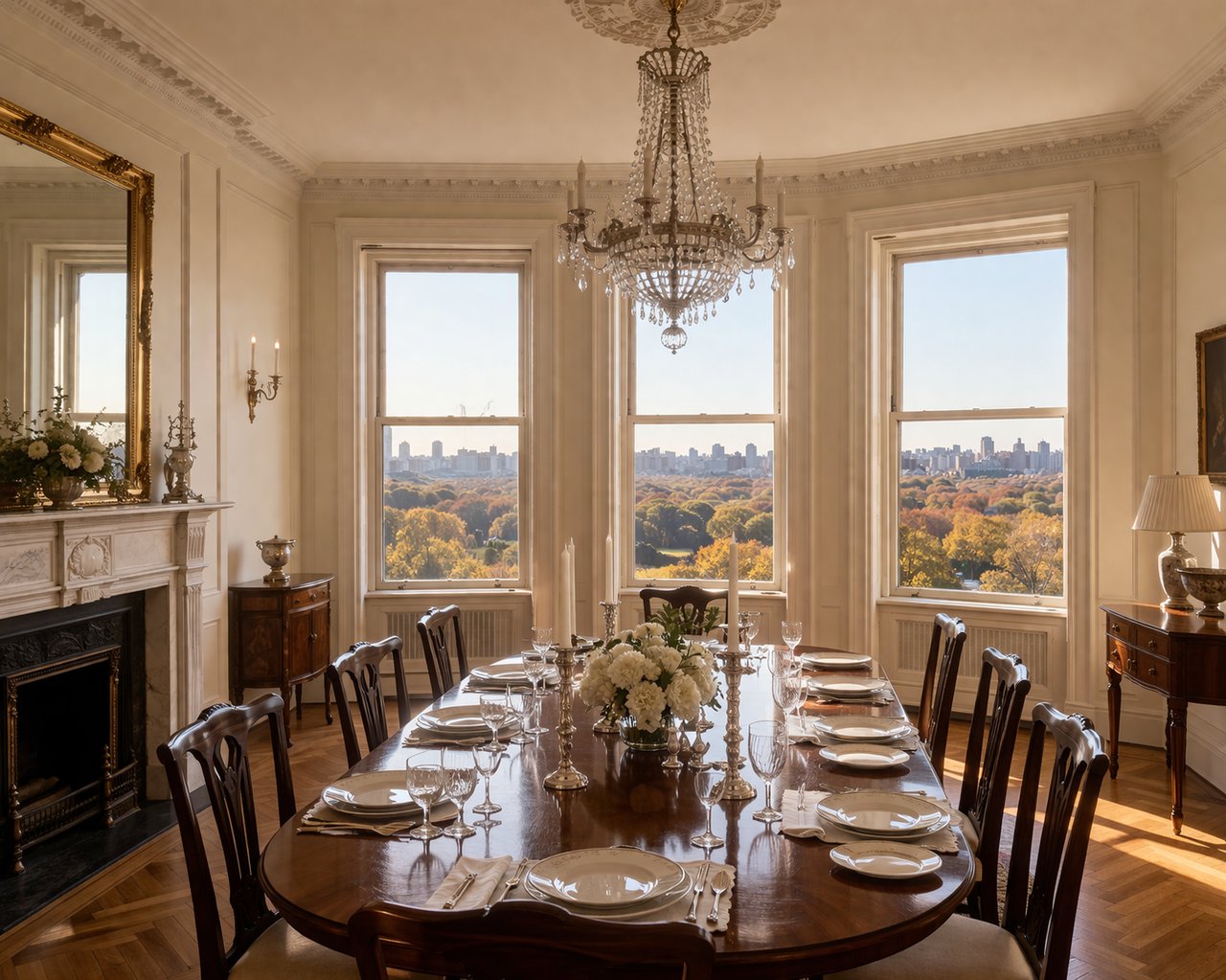
The original trophy apartments on Central Park South are the prewar co-ops and hotel-residences that line the street — buildings designed in the 1920s through 1940s by architects who understood that a park-facing apartment should be proportioned for grandeur, not efficiency. These buildings offer the physical characteristics that define classic Manhattan luxury: high ceilings, formal room sequences, windowed kitchens, service entrances, and the kind of plasterwork, millwork, and floor detailing that contemporary construction does not attempt.
The co-op ownership structure imposes the requirements that have historically filtered the buyer pool: board approval, substantial down payments typically ranging from 30 to 50 percent, post-closing liquidity requirements, and restrictions on subletting and pied-à-terre use that vary by building. The New York State Attorney General's guidance on co-op and condo purchases outlines the legal framework governing these transactions.
Co-op buyers benefit financially from avoiding the NYC Mortgage Recording Tax — a saving of 1.8 to 1.925 percent of the loan amount — and from typically lower monthly carrying costs compared to the newer condo towers. Buyers should confirm whether each building has filed for the Cooperative and Condominium Property Tax Abatement, which can reduce annual property taxes by up to 28 percent for eligible primary-residence owners.
Buyers frequently ask: Are the prewar co-ops on Central Park South still competitive with the new towers? For buyers who value architectural character, room proportions, and the social culture of a traditional co-op, these buildings remain the definitive Central Park South product. The physical quality of a Rosario Candela or Emery Roth apartment — the weight of the doors, the depth of the closets, the way light moves through rooms designed for it — is not available in any new building at any price.
BILLIONAIRES' ROW: THE TWENTY-FIRST-CENTURY REDEFINITION
Beginning with One57's completion in 2014, a sequence of supertall condominium towers rose along West 57th Street and the adjacent blocks, creating the corridor now known as Billionaires' Row. These buildings — including 432 Park Avenue, 111 West 57th Street, 220 Central Park South, and Central Park Tower — have produced the most expensive residential transactions in American history and fundamentally expanded the definition of what a Manhattan trophy apartment can be.
The product is engineered for a specific buyer: ultra-high-net-worth individuals, frequently international, who view Manhattan real estate as both a lifestyle asset and a store of value. The apartments are delivered with the highest-specification finishes, floor-to-ceiling glass or limestone-clad facades, central climate systems, and amenity suites that include private restaurants, saltwater pools, ballrooms, and dedicated concierge operations. Views extend in every direction — not just over Central Park but across the full Manhattan skyline and, from the highest floors, to the horizons of New Jersey, Brooklyn, and beyond.
Condo ownership provides structural advantages that co-ops do not: no board approval, no subletting restrictions, accommodation of LLC and trust ownership, and fee-simple title that simplifies financing and international transactions. The trade-off is cost. Price per square foot on Billionaires' Row ranges from approximately $4,000 to above $8,000 in the most exclusive buildings, with trophy penthouses trading at nine figures. Monthly carrying costs — common charges plus separately billed property taxes — are substantial, and buyers should model these carefully against the building's tax abatement status and expiration timeline.
Transaction history is searchable through the NYC Department of Finance's ACRIS system. The NYC Department of Finance's Property Tax Benefits page details all available programs, including abatements under the 421-a program that apply to several Billionaires' Row buildings and will expire on defined schedules.
220 CENTRAL PARK SOUTH: THE BUILDING THAT BRIDGED BOTH WORLDS
Among all the buildings in this corridor, 220 Central Park South occupies a singular position. Designed by Robert A.M. Stern Architects and completed in 2019, the 70-story tower was conceived as a deliberate synthesis of prewar architectural values and contemporary scale — a limestone-clad tower with classical proportions, herringbone oak floors, custom millwork, and warm material palettes that feel more like a prewar co-op than a glass supertall.
The building's sales record reflects this positioning. The $238 million penthouse sale to hedge fund manager Kenneth Griffin in 2019 remains the most expensive residential transaction in United States history. The building achieved over $1 billion in sales and has maintained the strongest resale performance of any Billionaires' Row address, with extremely limited inventory and consistent demand from a global buyer pool.
Buyers sometimes ask: Is 220 Central Park South the best building on the corridor? It is the building that most successfully reconciles the prewar sensibility with contemporary luxury — the one that buyers who value architectural warmth and material quality over glass-and-steel maximalism consistently prefer. Whether that makes it "best" depends entirely on the buyer's priorities.
WHAT MAKES AN APARTMENT A TROPHY
The term "trophy apartment" is used loosely in Manhattan real estate, but on Central Park South it has a specific meaning. A trophy apartment is one that cannot be replicated — because of its views, its proportions, its floor position, its building, or some combination of all four. It is an apartment that a knowledgeable buyer recognizes as irreplaceable, and that the market prices accordingly.
On Central Park South, the variables that elevate an apartment to trophy status include direct, unobstructed Central Park views from the primary living spaces; a floor position high enough to command a panoramic sightline rather than a close-range treetop perspective; room proportions that accommodate formal entertaining; a building with a track record of price appreciation and a culture of discretion; and a physical condition — whether original prewar or new-construction — that reflects the highest standard of its type.
Not every apartment on Central Park South is a trophy. Studios and junior one-bedrooms in the prewar buildings, while they carry the address, lack the scale and view characteristics that define the category. Buyers seeking a true trophy should work with a broker who understands the corridor at the building and unit level — who knows which lines face the park, which floors clear the tree canopy, and which buildings have the financial health and governance culture that support long-term value.
The buyer's guide at danielblatman.com provides the strategic framework for evaluating trophy-level purchases. Building compliance records are verifiable through the NYC Department of Buildings.
FINANCIAL CONSIDERATIONS AT THE HIGHEST LEVEL
Central Park South pricing places virtually every transaction in a territory where closing costs, tax planning, and ownership structuring require professional guidance.
Purchases above $1 million — which includes every Central Park South transaction — are subject to the New York State mansion tax, beginning at 1 percent and scaling to 3.9 percent for purchases of $25 million or more. For a $20 million purchase, the mansion tax alone exceeds $550,000. Financed condo buyers must also budget for the NYC Mortgage Recording Tax, though many Billionaires' Row transactions are all-cash.
Buyers using LLCs or trusts should understand that ownership structure affects tax treatment, estate planning, and the building's governance rules. An experienced attorney and tax advisor are essential — not optional — at these price points.
THE BOTTOM LINE
Central Park South is where Manhattan's residential market reaches its apex — in price, in permanence, and in the concentration of irreplaceable apartments that define what trophy ownership means in this city. The corridor offers two distinct but equally compelling paths: the prewar co-ops that embody a century of Manhattan prestige, and the supertall condos that have redefined luxury for a global buyer class. Between them, 220 Central Park South bridges both traditions with a building that may be the most architecturally accomplished residential tower built in New York in the past fifty years.
For buyers prepared to operate at this level, Daniel Blatman provides the market intelligence, building-level expertise, and negotiation discipline that Central Park South demands. The neighborhood profiles at danielblatman.com provide current context across Manhattan's luxury market.