How to Choose a Building for Long-Term Appreciation
WHY BUILDING SELECTION DETERMINES APPRECIATION MORE THAN TIMING DOES
The most common question buyers ask about Manhattan real estate is whether now is the right time to buy. It is a reasonable question, but it is ultimately the wrong one. Research consistently shows that in real estate, what you buy and where you buy it accounts for far more of long-term investment performance than when the purchase occurs. Buyers who focus on building selection with the same discipline they apply to market timing routinely outperform those who optimize for entry point while treating building quality as a secondary consideration.
Long-term appreciation in Manhattan is not evenly distributed. It concentrates in specific buildings, in specific neighborhoods, in specific construction typologies. The factors that drive that concentration are not mysterious. They are identifiable in advance and should be evaluated systematically before any acquisition decision is made.
Buyers who approach this process through Daniel Blatman's Manhattan property search with a long-term appreciation framework in mind are asking fundamentally better questions from the beginning of their search. Rather than asking which unit is nicest, they ask which building is most likely to produce compounding value over a five, ten, or twenty-year horizon. Those are different questions and they produce different answers.
THE PRIMACY OF LOCATION WITHIN THE BUILDING'S CONTEXT
Location is the most durable driver of long-term real estate appreciation. In Manhattan, location operates at multiple levels simultaneously: borough, neighborhood, block, and building position within the block. Each level of granularity introduces additional variables that affect value trajectory over time.
At the neighborhood level, buildings located in areas with structural demand advantages, including strong transit connectivity, proximity to major employment centers, access to high-quality parks and public infrastructure, and a demonstrated history of sustained buyer interest, tend to appreciate more reliably and recover more quickly from market downturns than buildings in neighborhoods with weaker structural demand.
A common question is whether an emerging neighborhood offers better appreciation potential than an established one. In some cases, yes. Buildings purchased in neighborhoods before significant demand concentration occurs can capture the full arc of appreciation as the area matures. The risk is that the appreciation timeline is uncertain and the holding period required to realize it may be longer than anticipated. Established neighborhoods with persistent demand tend to appreciate more steadily and predictably, with less variance around the expected return.
Zoning context and development trajectory also matter. A building surrounded by low-rise residential development in a neighborhood where upzoning is unlikely offers stronger long-term view and character protection than one in an area where neighboring lots could support substantially taller construction. The NYC Department of City Planning maintains zoning maps and ongoing land use review records that allow buyers to assess what is currently permitted to be built on adjacent and nearby parcels.
CONSTRUCTION TYPE AND BUILDING TYPOLOGY
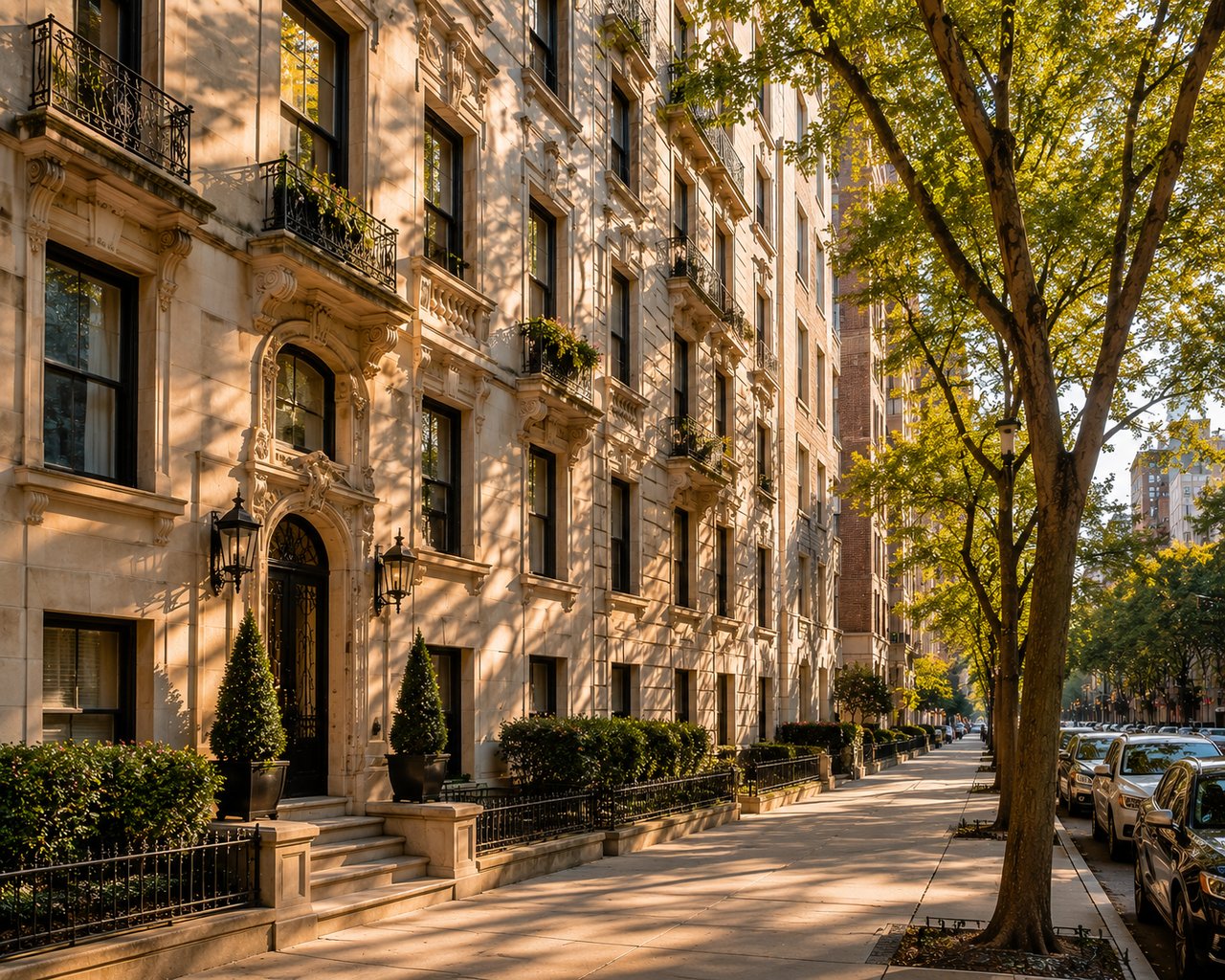
Not all Manhattan buildings appreciate equally, and construction type is one of the reasons why. Prewar buildings, particularly those constructed between 1910 and 1940 in established Manhattan neighborhoods, have demonstrated exceptional long-term appreciation characteristics. Their combination of architectural distinction, thick masonry construction, generous room proportions, high ceilings, and limited supply relative to demand creates a value premium that has proven highly durable across multiple market cycles.
Buyers often ask whether prewar buildings carry more maintenance risk than newer construction. They do require different maintenance, particularly around facade upkeep, plumbing infrastructure, and window replacement. However, a well-managed prewar building with an adequately funded reserve fund is not inherently more expensive to operate than postwar construction. The key variable is management quality and capital planning discipline, not the construction era itself.
Postwar buildings constructed in the 1950s and 1960s occupy a different position in the appreciation hierarchy. Many lack the architectural distinction of prewar construction and the amenity programming of contemporary development, which can limit their appreciation potential relative to both typologies. Contemporary new development, particularly well-located buildings with strong design credentials and high-quality amenity packages, has demonstrated strong appreciation in the near term, though the long-term track record relative to prewar construction is still being established in many submarkets.
BUILDING SIZE, DENSITY, AND UNIT MIX
Building size and unit mix affect long-term appreciation in ways that buyers do not always consider at the time of purchase. Boutique buildings with a small number of units tend to trade at premiums relative to large-scale residential towers, reflecting their relative scarcity, the greater privacy they offer, and the stronger sense of community that tends to develop in smaller buildings.
A frequent question is whether a large building with strong amenities is a better long-term hold than a smaller building with fewer shared facilities. The answer depends heavily on the specific buildings and their management quality, but as a general principle, the supply constraints around boutique residential product support appreciation more reliably than buildings where hundreds of comparable units compete for buyers in the same transaction window.
Unit mix within the building also matters. Buildings with a high concentration of studio and one-bedroom units tend to attract a transient buyer and tenant profile, which can contribute to higher turnover, less stable governance, and less consistent maintenance standards. Buildings with a mix of larger units, particularly two and three bedrooms, attract residents with longer-term horizons who tend to invest more in the building's community and physical condition.
BUILDING GOVERNANCE AND THE BOARD'S ROLE IN VALUE PROTECTION
In both co-ops and condominiums, the quality of building governance has a direct and lasting effect on long-term appreciation. A board that makes disciplined financial decisions, plans capital expenditures proactively, maintains building standards consistently, and enforces house rules fairly creates the conditions under which individual unit values grow. A board that defers maintenance, allows finances to deteriorate, or operates without a coherent capital plan systematically erodes the value of every unit in the building over time.
Buyers often ask how to evaluate governance quality before purchasing. The most direct evidence is in the building's financial statements, reserve fund balance, and board meeting minutes. Buildings where the minutes reflect substantive discussion of capital planning, financial oversight, and property management accountability are buildings where governance is being taken seriously. Buildings where the minutes are sparse, the financials show chronic deficits, or special assessments have been levied repeatedly are buildings where governance has been inadequate.
Financial compliance and operational standards for residential buildings in New York City are also shaped by obligations enforced by the New York City Department of Housing Preservation and Development, which administers housing quality standards and tenant protection programs that affect the operational environment for all residential buildings in the five boroughs.
AMENITY QUALITY AND ITS RELATIONSHIP TO BUYER DEMAND
Amenities contribute to long-term appreciation by expanding the buyer pool and supporting premium pricing at resale. In Manhattan, amenity programming has evolved considerably over the past two decades, and buyers at various price points now expect a baseline level of shared infrastructure that was not standard in older buildings.
A common question is which amenities most reliably support resale value. Doorman or concierge service is consistently cited as the single most valued amenity by Manhattan buyers, providing both practical convenience and a security component that many buyers treat as non-negotiable. Fitness facilities, rooftop or outdoor spaces, and package handling infrastructure have also become baseline expectations in competitive buildings.
The risk with amenity-heavy buildings is that they carry higher common charges to support their programming. Buyers considering buying a condo in Manhattan in a full-service building should evaluate whether the common charge level is sustainable relative to the income profile of the typical buyer in that price range, and whether the amenities being offered are ones that future buyers in that market will value or treat as a cost burden.
THE ROLE OF SCHOOL DISTRICT AND FAMILY DEMAND
In neighborhoods where family demand is a meaningful component of the buyer pool, proximity to well-regarded public schools is a persistent driver of long-term appreciation. Buildings located within the attendance zone of sought-after public elementary and middle schools command premiums that are supported by a structurally committed buyer segment, families who are specifically searching for that combination of location, property quality, and school access.
This premium tends to be more durable than premiums driven by trend or lifestyle positioning because the underlying demand driver is structural and persistent. Families with young children have a defined set of location requirements that does not change with market sentiment. Buildings that satisfy those requirements attract and retain buyers with long-term holding intentions, which contributes to ownership stability, governance quality, and consistent maintenance standards.
School zone boundaries and attendance eligibility are administered by the New York City Department of Education, which publishes zoning maps and enrollment information for all public schools in the five boroughs. Buyers purchasing in family-oriented neighborhoods should verify the specific school zone assignment for any building under consideration rather than relying on general neighborhood characterizations.
HISTORICAL TRANSACTION DATA AS AN APPRECIATION INDICATOR
One of the most practical tools available to buyers evaluating long-term appreciation potential is historical transaction data. Buildings with a consistent record of price appreciation across multiple sales cycles, with prices per square foot that have moved upward over time relative to comparable buildings in the same neighborhood, are demonstrating the structural characteristics that support continued appreciation.
Buyers often ask how to access this data for a specific building. Sales history is publicly recorded in New York City and is available through multiple channels. Rolling sales data published by the New York City Department of Finance documents transaction prices and dates for properties across all five boroughs, allowing buyers to track the appreciation trajectory of a specific building over time and compare it against broader neighborhood trends.
Buildings where historical appreciation has consistently exceeded the neighborhood average are typically those that combine the structural factors discussed in this analysis: favorable location, architectural distinction, strong governance, sound finances, and a buyer profile that skews toward long-term ownership.
BRINGING THE FRAMEWORK TOGETHER
Choosing a building for long-term appreciation is not a single decision. It is a framework applied across multiple evaluation dimensions simultaneously. Location and zoning context, construction type and architectural distinction, building size and unit mix, governance quality, amenity programming, school zone positioning, and historical transaction performance all contribute to a building's appreciation trajectory.
No single factor is determinative. A building that excels on every dimension but sits in a neighborhood with weakening demand will underperform a building with more modest characteristics in an area where demand is structurally strong. The goal is not to find a perfect building but to identify the combination of factors most likely to support sustained appreciation over the buyer's intended holding period.
Understanding where the broader Manhattan real estate market trends are pointing, which neighborhoods are attracting sustained demand, which building typologies are commanding consistent premiums, and which characteristics buyers are consistently willing to pay for at resale, is the market intelligence that turns a systematic framework into a grounded investment decision.
Through Daniel Blatman's NYC real estate expertise, buyers can apply this framework with the benefit of deep market knowledge and transaction experience across Manhattan's most established and emerging neighborhoods. Long-term appreciation in Manhattan is achievable. It begins with choosing the right building.