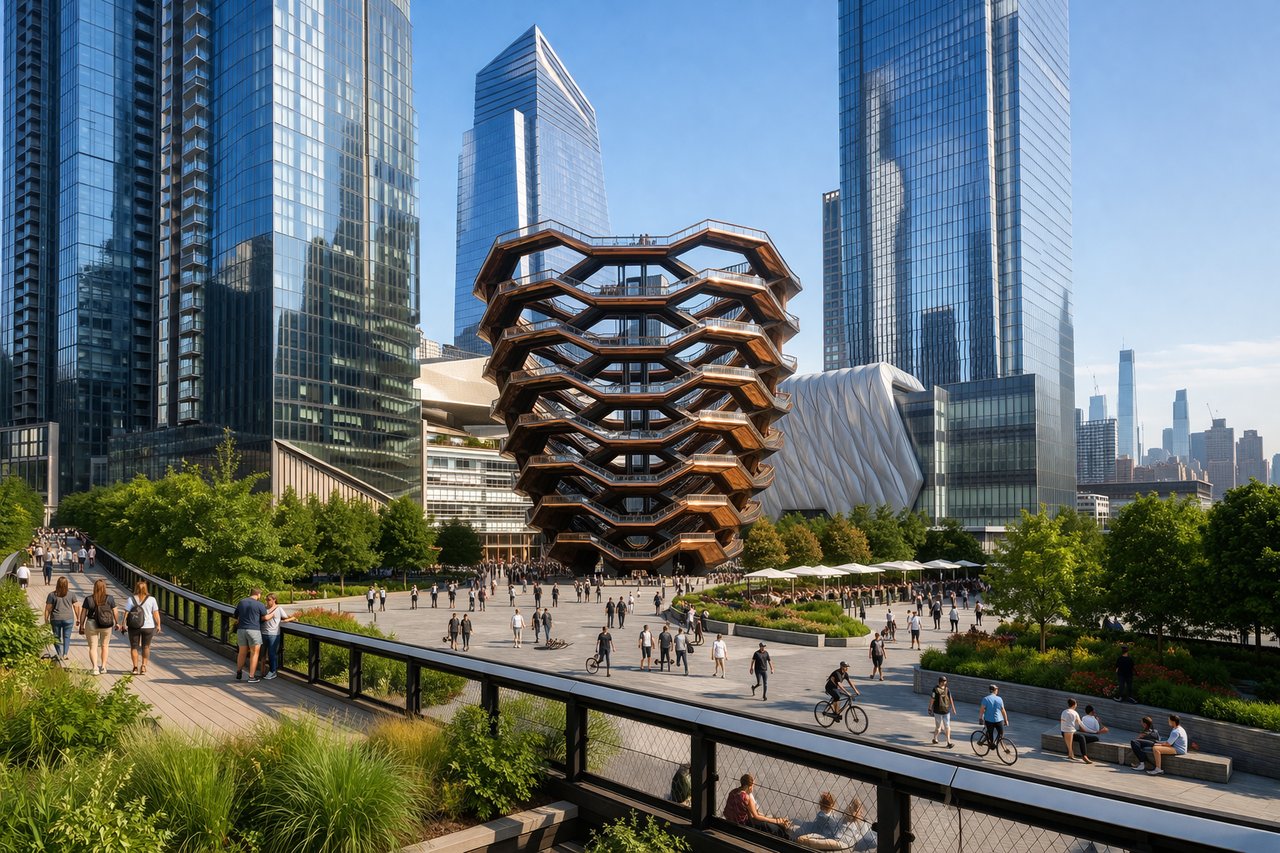
HUDSON YARDS: LIVING IN MANHATTAN'S NEWEST NEIGHBORHOOD
Hudson Yards is unlike any other residential neighborhood in Manhattan—because, in the traditional sense, it was not a neighborhood at all until recently. Built on a platform over the West Side rail yards, it is the largest private real estate development in United States history: a master-planned district of towers, plazas, cultural institutions, and retail that rose from raw infrastructure into one of the most discussed addresses in the city. For buyers evaluating where to live, the question is not whether Hudson Yards is impressive. It is whether the lifestyle it offers aligns with how you actually want to live.
That question deserves a precise answer, which is what this guide provides. Hudson Yards is not a neighborhood for every buyer. It is, however, an exceptional choice for a specific kind of buyer—and understanding who that is requires a clear-eyed look at the buildings, the pricing, the amenities, the transit access, and the long-term trajectory of a district still maturing.
THE ARCHITECTURE AND THE BUILDINGS
Hudson Yards is defined by its residential towers, all of which are new construction—primarily glass-and-steel high-rises developed by Related Companies and its partners. The residential addresses include 15 Hudson Yards, 35 Hudson Yards, and the broader collection of buildings that make up the eastern and western yards development phases. These are not prewar co-ops with patina and proportioned rooms. They are purpose-built luxury condominiums with contemporary floor plates, floor-to-ceiling windows, and amenity packages designed to compete with the finest full-service buildings in the city.
15 Hudson Yards, designed by Diller Scofidio + Renfro and Rockwell Group, is perhaps the most architecturally significant of the residential towers, rising 88 stories and offering buyers direct access to the Shed cultural center at its base. 35 Hudson Yards, designed by David Childs of SOM, positions itself as one of the city's premier luxury addresses, with Four Seasons Private Residences occupying the lower floors and condominiums above. Both buildings exemplify the design ambition and amenity depth that characterize Hudson Yards residential product. Buyers evaluating specific buildings can search current and recent transaction history through the NYC Department of Finance ACRIS system.
WHO BUYS IN HUDSON YARDS
The buyer profile at Hudson Yards is distinct from most Manhattan residential markets. The neighborhood attracts a high proportion of buyers who are purchasing as a pied-à-terre or secondary residence, executives and finance professionals drawn by proximity to Midtown offices, international buyers who value new construction and condo ownership structure, and empty-nesters downsizing from suburban houses who want full-service building life without the management burden of a co-op. Buyers frequently ask: Is Hudson Yards a good place for families? The neighborhood is still developing the residential infrastructure—schools, playgrounds, local services—that more established neighborhoods take for granted. Families with young children tend to find the Upper West Side, Tribeca, or Park Slope better suited to daily family rhythms, at least at this stage of Hudson Yards' maturation.
For buyers who prioritize building quality, panoramic views, modern layouts, and seamless access to transit and Midtown offices, Hudson Yards delivers at a level few other Manhattan neighborhoods can match. The lifestyle is urban and amenity-forward, with less emphasis on the block-by-block street life that defines older Manhattan neighborhoods.
PRICING AND THE CONDO STRUCTURE
Hudson Yards residential product is exclusively condominium, which means buyers receive fee-simple title, face no board approval process, and enjoy maximum flexibility on subletting and financing. For buyers comparing co-op and condo ownership structures, the NYC Department of Finance's guidance on property tax benefits provides detail on the Cooperative and Condominium Property Tax Abatement, which reduces annual property taxes by up to 28 percent for eligible primary-residence owners.
Pricing at Hudson Yards reflects both the newness of the product and the scale of amenities on offer. One-bedroom condominiums typically start above $1.5 million. Two-bedroom residences range from approximately $2.5 million to $5 million depending on floor height and view orientation. Full-floor and penthouse product has traded well above $10 million and, in the case of the most premium units at 35 Hudson Yards, far beyond that threshold. The NYC Mansion Tax applies to all residential purchases at or above $1 million and increases on a graduated scale above $2 million—a relevant consideration at Hudson Yards price points.
AMENITIES AND THE HUDSON YARDS DISTRICT
The amenity model at Hudson Yards operates at two levels. Within each residential building, amenities typically include attended lobbies, private fitness centers, resident lounges, children's play spaces, screening rooms, and outdoor terraces. 35 Hudson Yards residents have access to the Equinox hotel amenities in the same tower, including a pool and spa facility. 15 Hudson Yards residents have direct building access to the Shed, the climate-controlled arts venue that has hosted performances, exhibitions, and installations since its 2019 opening. The Shed's public programming calendar is a genuine neighborhood cultural asset that distinguishes this district from purely residential or commercial addresses.
At the neighborhood level, the Shops at Hudson Yards provide retail and restaurant access within the district. The High Line, the elevated linear park that connects Hudson Yards to the Meatpacking District and Chelsea, is immediately accessible from the development and provides one of the city's most distinctive public spaces for walking, cycling, and programming. The Hudson River Park waterfront is accessible within a short walk, offering a second major public green space. Buyers who want dense park access comparable to Central Park proximity should understand that Hudson Yards' public space model is different in character—more designed, more programmed, and less expansive—than the historic park neighborhoods.
TRANSIT AND CONNECTIVITY
Hudson Yards benefits from some of the most direct transit infrastructure of any Manhattan neighborhood developed in recent decades. The 7 train extension, completed in 2015, placed a station directly beneath the Hudson Yards development, connecting residents to Times Square in minutes and to Grand Central Terminal with one transfer. The MTA's 7 line service information details current service patterns and connections. For buyers who commute to Midtown or the East Side, the transit calculus is favorable. For buyers who work downtown or in Brooklyn, the commute requires more transfers and adds time.
The neighborhood is also well-positioned for connectivity via the West Side Highway for drivers, and the proximity to the Lincoln Tunnel makes access to New Jersey and Newark Liberty International Airport more direct than from most Manhattan addresses. This is a meaningful advantage for buyers who travel frequently or have ties to the tristate region.
THE LONG-TERM TRAJECTORY
Hudson Yards is still in the middle of its development arc. The western yards phase—additional residential and commercial towers on the platform over the remaining rail yard area—is expected to add significant inventory, office space, and additional neighborhood infrastructure over the coming decade. Buyers evaluating Hudson Yards as a long-term residence or investment should consider how this continued development will affect the neighborhood's character, density, and pricing. Historically, Manhattan neighborhoods that mature from new development into established residential addresses tend to see sustained value support—but the timeline for that maturation is not always predictable.
For current market context and building-level analysis, the neighborhood profiles at danielblatman.com provide perspective on how Hudson Yards compares to adjacent and competitive Manhattan markets. Buyers weighing this decision against other neighborhoods are encouraged to review the buyer's guide at danielblatman.com for a framework that addresses the full cost-of-ownership analysis relevant to condo purchases at this price tier.
THE BOTTOM LINE
Hudson Yards is Manhattan's most architecturally ambitious residential neighborhood, and it delivers a specific kind of urban life with exceptional fidelity: new construction quality, comprehensive amenities, direct Midtown transit, and a cultural infrastructure that no other newly developed Manhattan district can match. It is not the right choice for buyers seeking the texture and scale of a prewar neighborhood. It is an outstanding choice for buyers who want the most modern version of Manhattan luxury living—with the understanding that the neighborhood is still writing its own story.
For buyers navigating this decision, Daniel Blatman provides the building-level intelligence, financial modeling, and market expertise that Hudson Yards purchases require.