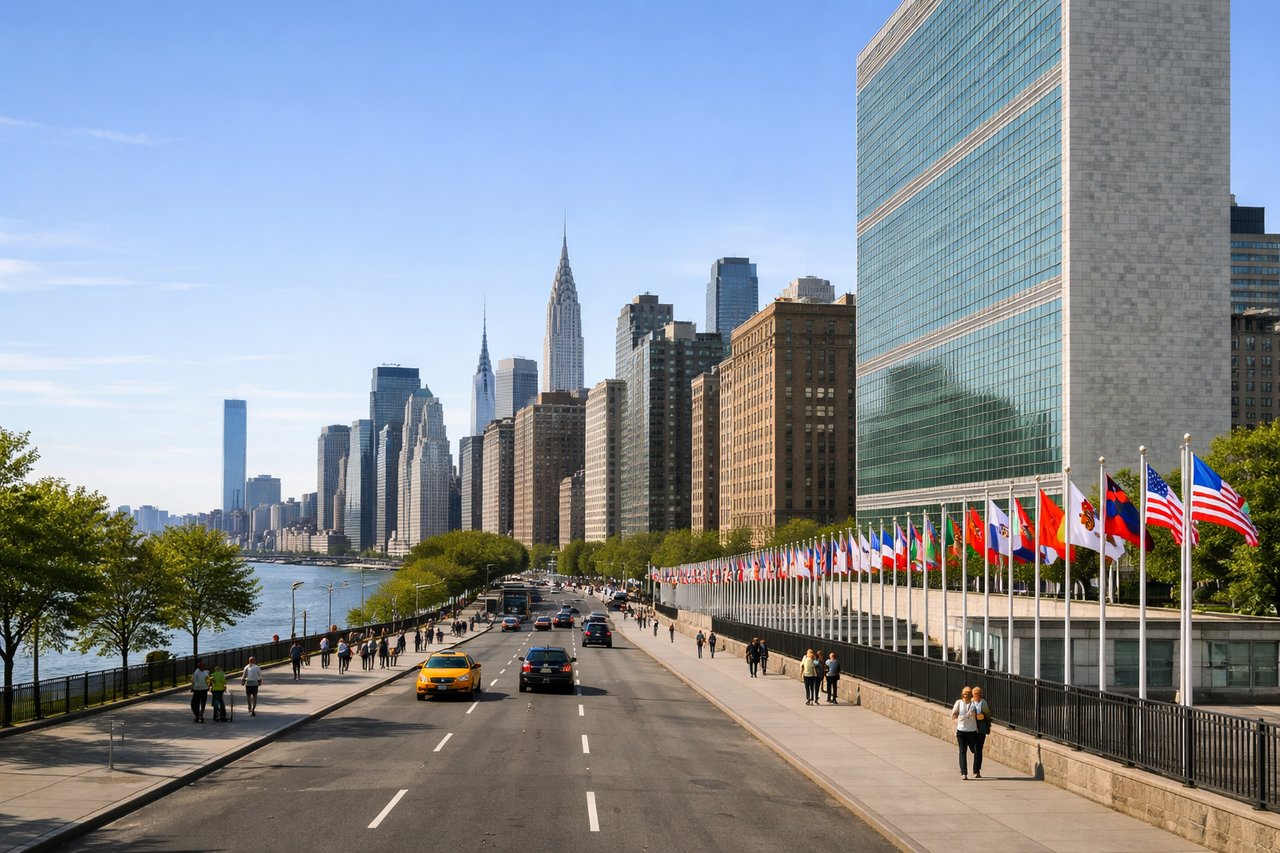
MIDTOWN EAST: UN PLAZA AND GLOBAL BUYERS
The stretch of Midtown East surrounding the United Nations headquarters occupies a specific position in the Manhattan real estate market—one defined as much by its international character as by its physical location. The corridor along First and Second Avenues between the high Forties and low Fifties has served as the residential anchor for diplomats, international organization staff, global executives, and foreign nationals making New York their primary or secondary address for decades. The buildings along UN Plaza and its surrounding blocks reflect that history in their ownership structures, amenity packages, and pricing—and understanding those characteristics is essential for international buyers evaluating this market.
This guide addresses what makes the UN Plaza corridor distinct, who buys here and why, what the ownership structures mean for international purchasers, and how to evaluate specific buildings in a market that rewards knowledge of individual addresses.
THE INTERNATIONAL CHARACTER OF THE CORRIDOR
The presence of the United Nations headquarters on the East River at 42nd Street has shaped the residential character of the surrounding blocks for seventy years. The UN campus employs thousands of international civil servants, diplomats, translators, and support staff—many of whom live within walking or short commute distance of the headquarters. This concentration of international residents has produced a neighborhood culture and a real estate market that are more cosmopolitan in character than most Manhattan addresses.
The practical implications for buyers are several. Buildings in this corridor have historically accommodated international ownership structures—corporate purchases, trust ownership, non-US resident buyers—with fewer restrictions than many Manhattan co-ops. The management companies and boards of buildings in this area have developed expertise in handling the documentation, financing structures, and residency patterns typical of international buyers. For a global buyer who has encountered friction in more traditional Manhattan co-op buildings, the UN Plaza corridor often provides a more accommodating path to ownership.
CONDO OWNERSHIP AND INTERNATIONAL BUYERS
The most important structural consideration for international buyers in this market is the ownership type. Condominiums offer full ownership flexibility for non-US residents: there is no board approval process, no restriction on foreign financing or trust ownership, and no limitation on subletting in most buildings. These features are particularly relevant for diplomatic staff and international executives whose residency in New York may be intermittent—buyers who need to rent the apartment during overseas postings or who are purchasing as a pied-à-terre alongside a primary international residence.
Several of the most prominent buildings in the UN Plaza corridor are condominiums that have served the international community since their development in the 1960s and 1970s. These buildings combine full-service amenity packages with the ownership flexibility that international buyers require. For buyers comparing co-op and condo ownership structures, the New York State Attorney General's guidance on co-op and condo purchases provides the legal framework governing both ownership types and the disclosures that sellers must provide.
International buyers should also be aware that condo purchasers who are primary residents may be eligible for the Cooperative and Condominium Property Tax Abatement, which reduces annual property taxes by up to 28 percent. Eligibility depends on primary residence status and the building's filing—buyers should confirm this with their attorney before closing.
NOTABLE BUILDINGS AND THE UN PLAZA ADDRESSES
One UN Plaza and Two UN Plaza—developed in the late 1970s as part of the same project—represent the most iconic residential addresses in the corridor and among the most recognized by international buyers. Designed as mixed-use towers combining hotel, office, and residential functions, these buildings have housed senior diplomats, executives, and high-profile international residents since their opening. The views from upper floors—the East River, the UN campus, the midtown skyline—are among the most distinctive in the borough.
Beyond the UN Plaza towers, the corridor includes a range of full-service buildings along First and Second Avenues and the side streets of the Forties and Fifties that serve international buyers with more conventional configurations: one- and two-bedroom condominiums in attended buildings with fitness facilities, concierge services, and the professional management that international residents who may not be in New York year-round require. Transaction history for specific buildings and units is searchable through the NYC Department of Finance ACRIS system.
PRICING IN THE UN PLAZA CORRIDOR
Pricing in the UN Plaza corridor reflects the full-service nature of the buildings and the international buyer premium associated with the most recognized addresses. One-bedroom condominiums at One and Two UN Plaza typically start above $1 million. Two-bedroom units range from $1.5 million to $3 million depending on floor height, view orientation, and condition. The most premium high-floor units with unobstructed river views and the UN campus below can reach significantly beyond that range.
In the surrounding blocks, more conventional full-service condominiums offer one-bedroom configurations from approximately $700,000 and two-bedroom units from $1.2 million—pricing that reflects the quality and amenity level of specific buildings rather than the address premium of the UN Plaza towers themselves. International buyers should account for the NYC Mansion Tax, which applies to all purchases at or above $1 million and increases on a graduated scale above $2 million. For international buyers, the Foreign Investment in Real Property Tax Act imposes withholding requirements on certain real estate dispositions, and buyers should engage qualified tax counsel before closing.
TRANSIT AND THE EAST SIDE INFRASTRUCTURE
The UN Plaza corridor is served by the 4, 5, 6, 7, and S trains at Grand Central Terminal—a five-minute walk from most UN Plaza addresses—providing access to the entire subway system from one of its most connected hubs. The Grand Central Madison Long Island Rail Road terminus, which opened in 2023 beneath Grand Central Terminal, further enhances connectivity for buyers with ties to Long Island or the broader tristate region. For international buyers who travel frequently through John F. Kennedy and LaGuardia airports, the East Side Access connection and the general East Side location improve airport commute times relative to West Side addresses.
The East River waterfront, while less developed as a public amenity than the Hudson River side of Manhattan, provides views and open sky that are particularly valued by upper-floor buyers in the corridor. The East River Greenway provides a continuous path along the river's edge for cyclists and pedestrians, and ongoing waterfront improvement projects are gradually enhancing the public realm along this stretch of Manhattan's eastern edge.
THE DIPLOMATIC AND GLOBAL COMMUNITY
One of the less tangible but genuinely meaningful features of the UN Plaza corridor for international buyers is the community itself. The concentration of diplomats, international organization staff, foreign correspondents, and globally mobile executives produces a social environment that reflects the international character of the United Nations itself. For buyers relocating from global capitals—Geneva, Brussels, London, Tokyo, Abu Dhabi—the Midtown East corridor offers a residential environment that is less parochially New York than most Manhattan neighborhoods, in ways that matter to buyers who have lived and worked across multiple countries.
The corridor's proximity to the permanent missions to the United Nations that line the avenues surrounding the headquarters, and to the concentration of international law firms, financial institutions, and multinational corporate offices in Midtown East, creates a professional geography that many international buyers find aligns with their daily lives in New York more naturally than neighborhoods that are primarily residential in character.
THE BOTTOM LINE
The UN Plaza corridor in Midtown East serves a specific buyer profile with precision: international buyers and diplomats who require condo ownership flexibility, full-service building infrastructure, and proximity to the United Nations and Midtown East's professional geography. The buildings are experienced in accommodating the ownership structures and residency patterns of global buyers. The views, the transit connections, and the community character are differentiated assets that comparable Midtown addresses do not replicate.
For international buyers navigating this market, Daniel Blatman provides the building-level expertise and cross-border purchase guidance that UN Plaza corridor acquisitions require. The buyer's guide at danielblatman.com addresses the full due diligence framework for international and domestic buyers alike.