NOMAD VS. FLATIRON: WHICH NEIGHBORHOOD FITS YOU?
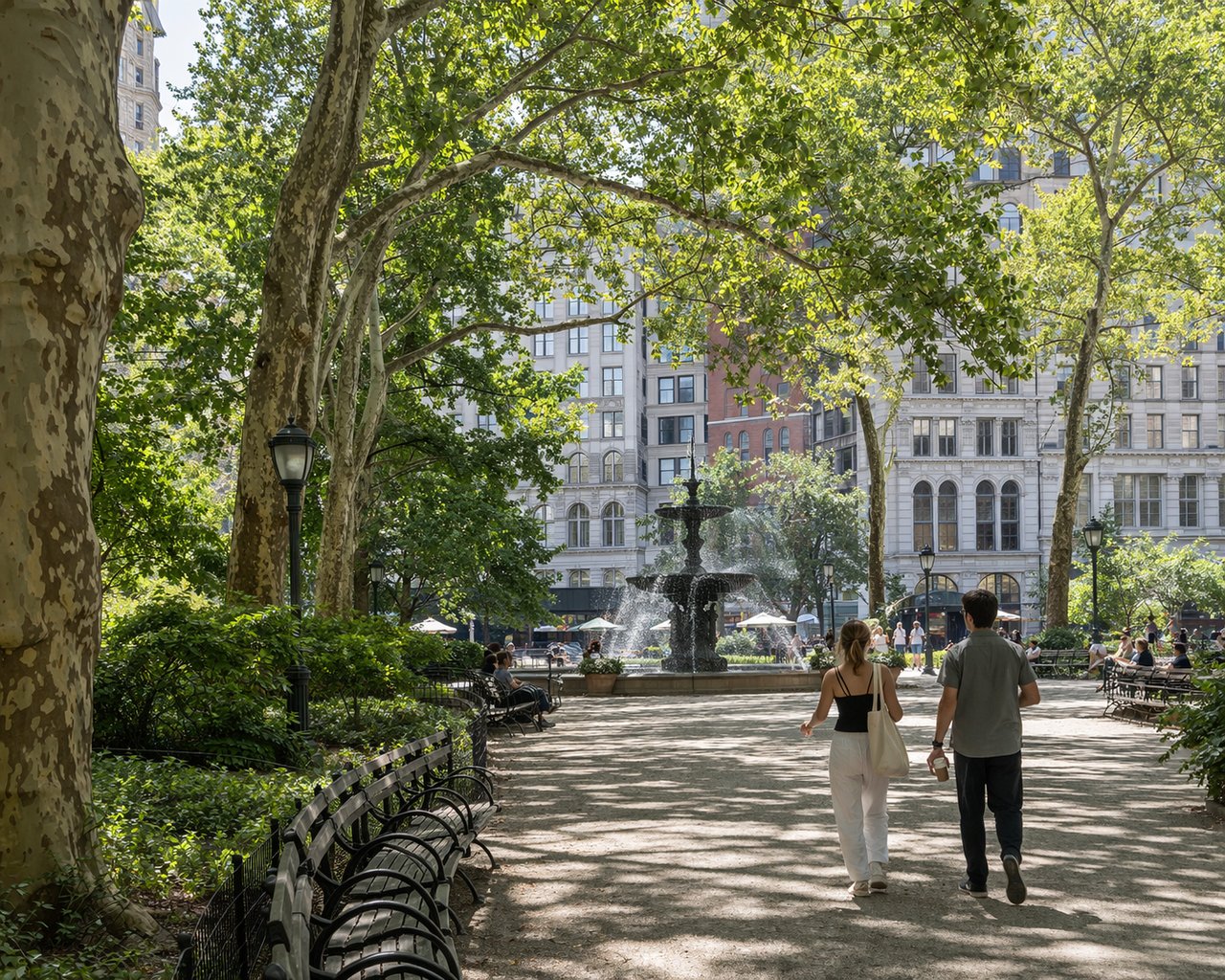
NoMad and Flatiron share a park, a price tier, and a Midtown South location that puts them in direct competition for the same buyer. Madison Square Park — the five-acre landmark green space at the intersection of Broadway, Fifth Avenue, and 23rd Street — sits precisely at the boundary between the two neighborhoods, and from many vantage points within the park, you can see buildings in both.
But the neighborhoods are not interchangeable. They differ in building stock, architectural character, commercial energy, and the daily experience of living in them. For buyers choosing between NoMad and Flatiron, the decision turns on which combination of those factors aligns with their priorities. This guide provides the side-by-side comparison that decision requires.
THE GEOGRAPHY: WHERE ONE ENDS AND THE OTHER BEGINS
Flatiron occupies the area roughly between 20th and 26th Streets, from Park Avenue South to Sixth Avenue. Its defining landmarks are the Flatiron Building at 23rd and Broadway, Madison Square Park at its northeastern edge, and the Ladies' Mile Historic District that preserves the ornamental cast-iron and masonry facades of its nineteenth-century commercial buildings.
NoMad — an acronym for North of Madison Square Park — extends from approximately 25th to 30th Streets, between Lexington Avenue and Sixth Avenue. Its anchor is the Madison Square North Historic District, which encompasses the neighborhood's collection of early-twentieth-century commercial loft buildings along Broadway and Fifth Avenue. NoMad's eastern boundary bleeds into Kips Bay; its northern edge transitions into the garment district and the commercial blocks approaching Penn Station.
The distinction matters because the two neighborhoods, despite their adjacency, produce meaningfully different residential experiences.
THE BUILDING STOCK: LOFTS VS. NEW DEVELOPMENT
Flatiron's residential inventory is dominated by loft conversions — former commercial and manufacturing buildings, many within the Ladies' Mile Historic District, that have been converted to residential use over the past three decades. These buildings offer the physical characteristics that define Manhattan loft living: high ceilings (often 10 to 12 feet), oversized windows, exposed structural columns, and raw industrial detailing that has been incorporated into contemporary residential design. Co-ops and condos coexist, with the older conversions tending toward co-op ownership and the more recent renovations structured as condos.
NoMad's building stock tilts more heavily toward new construction and recent ground-up development. The neighborhood's transformation from a largely commercial district into a residential destination has been driven by developers who recognized the value of the Madison Square Park location and the zoning flexibility of the blocks north of 25th Street. The result is a concentration of contemporary condo towers offering modern finishes, full amenity packages, and the ownership flexibility that new-development product provides.
Buyers sometimes ask: Which neighborhood has better building quality? The question is misframed. Flatiron's best buildings offer architectural character — the bones, the light, the volume — that new construction cannot replicate. NoMad's best buildings offer contemporary convenience — central HVAC, in-unit laundry, smart home integration, fitness centers, and rooftop spaces — that loft conversions were never designed to accommodate. The right answer depends entirely on the buyer's definition of quality.
PRICING: WHAT THE NUMBERS SAY
Flatiron pricing ranges from approximately $1,400 to $2,200 per square foot, with the premium end occupied by renovated loft condos with high ceilings and direct park proximity. A two-bedroom loft in a prime Flatiron conversion typically trades between $1.8 million and $3.5 million depending on floor, ceiling height, and condition.
NoMad pricing runs slightly higher at the top of the market, reflecting the concentration of newer development product. Contemporary two-bedroom condos in NoMad's best buildings trade between $2 million and $4 million, with price per square foot ranging from $1,600 to $2,500. The premium reflects the newer finishes, the amenity infrastructure, and the tax abatements that many NoMad buildings carry under the 421-a program or its successors — abatements whose expiration dates buyers should verify and model carefully.
Transaction history for both neighborhoods is searchable through the NYC Department of Finance's ACRIS system.
THE LIFESTYLE: TWO DIFFERENT VERSIONS OF MIDTOWN SOUTH
Flatiron's daily experience is shaped by its mature commercial and retail ecosystem. The neighborhood's dining, shopping, and cultural offerings are established and diverse — a product of decades of residential and commercial coexistence. Madison Square Park, one of Manhattan's most successful public spaces, anchors the northeastern corner and provides year-round programming, green space, and the kind of community gathering point that newer neighborhoods take decades to develop.
NoMad's energy is different — younger, more concentrated, and more restaurant-driven. The neighborhood has developed one of Manhattan's most acclaimed dining corridors, with a density of chef-driven restaurants and boutique hotels that gives NoMad a hospitality-district character that Flatiron does not share. The experience of walking through NoMad at 8 PM on a Friday is qualitatively different from walking through Flatiron at the same hour — more charged, more social, more intentionally curated.
For buyers who want the reassurance of an established residential neighborhood with a proven track record, Flatiron delivers. For buyers who want the energy of a neighborhood that is still defining itself — with the appreciation potential that comes with that trajectory — NoMad offers a compelling alternative.
CO-OPS, CONDOS, AND OWNERSHIP STRUCTURE
Flatiron's inventory splits between co-ops and condos, giving buyers a choice of ownership structures within the same neighborhood. Co-op buyers benefit from avoiding the NYC Mortgage Recording Tax and typically enjoy lower monthly carrying costs. Condo buyers gain the flexibility of no board approval, the ability to sublet, and accommodation of LLC and trust ownership.
NoMad's inventory is predominantly condo, reflecting its newer development history. This gives NoMad buyers structural ownership advantages but also means higher carrying costs and exposure to the Mortgage Recording Tax.
All buyers in both neighborhoods should confirm whether their building has filed for the Cooperative and Condominium Property Tax Abatement and should review the NYC Department of Finance's Property Tax Benefits page for all available programs. The New York State Attorney General's guidance on co-op and condo purchases outlines the legal framework governing both structures. Building compliance is verifiable through the NYC Department of Buildings.
TRANSIT: EQUALLY STRONG, DIFFERENTLY ACCESSED
Both neighborhoods benefit from exceptional transit access, though the specifics differ.
Flatiron is served by the N, R, W, and 6 trains at 23rd Street and the F and M trains at 23rd Street–Sixth Avenue. NoMad adds proximity to the 28th Street stations on the 6 and on the N/R/W, and the neighborhood's northern blocks provide walkable access to Penn Station and the LIRR, NJ Transit, and Amtrak connections it provides.
For commuters to Midtown, the Financial District, or Brooklyn, both neighborhoods deliver. For buyers who travel regionally — to Long Island, New Jersey, or points north — NoMad's Penn Station proximity is a meaningful differentiator.
WHO SHOULD BUY WHERE
The buyer who should choose Flatiron values architectural character, established neighborhood infrastructure, the light and volume of a loft conversion, and the stability of a residential market with a multi-decade track record. This buyer is willing to accept the trade-offs of older building systems — smaller closets, less central air, potentially no in-unit laundry — in exchange for the physical presence that only a loft building provides.
The buyer who should choose NoMad values modern finishes, full amenities, condo flexibility, and the energy of a neighborhood that is still appreciating. This buyer prioritizes convenience and lifestyle infrastructure over architectural heritage, and is comfortable with the premium pricing and carrying costs that new-development product commands.
The buyer's guide at danielblatman.com provides building-level data and financial modeling for both neighborhoods.
THE BOTTOM LINE
NoMad and Flatiron are not the same neighborhood described by two names. They are adjacent but distinct markets that serve different buyer profiles, deliver different residential experiences, and offer different value propositions. The park that connects them — Madison Square Park — is one of Manhattan's finest. The buildings that surround it, on both sides of the boundary, include some of the most compelling residential product in Midtown South.
For buyers choosing between them, Daniel Blatman provides the side-by-side intelligence, financial modeling, and negotiation expertise that this decision requires. The neighborhood profiles at danielblatman.com provide current pricing data across both markets.