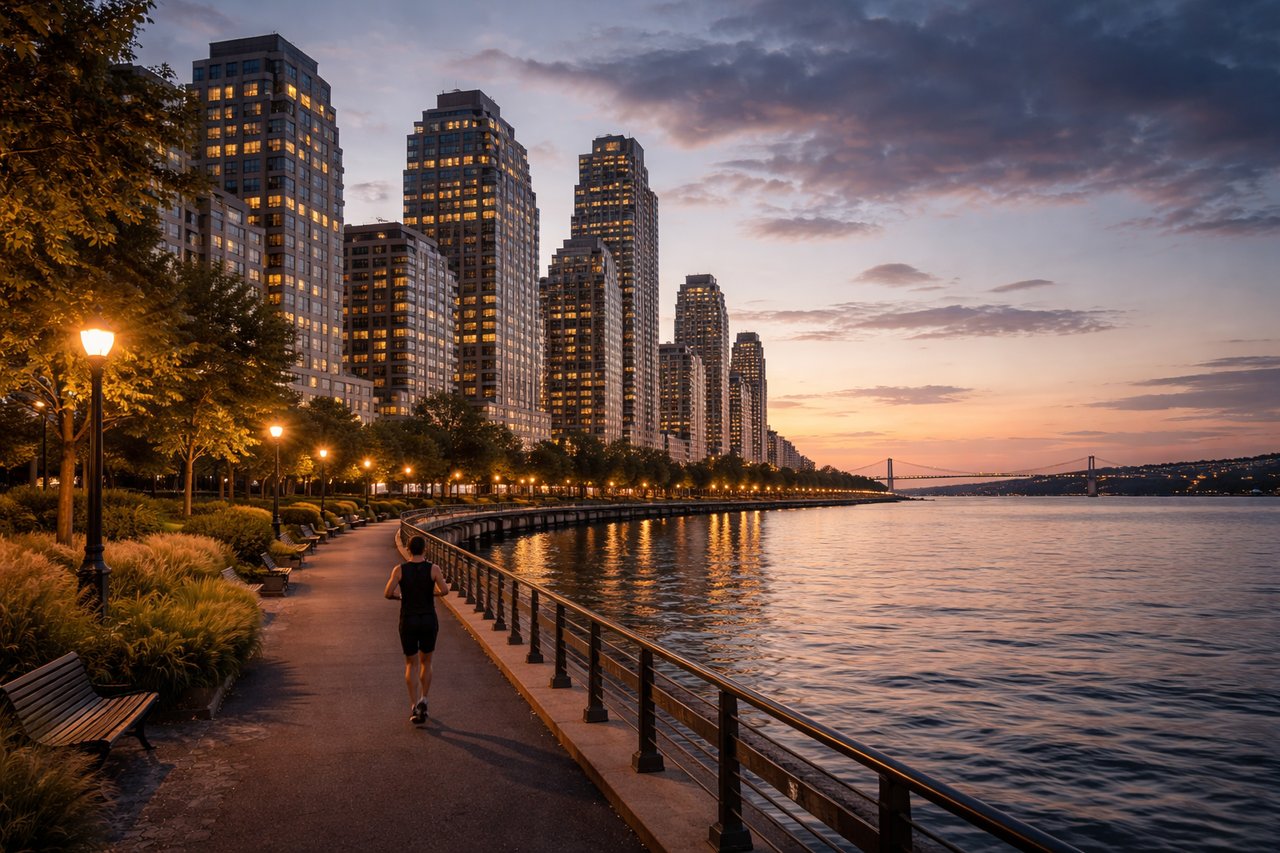
RIVERSIDE BOULEVARD: NEW DEVELOPMENT CORRIDOR ON THE UPPER WEST SIDE
Riverside Boulevard is not a neighborhood in the traditional sense. It is an engineered residential corridor — a sequence of 19 towers built over three decades on a former rail yard between 59th and 72nd Streets along the Hudson River — that has quietly become one of the Upper West Side's most significant concentrations of luxury condominium inventory. For buyers seeking modern construction, full amenity packages, waterfront park access, and the proximity advantages of an Upper West Side address without the co-op board requirements that define much of the neighborhood, Riverside Boulevard offers a product type that is difficult to assemble elsewhere in Manhattan.
This guide examines what the corridor actually delivers, how its buildings compare, what the financial profile looks like, and what buyers should understand before purchasing in a development that is still, in some respects, writing its final chapter.
THE HISTORY: FROM RAIL YARD TO RESIDENTIAL CORRIDOR
The land beneath Riverside Boulevard was once the Penn Central rail yards — 77 acres of derelict industrial infrastructure stretching along the Hudson River on the Upper West Side. In the late 1980s and early 1990s, a consortium of civic organizations negotiated a master plan with the site's developers to transform the yards into a mixed-use residential development with a requirement to create a significant new public park along the waterfront.
Construction began in 1997. The first buildings — designed by architects including Philip Johnson and Costas Kondylis — opened between 1999 and 2005. A second wave of development, led by Extell Development Company after acquiring a portion of the site in 2005, added buildings including the Rushmore, the Avery, and the Aldyn. The most recent phase includes the Riverside Center towers at the southern end of the corridor and the Waterline Square complex at the intersection with the Hudson River waterfront.
The result is a residential district of approximately 8,000 residents housed in buildings that range from 32 to 49 stories, virtually all of them condominiums, with a scale and amenity level that the prewar Upper West Side was never designed to provide.
THE PARK: RIVERSIDE PARK SOUTH
The development's most significant public amenity is Riverside Park South — a 25-acre waterfront park stretching from 59th to 72nd Streets along the Hudson River, constructed in phases between 2001 and 2020. The park connects to the historic Riverside Park at 72nd Street, creating continuous waterfront green space that extends more than four miles north along the river.
For residents of Riverside Boulevard, the park is not across the street. It is at the doorstep. The buildings front directly onto landscaped promenades, athletic facilities, children's playgrounds, and a 750-foot recreational pier that extends into the Hudson River. The Manhattan Waterfront Greenway — a continuous bicycle and pedestrian path — runs through the park, connecting the corridor to the George Washington Bridge to the north and Battery Park to the south.
Buyers frequently ask: How does Riverside Park South compare to Central Park? They serve different purposes. Central Park offers 843 acres of varied terrain, cultural institutions, and seasonal programming. Riverside Park South offers waterfront access, open sky, river views, and a quieter, less tourist-heavy daily experience. The advantage of Riverside Boulevard is that residents are within walking distance of both — Central Park's southwestern entrance at Columbus Circle is a 10- to 15-minute walk east.
THE BUILDING STOCK: WHAT YOU ARE BUYING
Riverside Boulevard's condominium inventory falls into three general categories, distinguished by era, developer, and amenity level.
The first-generation buildings — constructed between 1997 and 2005 at addresses including 120, 200, 220, and 240 Riverside Boulevard — offer generous floor plans, Hudson River views, and full-service amenities including doormen, fitness centers, swimming pools, and parking garages. These buildings have now been occupied for 20 to 25 years, and their finishes and common areas reflect the standards of late-1990s and early-2000s construction. Price per square foot in these buildings typically ranges from $1,200 to $1,600, representing strong value relative to newer Upper West Side product.
The second-generation buildings — the Rushmore, the Avery, and the Aldyn, completed between 2008 and 2012 — introduced higher-end finishes, more sophisticated architectural design, and expanded amenity packages including children's playrooms, screening rooms, and concierge services. These buildings trade between $1,500 and $2,200 per square foot, depending on floor, exposure, and condition.
The most recent developments — including One Riverside Park, One West End, and the Waterline Square complex — deliver the current state of the art in Manhattan residential construction: floor-to-ceiling glass, central HVAC with individual climate control, smart home integration, and amenity suites that include swimming pools, rock climbing walls, bowling alleys, and dedicated fitness facilities. Premium units in these buildings trade above $2,000 per square foot, with penthouses and river-facing units commanding significantly more.
Buyers should verify building compliance and open violations through the NYC Department of Buildings' BIS system before making an offer. Transaction history is searchable through the NYC Department of Finance's ACRIS system.
THE CONDO ADVANTAGE — AND ITS COSTS
Virtually every residential building on Riverside Boulevard is a condominium, which gives buyers structural advantages that the co-op-dominated prewar Upper West Side does not: no board approval, no restrictions on subletting, accommodating of corporate and trust ownership, and a fee-simple title that simplifies financing and resale. The New York State Attorney General's guidance on co-op and condo purchases outlines the disclosure requirements that govern condo transactions in New York.
The financial trade-off is real. Condo buyers pay the NYC Mortgage Recording Tax — 1.8 percent for loans below $500,000 and 1.925 percent for loans of $500,000 or more — a cost that co-op buyers avoid entirely. Monthly carrying costs for Riverside Boulevard condos — common charges plus separately billed property taxes — are typically higher than for comparable prewar co-ops on the avenues to the east, reflecting the modern amenity infrastructure and higher staffing levels these buildings maintain.
All buyers should confirm whether the building has filed for the Cooperative and Condominium Property Tax Abatement, which can reduce annual property taxes by up to 28 percent for eligible primary-residence owners. Some Riverside Boulevard buildings also carry tax abatements under the 421-a program or its successors, which can reduce property taxes for a defined period. Buyers should verify the abatement's expiration date and model the tax increase that will follow — a variable that materially affects the building's long-term carrying cost profile. The NYC Department of Finance's Property Tax Benefits page details all available programs.
The buyer's guide at danielblatman.com provides the financial modeling framework for evaluating total cost of ownership across competing Riverside Boulevard buildings.
TRANSIT AND LOCATION
Riverside Boulevard's location delivers strong transit access despite its western position. The 1 and 2 trains at 66th Street–Lincoln Center and the A, B, C, D, and 1 trains at Columbus Circle are within a 10- to 15-minute walk. The M57 and M72 crosstown buses connect the corridor to the east side. Lincoln Center, the Deutsche Bank Center retail complex, and the commercial infrastructure of Broadway and Columbus Avenue are all within comfortable walking distance.
Buyers sometimes ask: Does Riverside Boulevard feel isolated from the rest of the Upper West Side? The first-generation buildings, located closer to 72nd Street, integrate naturally with the surrounding neighborhood. The southern buildings, closer to 59th Street, feel more self-contained — a residential enclave defined by the park and the river rather than by the avenue grid. Whether this registers as seclusion or privacy depends entirely on the buyer's preferences.
WHO BUYS ON RIVERSIDE BOULEVARD
The corridor attracts a buyer profile that differs meaningfully from the traditional Upper West Side co-op purchaser. Riverside Boulevard buyers tend to be younger professionals and families who value modern finishes and amenities over prewar character, international purchasers who need the flexibility of condo ownership, investors who want the ability to rent without board restrictions, and pied-à-terre users who want turnkey luxury without the co-op's primary-residence requirements.
This buyer diversity supports liquidity and resale demand, but it also creates a more transactional ownership culture than what prevails in the co-op buildings to the east. Buyers who value long-term residential community and neighborly stability should evaluate individual buildings carefully — some have developed strong resident cultures, while others function more as luxury housing stock.
THE BOTTOM LINE
Riverside Boulevard offers something that the traditional Upper West Side cannot: modern luxury condominium construction with full amenity packages, waterfront park access, and ownership flexibility, all within walking distance of Lincoln Center, Central Park, and the transit infrastructure of Columbus Circle. The corridor's range of building vintages and price points provides entry at multiple levels, from first-generation towers offering strong per-square-foot value to the latest developments delivering the current state of the art in Manhattan residential design.
For buyers who want the Upper West Side's location advantages without the co-op framework that defines its prewar stock, Riverside Boulevard is the most concentrated and compelling alternative in the neighborhood.
For Riverside Boulevard buying strategy, Daniel Blatman provides the building-level intelligence, financial modeling, and negotiation expertise that this corridor's competitive market demands. The neighborhood profiles at danielblatman.com provide current pricing data and market context across the Upper West Side.