SOHO MANHATTAN: THE COMPLETE BUYER'S GUIDE TO ONE OF NEW YORK CITY'S MOST COVETED NEIGHBORHOODS
Few neighborhoods in Manhattan carry the cultural gravity, architectural distinction, and enduring real estate value of SoHo. Bounded by Canal Street to the south, Houston Street to the north, Lafayette Street to the east, and Sixth Avenue to the west, SoHo occupies a compact but consequential footprint in Lower Manhattan. For buyers, it offers something increasingly rare in this city: genuine character with genuine investment depth.
This guide is written for serious buyers, those who understand that purchasing in SoHo is not simply a lifestyle decision but a long-term real estate play in one of the most supply-constrained markets in the country. Whether you are evaluating a loft conversion for the first time or comparing co-op structures across buildings, Daniel Blatman at Compass brings the market fluency and negotiating precision this neighborhood demands.
WHAT MAKES SOHO DIFFERENT: ARCHITECTURE, ZONING, AND LOFT CULTURE
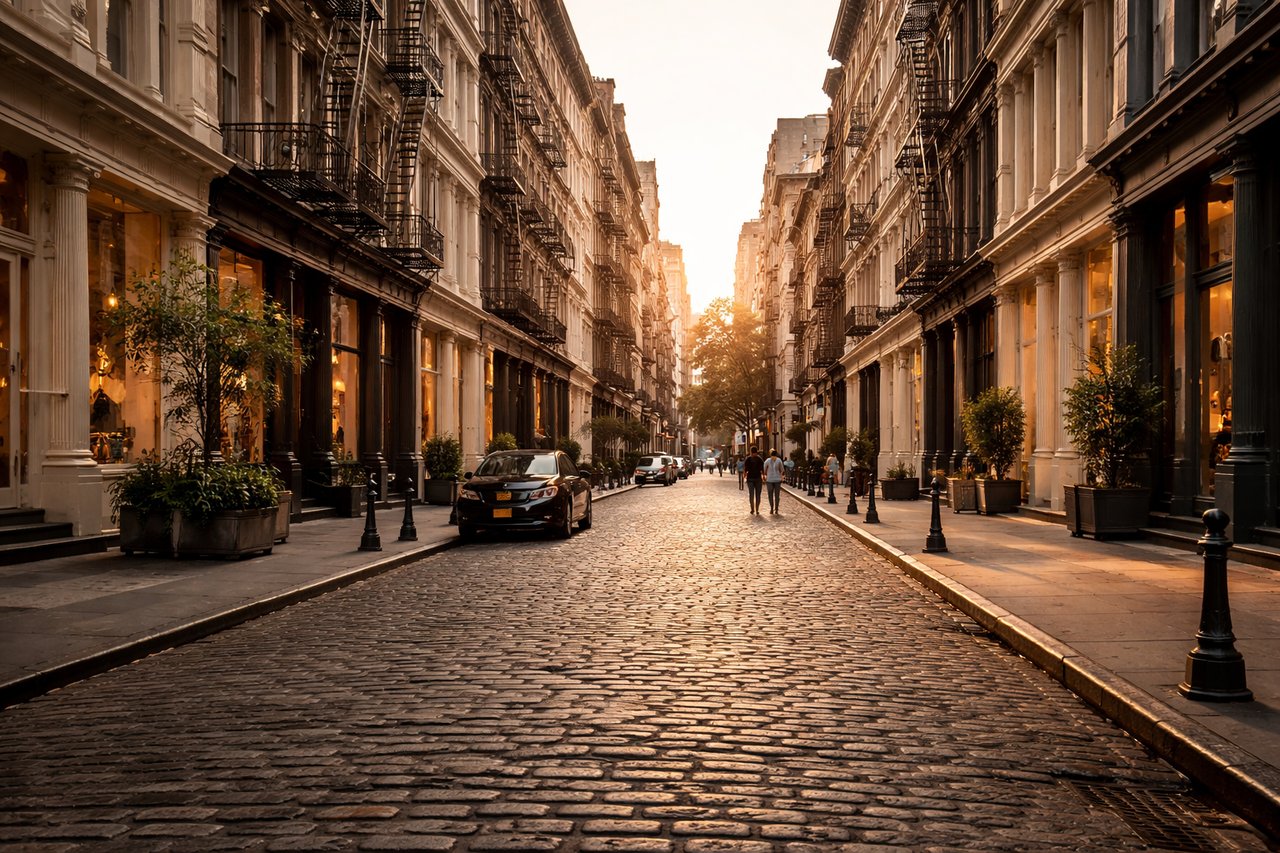
SoHo's real estate identity begins with its architecture. The neighborhood contains the largest concentration of cast-iron buildings in the world, many of which are now designated landmarks under the jurisdiction of the New York City Landmarks Preservation Commission. These structures, originally built as light manufacturing and warehouse spaces in the mid-to-late 1800s, define the visual and spatial character of the neighborhood. Soaring ceilings, oversized windows, exposed columns, and open floor plans are not amenities here. They are the baseline.
The zoning history of SoHo is essential context for any buyer. The neighborhood's residential evolution began in earnest when the New York City Department of City Planning established the SoHo-NoHo Historic District and its associated M1-5A and M1-5B zoning designations. For decades, legal residency in SoHo required artist certification through the New York City Department of Cultural Affairs, a rule that shaped the building stock and kept inventory tightly controlled. While significant zoning reforms passed in 2021 removed the artist certification requirement for most buildings, buyers should verify the specific legal status of any unit with qualified legal counsel before proceeding.
Many buyers entering SoHo for the first time ask whether they need to be a certified artist to purchase in the neighborhood. The short answer is no, not in most buildings today. But the legal history of individual units varies, and working with an advisor who knows the SoHo inventory at the building level is not optional. It is essential.
THE REAL ESTATE LANDSCAPE: CO-OPS, CONDOS, AND LOFT CONVERSIONS
SoHo's housing stock does not fit neatly into Manhattan's standard co-op and condo framework. The majority of available residences are loft conversions, either co-operative or condominium in structure, housed within those signature cast-iron commercial buildings. True ground-up residential construction is rare, and when new development does appear, it commands a substantial premium.
Co-ops in SoHo tend to be older conversions with board approval processes that require financial disclosure, reference letters, and in-person interviews. Many SoHo co-ops have relatively flexible subletting policies compared to their Upper East Side counterparts, but each building's proprietary lease and house rules are distinct. Buyers should obtain and review the co-op's most recent financial statements, board minutes, and underlying mortgage documentation. The New York State Attorney General's office oversees co-op offering plan filings, and reviewing the original plan and any amendments is a standard part of due diligence.
Condos in SoHo offer greater flexibility, particularly for buyers who intend to use the property as a pied-à-terre or investment unit. Condo ownership conveys real property rights rather than shares in a corporation, which simplifies financing and resale. However, condo inventory in SoHo is limited, and when it comes to market, it moves quickly and at a premium over comparable co-op units.
Buyers frequently ask how to decide between a co-op and a condo in SoHo. The answer depends on your financing structure, your intended use, your timeline, and your risk tolerance. Connecting with an experienced Manhattan buyer's advisor early in the process allows you to narrow the search before you fall in love with something that does not match your qualifying profile.
PRICING, MARKET DYNAMICS, AND WHAT BUYERS SHOULD EXPECT
SoHo occupies the upper tier of Manhattan's price-per-square-foot spectrum. Loft units with authentic pre-war details, north-south light, and ceiling heights above twelve feet routinely trade at a meaningful premium over the Manhattan median. Entry-level one-bedrooms in older co-op conversions can begin below two million dollars, but the true center of the SoHo market, the two- and three-bedroom loft units in recognized buildings, trades between three million and eight million dollars, with penthouses and full-floor units reaching well above that range.
Buyers should understand that SoHo is not a high-inventory neighborhood. At any given time, the active listing count is modest, which means that well-priced, well-maintained units generate real competition. Bidding above ask is not uncommon, and contingency-free offers backed by strong financing or all-cash consideration are frequently preferred by sellers.
If you are financing your purchase, working with a lender who has direct experience with Manhattan co-op and condo transactions is not a suggestion. It is a requirement. The Federal Reserve's consumer resources on mortgage lending provide a useful baseline, but the specifics of co-op financing, including share loan structures and debt-to-income requirements imposed by individual boards, require lender relationships that understand this market.
LIVING IN SOHO: DAILY LIFE, WALKABILITY, AND NEIGHBORHOOD CHARACTER
SoHo is one of the most walkable neighborhoods in Manhattan, which is to say it is one of the most walkable urban environments in the country. The New York City Department of Transportation has invested significantly in the neighborhood's pedestrian and cycling infrastructure, and the combination of the A, C, E, 1, N, Q, R, W, B, D, F, and M subway lines within a short walk means that connectivity to the rest of the city is exceptional.
Ground-floor retail in SoHo remains internationally recognized, with flagship stores, independent galleries, and a food and beverage culture that ranges from neighborhood staples to some of the city's most acclaimed dining rooms. The SoHo-NoHo corridor also connects directly to Tribeca, the West Village, and Nolita, giving residents access to a remarkably diverse set of daily environments within a ten-minute walk.
Buyers with children frequently ask about public school zoning in SoHo. The neighborhood falls within Community School District 2, which includes some of the highest-performing public schools in Manhattan. Zoned school assignments are determined by home address, and the New York City Department of Education's school finder is the most accurate resource for verifying your specific assignment before you close.
WHAT TO KNOW BEFORE YOU MAKE AN OFFER IN SOHO
The gap between interest and offer in a competitive Manhattan market is where buyers lose deals. In SoHo, preparation is not optional. Before submitting an offer, you should have your financing pre-approval in hand, your attorney identified and ready to review a contract within 24 to 48 hours, and a clear sense of your walk-away price. Daniel Blatman's approach to buyer representation is grounded in exactly this kind of preparation, ensuring that when the right unit comes to market, you are positioned to move with confidence rather than scrambling to catch up.
You should also understand the cost structure of a Manhattan purchase before you fall in love with a specific unit. Closing costs in New York City are among the highest in the country. The New York City Department of Finance administers the Mansion Tax, which applies to residential transactions at or above one million dollars and scales with the purchase price. Transfer taxes, mortgage recording taxes, attorney fees, and title insurance are additional line items that your advisor and attorney should walk you through in detail before you commit to a number.
SoHo rewards buyers who do the work before they walk through the door. The neighborhood's combination of architectural irreplaceability, location, and long-term value retention makes it one of the most defensible places to own real estate in Manhattan. But it is not a forgiving market for the underprepared.
Reach out to Daniel Blatman at Compass to begin a conversation about your SoHo search. The inventory is limited, the competition is real, and the right guidance makes a measurable difference.