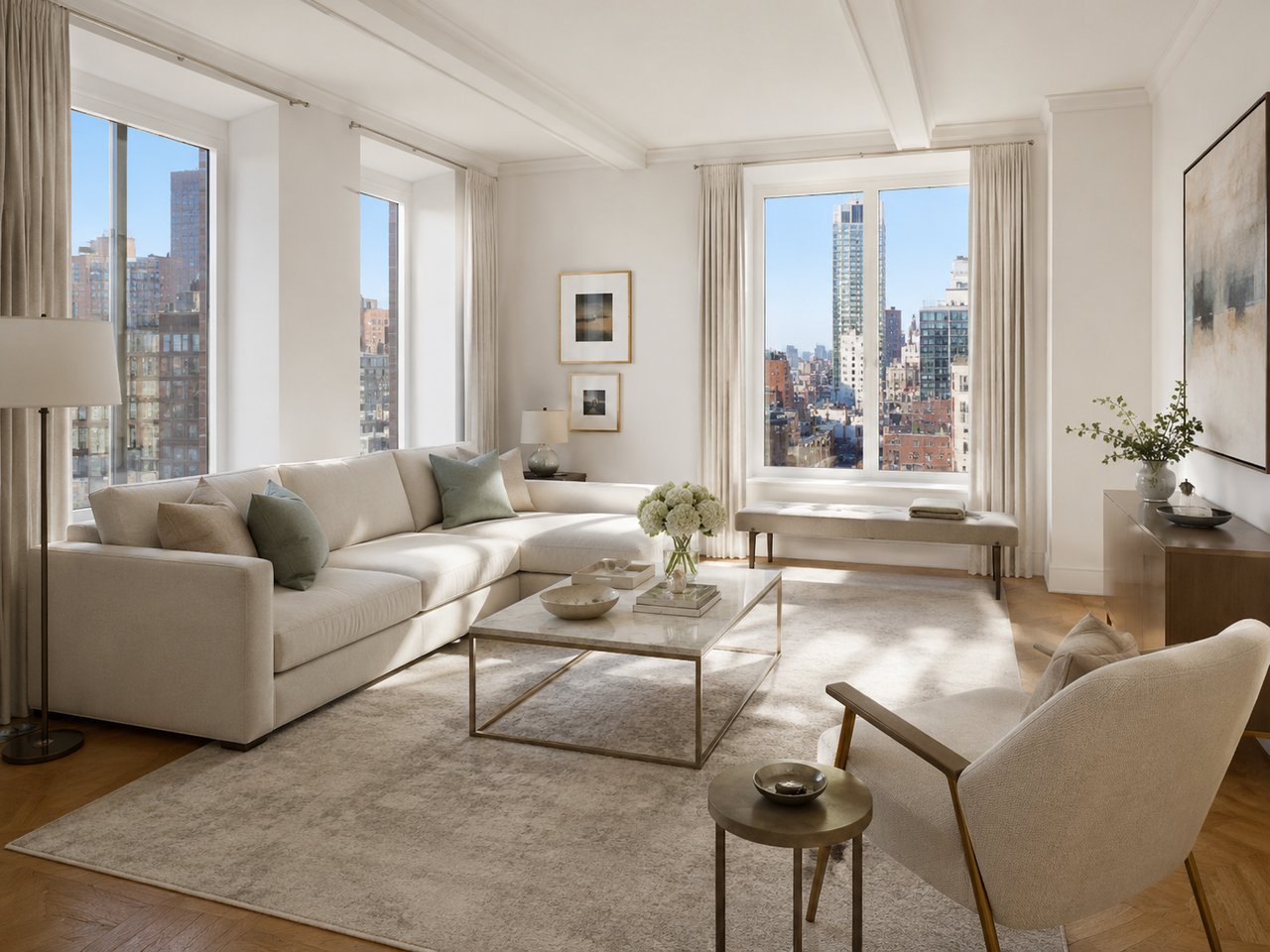
STAGING ROI: WHAT THE DATA SHOWS
WHY STAGING IS AN INVESTMENT DECISION, NOT AN AESTHETIC ONE
Staging a Manhattan property for sale is frequently discussed in terms of style and presentation. The more useful frame is financial. The decision to stage, how extensively to stage, and which elements of the property to prioritize is fundamentally a return on investment calculation, and it is one that sellers who approach it analytically consistently execute better than those who treat staging as a subjective preference.
The data on staging returns in residential real estate is sufficiently consistent to support clear conclusions, even in a market as distinctive as Manhattan. Staged properties sell faster, sell closer to or above asking price, and generate stronger buyer engagement from first contact than comparable unstaged properties. The financial effect of staging is not theoretical. It shows up in transaction records, in days on market statistics, and in the offer quality that sellers receive across property types and price points.
Sellers evaluating the economics of staging as part of the process of selling a home in Manhattan should approach the decision the way they would approach any capital allocation: by comparing the likely cost of staging against the expected improvement in outcome, measured in price, speed, and negotiating position. The data supports this investment more consistently than most sellers initially assume.
WHAT THE RESEARCH SAYS ABOUT STAGED VERSUS UNSTAGED PROPERTIES
Multiple studies on staging outcomes in residential real estate have produced findings that align closely enough to draw reliable conclusions. The National Association of Realtors has tracked staging data through its annual Profile of Home Staging report for over a decade, and the findings have been consistent: a significant majority of buyer's agents report that staging makes it easier for buyers to visualize a property as their future home, and staged properties tend to receive offers more quickly and at higher prices than their unstaged counterparts.
A common question is how much of a price premium staging actually produces. The NAR research has found that staged homes typically sell for between one and ten percent more than comparable unstaged homes, with the range reflecting differences in property type, staging quality, and market conditions. In Manhattan, where the median transaction price is measured in millions, even a one percent improvement in sale price on a two million dollar property represents twenty thousand dollars, a figure that substantially exceeds the cost of a well-executed staging engagement in most cases.
Days on market data reinforces the price finding. Properties that are professionally staged enter the market with stronger buyer engagement from the first showing, which translates into faster offer conversion. Reducing days on market is not merely a convenience for sellers. In Manhattan, where carrying costs including maintenance, property taxes, and mortgage interest can run several thousand dollars per month or more, each week a property sits unsold represents a real financial cost that accelerates the net benefit of the staging investment.
THE COST OF STAGING RELATIVE TO THE BENEFIT
Understanding staging ROI requires accurate cost data as well as accurate benefit data. Staging costs in Manhattan vary considerably depending on the scope of work, the size of the property, and whether the property is vacant or occupied. Light staging for an occupied property, which involves decluttering, editing existing furnishings, and adding curated accessories, typically costs between one and three thousand dollars depending on the property's size and the stager's hourly or project rate.
Full vacant staging, in which a professional stager furnishes an empty apartment with rented furniture, art, lighting, and accessories for the duration of the listing, is more expensive. For a one-bedroom or two-bedroom Manhattan apartment, full staging typically ranges from three to eight thousand dollars for an initial installation with monthly continuation fees of one to two thousand dollars if the listing remains active beyond the initial period. Larger apartments and luxury properties carry higher staging costs proportional to their size and the quality of furnishings required to present them credibly.
Sellers often ask whether they can approximate professional staging results by purchasing furniture and accessories themselves. In most cases, the attempt produces results that fall short of professional quality at a cost that exceeds professional staging fees when the time investment and the risk of poor selection are factored in. Professional stagers have developed specific knowledge of what resonates with Manhattan buyers at each price point and property type, and that expertise is what the staging fee is actually purchasing.
VACANT VERSUS OCCUPIED: WHERE STAGING MATTERS MOST
The staging ROI calculation is not uniform across all property conditions. The return on professional staging is highest for vacant properties, where the absence of furniture leaves buyers struggling to understand how a space functions, how it feels at scale, and whether their life could fit within it. Vacant apartments consistently underperform staged apartments in showing engagement and offer quality, regardless of how attractive the underlying architecture may be.
Buyers often ask why an empty apartment would generate weaker buyer response than the same apartment furnished. The answer is psychological. Most buyers lack the spatial imagination to see a furnished life in an empty room. Without furniture as a reference point, rooms appear smaller, proportions seem ambiguous, and the emotional connection that drives purchase decisions is harder to form. A professionally staged apartment answers these questions before the buyer has to ask them, and the result is a buying experience that is more immediate, more confident, and more likely to produce an offer.
Occupied properties benefit from staging as well, though the scope and ROI calculation differ. For occupied properties, the primary staging objectives are depersonalization, editing, and enhancement. Removing personal photographs, reducing furniture to create a sense of space, and adding elements that elevate the visual quality of the interior all contribute to buyer perception without requiring a full furnishing installation. The cost is lower and the return, while typically smaller in absolute terms, remains positive in most cases.
HOW STAGING INTERACTS WITH PHOTOGRAPHY AND LISTING PERFORMANCE
One of the most direct and measurable effects of professional staging is its impact on listing photography. Photographs of a staged property consistently outperform photographs of the same property in an unstaged condition, producing images that are more compelling, more widely shared, and more effective at converting online views into showing requests.
A common question is whether staging is necessary if a property photographs well on its own. In Manhattan, very few occupied properties photograph at their best without some degree of staging intervention. The lived-in quality of a personal home, the accumulation of belongings, and the arrangement of furniture for daily use rather than visual presentation all work against strong listing imagery. Professional staging addresses these issues specifically for the camera as well as for the in-person experience.
The interaction between staging and photography creates a compounding effect on listing performance. A staged property produces better photographs, which generates more online engagement, which produces higher attendance at open houses, which increases the probability of competitive offer dynamics. Each link in that chain strengthens the next, which is why the staging investment is best understood as the foundation of the entire marketing effort rather than as one isolated line item in the listing budget. Sellers managing this process effectively track relevant Manhattan real estate market trends alongside their listing performance to understand whether their results reflect staging quality, market conditions, or both.
STAGING BY PRICE POINT: WHERE THE RETURNS DIFFER
Staging ROI is not constant across all price points in Manhattan, and understanding where returns are strongest helps sellers allocate their staging budget most effectively. At entry-level price points, where buyers are often stretched financially and are evaluating properties primarily on practical criteria, staging produces strong results by helping buyers overcome the spatial ambiguity of compact apartments and visualize comfortable living in smaller footprints.
At mid-market price points, staging is effectively a competitive necessity. In segments where multiple comparable properties are available simultaneously, a staged property has a visible presentation advantage over an unstaged competitor that manifests in showing traffic, offer quality, and ultimate sale price. Sellers in this segment who choose not to stage are making a decision to compete at a disadvantage.
At the luxury price point, staging takes on a different character. The buyers transacting above five million dollars in Manhattan expect a level of design quality and finish that standard staging cannot produce. At this level, high-end staging with luxury furnishings, curated art, and designer lighting and accessories is the appropriate investment, and the cost rises proportionally. The ROI remains positive but the execution requires a stager with direct experience in the luxury segment and a deep understanding of what buyers at this level expect to encounter in a property that commands a premium price.
THE SELLER'S PRACTICAL GUIDE TO STAGING DECISIONS
Given the consistent data supporting staging ROI, the practical question for sellers is not whether to stage but how to stage appropriately for their specific property, price point, and market conditions. Several principles guide this decision effectively.
Sellers should invest in staging before photography, not after. The sequence matters because photography captures the staged condition for permanent use in all listing materials. Staging after photographs have already been taken produces two different versions of the property that can create confusion for buyers who viewed the listing online before attending the open house.
Sellers should prioritize the rooms that photographs show most prominently. In most Manhattan apartments, the living room, primary bedroom, and kitchen carry the greatest visual weight in listing imagery. Allocating the staging budget to these spaces first, before less photographed rooms, produces the strongest improvement in listing performance per dollar spent.
Sellers should ask their broker to provide comparable sales data on staged versus unstaged transactions in their specific building or immediate neighborhood. Building-level and submarket-level data is more directly applicable than national averages and provides the most relevant context for the ROI calculation that should drive the staging decision.
Through Daniel Blatman's NYC real estate expertise, sellers receive staging guidance that is grounded in current Manhattan transaction data and calibrated to the specific property, price point, and competitive environment in which the listing will operate. Staging ROI in Manhattan is not a matter of opinion. It is a matter of data, and the data consistently supports the investment.