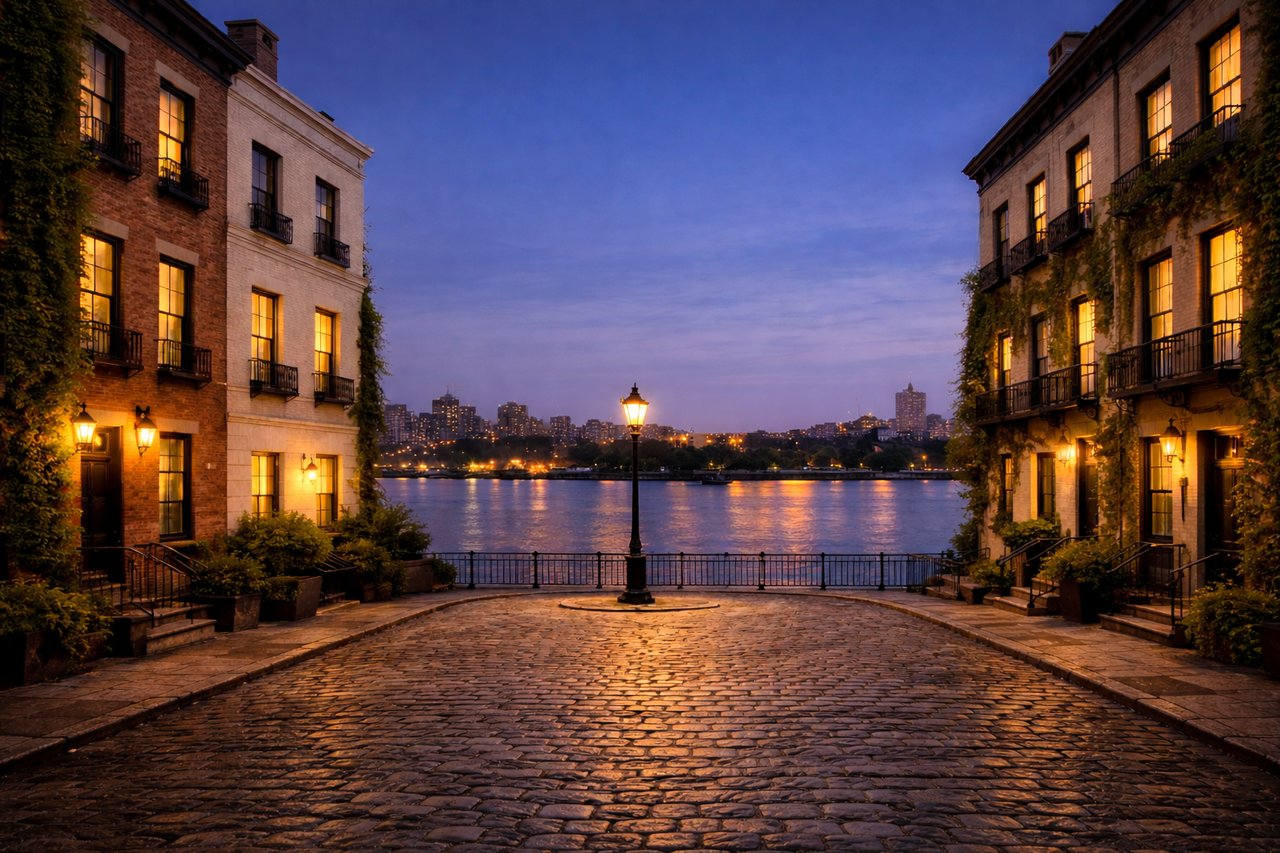
SUTTON PLACE: THE QUIET LUXURY ON THE EAST RIVER
There are neighborhoods in Manhattan that announce themselves — with celebrity restaurants, landmark towers, and cultural institutions that draw millions. Sutton Place is not one of them. Tucked between East 53rd and 59th Streets along the East River, bounded by First Avenue to the west and the waterfront to the east, this six-block enclave has operated for a century as one of Manhattan's most discreet residential addresses — a place where wealth does not perform but simply resides, in prewar co-ops and townhouses that face the river with a composure the rest of Midtown cannot approach.
For buyers who understand that luxury in Manhattan is not always measured in amenity counts or ceiling heights but in permanence, quiet, and the quality of daily life, Sutton Place offers something genuinely rare. This guide examines what the neighborhood delivers, how its market functions, and what informed buyers need to evaluate before purchasing here.
THE HISTORY THAT SHAPED THE NEIGHBORHOOD
Sutton Place owes its character to a deliberate act of reinvention. In the 1920s, a group of wealthy socialites — Anne Harriman Vanderbilt, Anne Morgan, and Elisabeth Marbury among them — purchased and rebuilt a row of deteriorating brownstones on the bluffs overlooking the East River, transforming a neglected industrial waterfront into an enclave of patrician elegance. The gamble worked. Within a decade, Sutton Place had attracted the city's most prominent architects and developers, who lined the street with prewar apartment buildings and townhouses designed to a standard of quality that has defined the neighborhood ever since.
The Sutton Place Historic District, added to the National Register of Historic Places in 1985, encompasses the original townhouse rows at 1 through 21 Sutton Place and 4 through 16 Sutton Square, along with the communal garden that connects them. Conservation easements and the neighborhood's low-rise zoning have preserved the scale and intimacy of the historic core, ensuring that the district's defining character — the river views, the quiet streets, the garden squares — endures.
The NYC Landmarks Preservation Commission's designation reports page provides access to the formal documentation of individually landmarked buildings within and adjacent to Sutton Place, including several that contribute to the neighborhood's architectural significance.
WHAT THE BUILDING STOCK LOOKS LIKE
Sutton Place's residential inventory is overwhelmingly prewar cooperative — the product of a concentrated building period from the 1920s through the early 1940s that produced some of the finest apartment buildings on the East Side. Architects including Rosario Candela, Emery Roth, and Cross & Cross designed buildings here with the same attention to proportion, material, and light that they brought to their work on Park and Fifth Avenues.
The physical characteristics are distinctive. Apartments are generous in scale, with room proportions designed for formal living. Many units face east toward the river, delivering natural light and water views that are unobstructed by the low-rise zoning to the east. Service entrances, windowed kitchens, gracious foyers, and deep closets are standard in the better buildings. The River House at 435 East 52nd Street, designed by William Lawrence Bottomley and completed in 1931, remains one of the most prestigious co-op addresses in Manhattan.
A smaller inventory of townhouses — primarily along Sutton Place, Sutton Square, and the private Riverview Terrace — offers buyers the rarest residential product in the neighborhood: single-family homes on the East River with private gardens, direct river views, and the architectural character of the 1920s originals.
Newer condominium development has been limited in the historic core, though several modern towers have risen along First Avenue and the adjacent blocks. These buildings offer contemporary finishes, full amenity packages, and the ownership flexibility that condos provide, but they occupy a different market segment from the prewar co-ops that define Sutton Place's identity.
Buyers should verify building compliance through the NYC Department of Buildings' BIS system and review housing maintenance records through HPD Online before making an offer on any property.
THE CO-OP MARKET: BOARDS, REQUIREMENTS, AND EXPECTATIONS
Sutton Place co-ops are among the most traditional in Manhattan. Boards in this neighborhood tend to be conservative, often requiring down payments of 30 to 50 percent, substantial post-closing liquidity, and debt-to-income ratios that leave wide margins. Subletting is restricted or prohibited in most buildings. Pied-à-terre purchases are evaluated on a building-by-building basis, with some of the most exclusive addresses requiring primary residency.
Buyers often ask: Are Sutton Place boards harder to get into than the Upper East Side? In some buildings, yes. The neighborhood's emphasis on residential stability and community — reinforced by the small scale of many buildings and the long tenures of existing shareholders — creates a vetting culture that values discretion, financial strength, and demonstrated commitment to the building. Buyers who approach the board process with preparation, transparency, and an experienced broker consistently fare better than those who treat it as a formality.
The New York State Attorney General's guidance on co-op and condo purchases provides the legal framework governing board submissions and offering plan review. The buyer's guide at danielblatman.com offers strategic context for assembling a board package that meets the standards Sutton Place buildings expect.
PRICING: WHAT QUIET LUXURY COSTS
Sutton Place pricing reflects a market that is quieter in volume but competitive in value. The neighborhood trades fewer units per year than the Upper East Side or Upper West Side — a function of its small geographic footprint and low turnover — but the properties that do trade command prices that reflect their quality, views, and exclusivity.
A renovated two-bedroom co-op with river views in a prime Sutton Place building may trade between $1.5 million and $3 million. Larger apartments — three and four bedrooms with direct river exposure in the best prewar buildings — range from $3 million to $8 million or more. Townhouses, when they appear, can exceed $10 million. Price per square foot varies from $1,200 in unrenovated units to $2,500 or above in premium river-facing apartments.
One of the most significant value propositions in Sutton Place is the discount to comparable prewar co-ops on Park and Fifth Avenues. A buyer who would pay $3,000 per square foot for a Park Avenue apartment may find equivalent architectural quality, superior natural light, and unobstructed river views in Sutton Place at $1,800 to $2,200 per square foot — a differential that reflects the market's preference for avenue addresses rather than any fundamental difference in building quality.
Transaction history is searchable through the NYC Department of Finance's ACRIS system. An agent who understands how Sutton Place pricing compares to adjacent markets — and who can identify properties trading below their intrinsic value — provides a material advantage in a neighborhood where inventory is thin and opportunities are fleeting.
FINANCIAL CONSIDERATIONS
Co-op buyers in Sutton Place avoid the NYC Mortgage Recording Tax — a saving of 1.8 to 1.925 percent of the loan amount — because co-op shares are classified as personal property. For a buyer financing $1.5 million, this represents a saving of approximately $29,000 at closing.
All buyers should confirm whether the building has filed for the Cooperative and Condominium Property Tax Abatement, which reduces annual property taxes by up to 28 percent for eligible primary-residence owners. The NYC Department of Finance's Property Tax Benefits page provides detail on all available programs, including STAR exemptions and senior citizen homeowner benefits that may apply to long-term Sutton Place residents considering a sale or intergenerational transfer.
THE RIVER: THE AMENITY THAT CANNOT BE BUILT
Sutton Place's defining feature is not a building or an institution. It is the East River — and the fact that many apartments in the neighborhood face it directly, without obstruction. The low-rise zoning east of First Avenue, the absence of commercial development between the residential buildings and the waterfront, and the elevated position of several Sutton Place buildings above the FDR Drive create sight lines and light conditions that are genuinely unique in Midtown Manhattan.
Sutton Place Park, perched above the FDR Drive at 57th Street, provides a landscaped terrace with benches, mature trees, and panoramic views of the East River, Roosevelt Island, and the Queensboro Bridge. It is small, quiet, and used almost exclusively by neighborhood residents — the kind of public space that functions as a private garden in all but name.
For buyers who have lived in Manhattan long enough to understand what is truly scarce, river-facing light and unobstructed views from a Midtown address are among the rarest commodities in the city. Sutton Place delivers both, quietly and consistently.
THE LIFESTYLE: CALM AT THE CENTER
Sutton Place is not a destination neighborhood. It does not have a restaurant row, a gallery district, or a retail corridor. What it has is proximity to all of these things — Midtown's commercial and cultural infrastructure is within a 10-minute walk — combined with a residential calm that those resources cannot provide.
The neighborhood's commercial offerings are modest and intentional: a handful of long-tenured restaurants, a few boutiques, and the daily necessities available along First and Second Avenues. Grand Central Terminal, one of the city's most important transit hubs, is a short walk west, providing access to the 4, 5, 6, 7, and S trains as well as Metro-North commuter rail. The E and M trains at Lexington Avenue–53rd Street add further connectivity.
For buyers who want to live in the center of Manhattan without being consumed by it — who value residential quiet, architectural refinement, and the daily presence of water and light — Sutton Place offers a quality of life that no amount of new construction elsewhere can replicate.
THE BOTTOM LINE
Sutton Place is Manhattan's answer to a question that most neighborhoods never think to ask: What does luxury look like when it stops trying to be noticed? The answer, here, is prewar architecture of exceptional quality, river views that cannot be built over, a residential culture that values permanence over turnover, and pricing that reflects a market opportunity for buyers who can see past the quieter profile to the fundamental value underneath.
For buyers who recognize what Sutton Place offers, Daniel Blatman provides the neighborhood expertise, financial modeling, and negotiation discipline that this discreet market rewards. The neighborhood profiles at danielblatman.com provide current market data and strategic context.