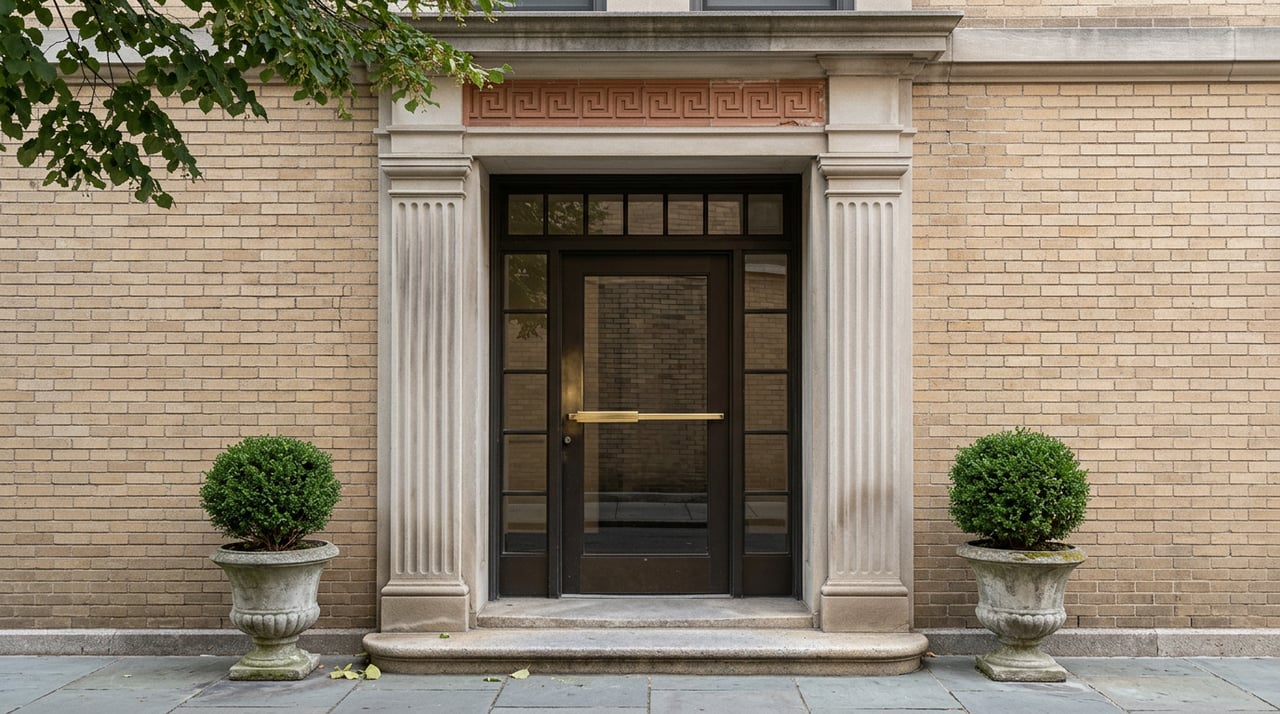
Two Chelsea buyers could sign contracts on the same afternoon this month. One is buying into a prewar line at London Terrace Towers on West 23rd Street. The other is closing on a unit eight blocks west at 100 Eleventh Avenue. Both will hand their attorneys a stack of financial documents. Only one of them is protected by a law that took effect just two weeks before either signature dries.
That is not a footnote about paperwork. It is the actual boundary of New York City's new co-op board timeline law, and in Chelsea that boundary runs almost exactly along Ninth Avenue.
What Changed on July 28
On July 28, 2026, the Cooperative Application Timeline Law, known in the city's records as Local Law 58, went into effect. The City Council passed it by a 46-2 margin in December 2025, then overrode a veto from then-Mayor Eric Adams before it could take hold. NY1 reported that the statute now requires management companies to acknowledge a purchaser's application within 15 days, and once that application is deemed complete, the board has 45 days to approve or deny the sale.
The mechanics matter more than the headline. A board or managing agent has 15 days to confirm, in writing, by both email and registered mail, whether a submitted package is complete. Silence past that window does not stall the buyer. It deems the application complete automatically, and the 45-day decision clock starts whether or not anyone on the board has looked at it. Once that clock is running, the board can take one 14-day extension without asking. Anything beyond that needs the buyer's written consent, not a unilateral decision by the co-op. Boards that want to slow down for the summer can adopt a written recess policy tolling both deadlines through July and August, but only if that policy existed on paper before July 28 and was disclosed to applicants ahead of time. Gallet Dreyer & Berkey's summary of the law lays out those extension and recess provisions in detail for boards preparing to comply.
None of this guarantees a yes. A board that blows through 45 days does not hand the buyer an apartment. It triggers a complaint to the city's Department of Housing Preservation and Development and fines starting at $1,000 for a first violation, climbing for repeat offenses. The board can still say no, and it still does not have to explain why.
"This is a change that boards are paying attention to."
That is Peter Massa, a real estate attorney, describing the law's early effect on co-op governance in reporting from Brick Underground. Boards are paying attention because, for the first time, there is something to comply with.
Where the Line Falls in Chelsea
East of Ninth Avenue, Chelsea is still overwhelmingly the kind of housing this law was written to reach. The largest concentration sits at London Terrace Towers, four ornate corner buildings occupying the full block between Ninth and Tenth Avenues, from West 23rd to West 24th Street. Built in 1929 and 1930 for developer Henry Mandel and designed by Farrar & Watmough, the complex converted from rental to cooperative ownership in the 1980s and today holds roughly 700 co-op apartments across those four towers, according to building history documented on Wikipedia. Pied-a-terre purchases, gifts, and subletting are all permitted at the building, which matters here because Local Law 58 does not stop at ordinary sales. It defines a covered application broadly enough to reach gifts and trust transfers along with standard purchases, so the same 15-and-45-day clock now applies to more than a straightforward buyer writing a check.
Walk eight or nine blocks west toward the High Line and the housing stock flips almost entirely to condominium. The Jean Nouvel-designed tower at 100 Eleventh Avenue, HL23 cantilevered directly over the elevated park, the Art Deco conversion at Walker Tower where a penthouse once sold for $50.9 million, and Lantern House by Thomas Heatherwick are all condos. None of them, and no other condo building in Chelsea, falls under Local Law 58. The statute's coverage is written around cooperative corporations specifically. Condo boards of managers, sponsor sales, and every closing in those buildings proceed exactly as they did on July 27.
| East Chelsea co-ops (London Terrace Towers and similar prewar stock) | West Chelsea condos (100 Eleventh, HL23, Walker Tower, Lantern House) | |
|---|---|---|
| Ownership structure | Shares in a corporation with a proprietary lease | Deeded real property |
| Covered by Local Law 58 | Yes, for buildings with 10 or more units | No, condominiums are exempt |
| Board review before July 28, 2026 | Open-ended, no statutory deadline | Administrative review, generally no interview |
| Typical 2026 price per square foot | Roughly $1,400 to $2,200 | Roughly $2,800 to $4,500 and up |
A Deadline Is Not a Guarantee
The law regulates the clock, not the outcome. Boards keep full discretion to reject a buyer for any lawful, non-discriminatory reason, and they are still not required to say why. A separate bill, the Fair Residential Cooperative Disclosure Law, would force boards to disclose written reasons for a denial, but as of this writing it has not been enacted. The coverage carve-outs matter too. Buildings with fewer than 10 units, HDFC cooperatives, and Mitchell-Lama developments sit entirely outside the law's reach, so a small nine-unit conversion just off Ninth Avenue faces no new obligation at all.
The Trade Chelsea Buyers Are Actually Making
Part of the price gap between a Chelsea co-op and a Chelsea condo has never been about square footage or finishes alone. Co-ops typically trade 15 to 30 percent below comparable condos in the same neighborhood, a discount that reflects board discretion and financing restrictions as much as anything about the apartment itself. A meaningful piece of that discount has always been a risk premium: the chance that a complete board package sits untouched for four months with no obligation on anyone's part to move it forward, or that a mortgage rate lock expires while a buyer waits for a board meeting that was never scheduled.
Local Law 58 does not remove that risk. It puts a ceiling on the open-ended part of it. A buyer weighing a London Terrace listing against a 100 Eleventh listing this fall is now comparing a bounded, if still real, uncertainty against a premium of $1,000 or more per square foot for a product that was never exposed to board discretion in the first place. That comparison did not exist a few weeks ago. It exists now, and it changes what the co-op discount is actually paying for.
The same logic runs in reverse for sellers. A Chelsea co-op owner listing this fall now has something concrete to bring into conversations with a buyer's attorney: a statutory outer limit on how long a complete application can sit, even accounting for extensions and a possible summer recess. That is a different pitch than the open-ended uncertainty co-op sellers have lived with for decades, and it is worth raising early rather than treating as a footnote.
Quick Questions Before You Sign
Does the new law guarantee my Chelsea co-op board will approve my application faster? No. It guarantees a decision within a set number of days, not a favorable one. Boards can still deny an application for any lawful reason and do not have to explain the denial.
I am buying at a West Chelsea building like HL23 or Lantern House. Does any of this touch my closing? No. Condominiums sit entirely outside the law's scope. Your timeline still runs on attorney review, lender underwriting, and the condo board's administrative process, typically weeks rather than months.
What actually happens if my co-op board misses the 45-day deadline? You can file a complaint with the city's Department of Housing Preservation and Development, and the building faces fines starting at $1,000 for a first violation. You do not get the apartment by default. The board still has to say yes.
Choosing between a London Terrace co-op and a High Line condo was never just a style decision, and now it carries a genuinely different legal timeline depending on which one you pick. If you are weighing that trade for a Chelsea purchase or sale this fall, the Blatman Team can walk through what it means for your specific building and timeline. Schedule a personalized consultation before you write an offer.