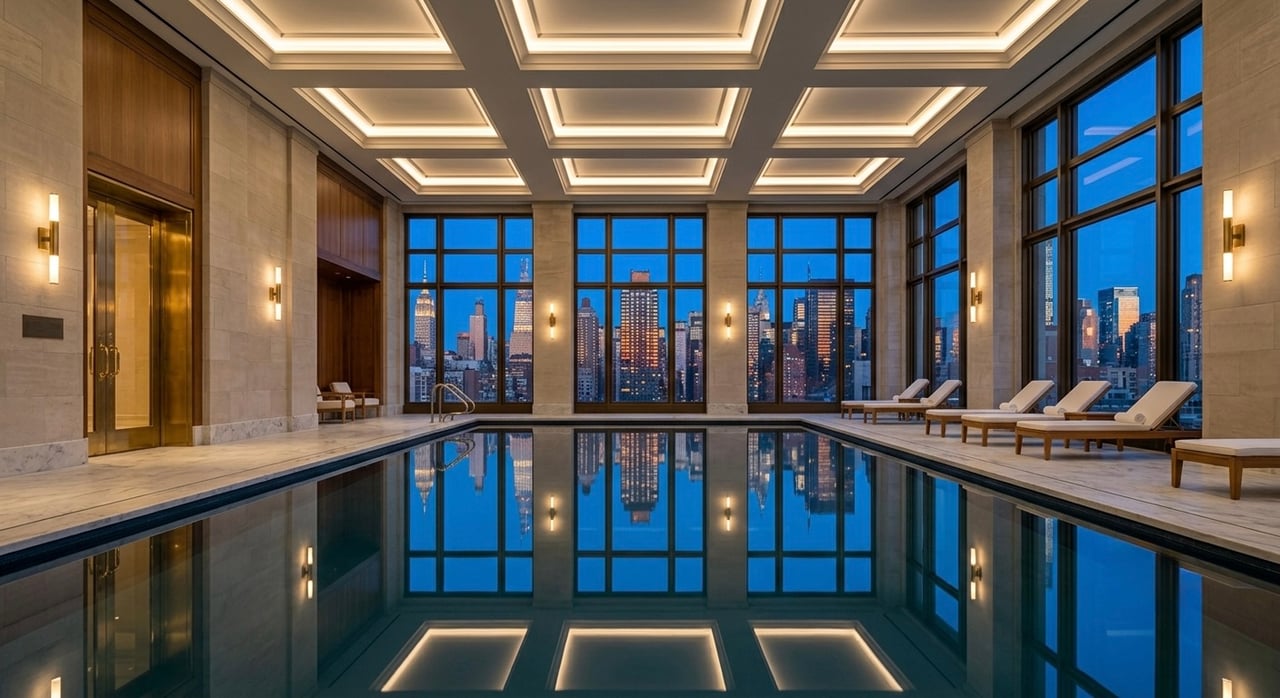
TOP BUILDINGS WITH POOLS
In most cities, a building with a pool is a nice feature. In Manhattan, where land scarcity makes it one of the rarest residential amenities available, a pool is a meaningful differentiator that affects pricing, carrying costs, buyer demand, and the character of daily building life in ways that buyers should understand completely before they pay a premium to access it.
WHAT A POOL ACTUALLY MEANS IN A MANHATTAN BUILDING
The word pool encompasses a range of amenity types in Manhattan buildings that vary significantly in their practical utility, maintenance cost, and contribution to the overall living experience. Understanding which type of pool a building offers, and how it is programmed and maintained, is the first step in evaluating whether the amenity justifies the premium.
Lap pools, designed for serious swimming, are the most operationally useful pool type for residents who intend to use the amenity regularly for fitness. They are also the most expensive to build and maintain, which is reflected in the buildings that include them. Leisure pools, which prioritize atmosphere and visual impact over athletic function, attract residents for whom the amenity is as much about lifestyle signaling as daily use. Rooftop pools, which are among the most visually dramatic amenity configurations available in Manhattan, offer an outdoor experience that varies dramatically with the season and are often more fully utilized as social spaces in summer months than as year-round amenities.
Buyers evaluating buildings with pools through buying a condo in Manhattan should ask not just whether a pool exists but how it is configured, how it is maintained, what hours it operates, and how it is actually used by the building's residents. A pool that is crowded during peak hours in a building with many investor-owned rental units has a different character than a well-maintained lap pool in an owner-occupied building where a smaller resident community manages access comfortably.
WHERE POOL BUILDINGS CLUSTER IN MANHATTAN
Buildings with pools in Manhattan are not evenly distributed across the borough. They cluster in areas where large-scale new development has been possible, where land costs and development economics have supported the construction of the large floor plates and mechanical infrastructure that pool buildings require. The Financial District, Hudson Yards, Battery Park City, Long Island City in Queens, and certain stretches of midtown and downtown Manhattan have seen the greatest concentration of pool building development over the past two decades.
Prewar buildings, which represent a significant share of Manhattan's residential inventory, almost never include pools because the structural and mechanical systems of their era were not designed to accommodate this amenity. Pool buildings in Manhattan are almost exclusively postwar construction, and the majority are products of the development cycles from the 1990s forward, with the most sophisticated pool amenities concentrated in buildings completed in the last fifteen years.
The neighborhood in which a pool building sits affects not just the pool's physical configuration but the building's overall investment profile. A pool building in a neighborhood with strong rental demand, limited comparable inventory, and proximity to major employment centers is a more compelling acquisition than a pool building in a neighborhood where the pool is the primary differentiator and comparable non-pool inventory provides significant competition. Understanding the broader Manhattan real estate market trends that affect the specific submarket is as important as evaluating the pool itself.
THE TRUE COST OF THE POOL AMENITY
A pool is not free to residents, even after the purchase price has been paid. The operational cost of maintaining a pool in a Manhattan building, including water treatment, heating, lifeguard staffing where required, equipment maintenance, and facility management, is substantial and flows directly into common charges. Buyers who are comparing two buildings, one with a pool and one without, will almost always find that the pool building carries meaningfully higher common charges per square foot, and they should evaluate whether the amenity value justifies that carrying cost differential.
A common question is how much more expensive a pool building is to own on a monthly basis than a comparable non-pool building. The differential varies significantly depending on the size of the building, the configuration of the pool facility, and how the building allocates amenity costs across unit types. In general, buildings with pools in Manhattan carry common charges that can be twenty to forty percent higher than comparable buildings without pools in the same neighborhood and price tier. For a buyer who is purchasing primarily for pool access and will use the amenity consistently, this premium may be justified. For a buyer who is purchasing the unit for other reasons and expects to use the pool occasionally, the carrying cost differential deserves careful evaluation.
Buyers should also assess the pool's maintenance condition and the building's track record of investing in pool upkeep. A pool facility that is poorly maintained, operates restricted hours due to mechanical problems, or has been the subject of health code complaints represents a carrying cost without the amenity value the cost implies. Records of building violations, including any related to pool facilities or mechanical systems, are searchable through the New York City Department of Buildings and should be reviewed as part of standard due diligence for any building under serious consideration.
HOW POOL AMENITIES AFFECT RESALE VALUE AND BUYER DEMAND
A pool building's resale dynamics are distinct from those of comparable non-pool buildings in two ways simultaneously. First, the pool creates a specific buyer segment that actively seeks this amenity and will pay a premium to access it, which supports pricing above comparable non-pool inventory in the same neighborhood and price tier. Second, the higher common charges associated with pool buildings narrow the overall buyer pool to those who can comfortably sustain the elevated carrying costs, which can reduce liquidity relative to buildings with lower monthly costs.
Sellers in pool buildings benefit from marketing specifically to the buyer segment that values the amenity, which means ensuring that listing photography and descriptions feature the pool facility prominently and accurately. A buyer who purchases in a pool building and treats the pool as incidental to their purchase decision is not capturing the full value the amenity represents at resale.
Buyers should also evaluate the pool's competitive positioning within the building's immediate peer group. A pool building that competes directly with several other pool buildings in the same submarket, each offering comparable or superior pool facilities, has a different amenity value story than a pool building that is one of a limited number in its neighborhood and price tier. Scarcity of the amenity relative to buyer demand for it is what sustains the pricing premium over the long term.
BUILDING QUALITY BEYOND THE POOL
The most common mistake buyers make when evaluating pool buildings in Manhattan is allowing the pool amenity to dominate the evaluation at the expense of the building characteristics that determine long-term value. A spectacular pool in a building with underfunded reserves, questionable management, a non-cooperative board, and an investor-heavy ownership profile is a spectacular pool in a problematic building, and no pool makes a problematic building a sound investment.
Buyers are often asked what they should prioritize when a pool building excites them but the building-level fundamentals give them pause. The answer is consistent: the building fundamentals should be evaluated on their own merits as if the pool did not exist. If the building passes that evaluation, the pool is a genuine value-add. If the building does not pass that evaluation, the pool is a distraction.
Building financial health, reserve fund adequacy, management quality, board governance, and lender eligibility are the characteristics that determine whether any Manhattan building is a sound acquisition. For pool buildings, these characteristics are supplemented by the pool facility's specific maintenance condition, operational quality, and the financial integrity of how amenity costs are allocated and managed within the building's budget.
The reserve fund analysis for a pool building should specifically address whether the pool facility's major capital components, including the pool structure, filtration systems, heating infrastructure, and enclosure or rooftop structure, are adequately funded within the reserve. Pool facilities have defined useful lives and require capital replacement on a timeline that a well-managed building's reserve study will have projected and funded. A building where the pool facility's capital replacement has not been specifically addressed in the reserve plan is a building where a future special assessment related to pool renovation is a meaningful probability.
MANAGEMENT QUALITY AND POOL PROGRAMMING
A pool is only as good as the management team responsible for it. In Manhattan buildings with pools, the quality of the building's property management company, and specifically their track record of operating and maintaining pool facilities, is a more consequential factor than it would be in a building without this amenity. A management company that is experienced with residential pool operations will maintain the facility at a standard that justifies the carrying cost premium. A management company that treats the pool as one item on a long facilities checklist will produce a pool that is technically functional but not well-maintained or well-programmed.
Buyers should ask the building's management team specifically about pool operations: what hours the pool is open, whether lifeguard staffing is provided, how the facility is reserved or accessed during peak periods, what the maintenance schedule looks like, and whether any planned renovations or capital projects related to the pool are anticipated in the near term. These questions distinguish between buyers who are evaluating the pool seriously and those who are treating it as a checkbox, and the quality of the answers reveals whether the building is managing the amenity with the same seriousness.
For luxury buyers evaluating pool buildings as part of a broader Manhattan search, the guidance available through Daniel Blatman's NYC real estate expertise provides the building-level intelligence and market context that separates the pool buildings worth the premium from those where the amenity looks better on the listing than it functions in daily life.