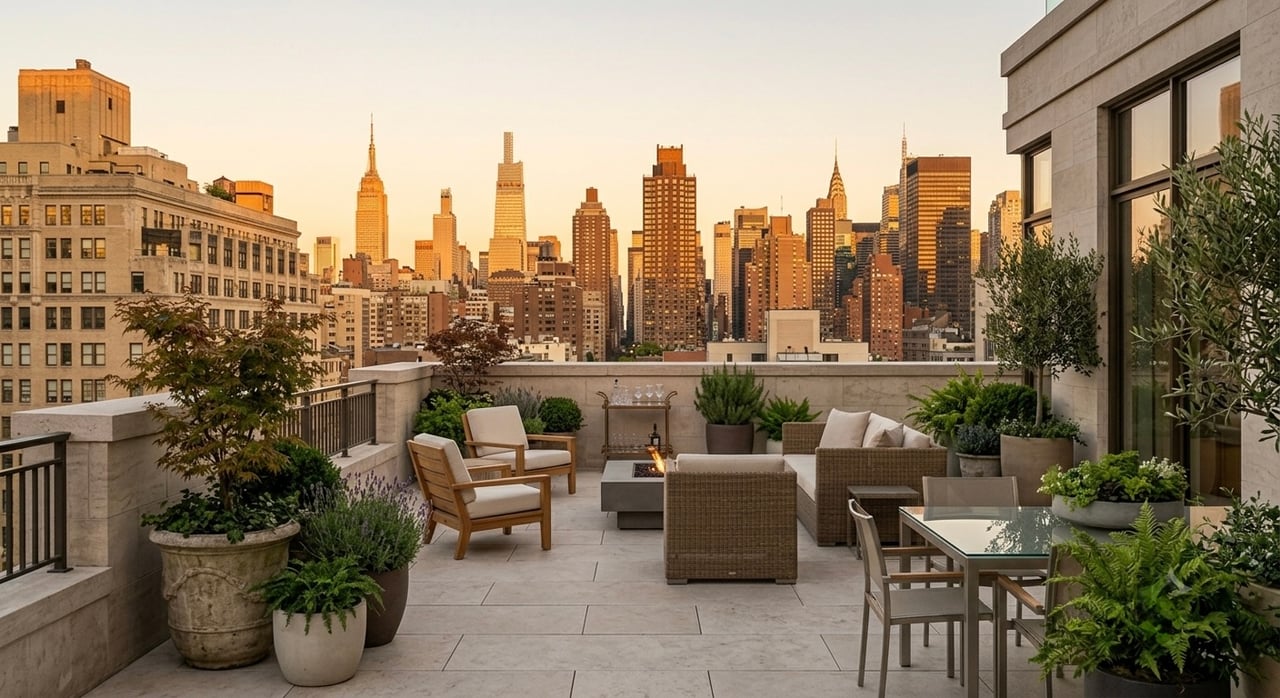
TOP BUILDINGS WITH TERRACES
Private outdoor space in Manhattan is not just an amenity. It is one of the borough's most structurally constrained commodities, produced by the interaction of zoning setback requirements, building massing, and the rare instances where a developer has left usable outdoor space at the unit level rather than converting every square foot to interior selling area. Buyers who want it pay a premium for it. What they often do not fully understand is exactly what they are buying, who is responsible for it, and what happens when something goes wrong.
WHAT TERRACE ACTUALLY MEANS IN A MANHATTAN CONTEXT
The word terrace in a Manhattan listing can refer to several distinctly different types of outdoor space, each with different ownership structures, maintenance obligations, and practical utility. Understanding which type is being offered is essential before a buyer places any financial value on the outdoor space component of an apartment.
A private terrace attached to an individual unit is the most common and most valuable form of private outdoor space in Manhattan residential buildings. These terraces are typically created by the setback of upper floors from the building's street-facing or rear facade, creating an outdoor platform that is directly accessible from the unit below. Private terraces of this type may be owned outright as part of the unit in a condominium, or they may be allocated to the shareholder through the proprietary lease in a co-op, where ownership of the terrace remains technically with the cooperative corporation.
Wrap terraces, which surround two or more sides of a unit and offer exposure in multiple directions, are among the most sought-after outdoor configurations in Manhattan and command the strongest premiums among terrace types. They are also the most demanding from a maintenance standpoint, as their larger surface area and complex perimeter require more active upkeep and more frequent attention to waterproofing integrity.
Buyers evaluating terrace apartments through buying a condo in Manhattan should request specific documentation of the terrace's ownership structure, its exact square footage, and the maintenance and repair obligations that attach to it before making an offer. These details are contained in the unit's deed or proprietary lease, the building's offering plan, and any terrace-specific maintenance agreements or riders that may have been adopted over the building's history.
THE PREMIUM OUTDOOR SPACE COMMANDS AND HOW TO EVALUATE IT
Private outdoor space in Manhattan commands a price premium that varies significantly by terrace size, orientation, views, and the neighborhood and building in which it is located. As a general principle, buyers pay less per square foot for terrace square footage than for interior square footage in the same building, reflecting the fact that outdoor space has a lower utility ceiling than climate-controlled interior space and carries its own maintenance obligations. The exact ratio varies widely by market conditions and specific terrace characteristics.
A common question is whether a larger terrace commands a proportionally larger premium. Not always. There is often a diminishing premium per square foot of terrace as size increases, reflecting the practical reality that most residents cannot meaningfully use more than a certain amount of outdoor space for their daily lifestyle. A four hundred square foot terrace may command a substantial premium. A fifteen hundred square foot terrace in the same building may not command proportionally more, because the marginal utility of additional terrace square footage decreases beyond what a resident can actively program and maintain.
Terrace orientation and views are among the most significant drivers of outdoor space value in Manhattan. A terrace with an unobstructed open city view to the south captures year-round sunlight and holds a premium that a comparable north-facing terrace cannot match. A terrace with protected views, where neighboring construction cannot legally reach heights that would obstruct the current outlook, offers a durability of value that view-dependent terraces in areas of active development cannot guarantee.
MAINTENANCE OBLIGATIONS AND WHO IS RESPONSIBLE
The question of who is responsible for terrace maintenance and repair is one of the most consequential due diligence questions for any buyer of a terrace apartment in Manhattan, and one that is addressed very differently depending on the building's ownership structure, the age and condition of the terrace, and the specific language of the governing documents.
In most Manhattan buildings, the terrace surface and the immediately accessible components of the outdoor space are the unit owner's responsibility. The structural components of the terrace, including the waterproofing membrane below the surface material, the drains, and the concrete substrate, are typically the building's responsibility. This distinction matters significantly because waterproofing failures in Manhattan terraces, which are common in older buildings and in terraces that have not been regularly maintained, are one of the most expensive and contentious repair scenarios a terrace apartment owner can face.
Sellers often ask why buyers are so focused on the waterproofing documentation when evaluating a terrace apartment. The answer is that a waterproofing failure on a high-floor terrace causes damage not only to the terrace unit itself but potentially to units below it, and the cost of replacement can easily run into six figures on larger terraces. A terrace with a waterproofing membrane that has not been replaced within the last fifteen to twenty years is a terrace where the risk of imminent failure is elevated, and the question of who bears the cost of replacement should be resolved before the purchase, not after the failure.
Terrace maintenance responsibilities are typically documented in the building's house rules, the proprietary lease for co-ops, and any terrace-specific riders attached to the purchase. Buyers should have their attorney review these documents specifically for the maintenance allocation before contract execution. Additional guidance on building maintenance standards and responsibilities in New York City residential buildings is available through regulations administered by the New York City Department of Buildings, which oversees structural safety standards and complaint records for all residential properties in the five boroughs.
TERRACE USE RESTRICTIONS AND WHAT THEY LIMIT
Many Manhattan buildings with private terraces impose use restrictions that limit what owners can do with their outdoor space. These restrictions are typically established in the house rules, the proprietary lease, or the condo bylaws and may include limitations on the type of furniture allowed, prohibitions on barbecuing, restrictions on the installation of planters or garden beds above a specified weight, noise limitations during evening hours, and prohibitions on structural modifications to the terrace surface or parapet.
Buyers often ask whether these restrictions are commonly enforced or generally ignored. The answer depends on the specific building and its governance culture. A building with an active and engaged board that applies house rules consistently will enforce terrace restrictions in the same way it enforces other building standards. A building with less engaged governance may allow terrace use that technically violates the rules but has been tolerated historically. Buyers who are purchasing a terrace apartment with specific plans for how they intend to use the outdoor space should confirm that those uses are permitted before assuming the restrictions are merely aspirational.
The most consequential restriction for many buyers is the prohibition on structural modifications. A buyer who intends to install a pergola, a permanent planters, or a hardscaped area beyond the terrace's current configuration should confirm that these modifications are permitted by the building and, where applicable, by the New York City Department of Buildings before including them in their purchase plans. Unpermitted structural modifications to terraces can create liability for the unit owner, require removal at the owner's expense, and complicate future sales of the unit.
THE DUE DILIGENCE PROCESS FOR A TERRACE APARTMENT
Buying a Manhattan apartment with a private terrace requires a more extensive due diligence process than a comparable interior unit, because the terrace adds a set of physical, legal, and financial variables that have no equivalent in a standard unit purchase.
The physical inspection of a terrace apartment should specifically address the condition of the waterproofing membrane, the integrity of the drainage system, the condition of the terrace surface and any existing furniture or planters, the structural condition of the parapet or railing system, and the absence of any visible water intrusion into the unit below the terrace or into adjacent units. A general real estate inspection may cover these items superficially. For a terrace of any size or age, a specialized waterproofing inspection by a contractor with specific experience in New York City terrace systems is worth the additional cost.
A common question is whether the seller is required to disclose known waterproofing issues before the purchase contract is executed. Under New York's disclosure framework, sellers of covered property types are required to disclose known material defects, and a documented waterproofing problem would typically fall within this obligation. The specific disclosure requirements for co-op and condo sales are shaped in part by standards maintained by the New York State Department of State, which governs real estate licensee conduct and transaction standards. Buyers should ensure that their attorney specifically requests disclosure of any known terrace condition issues as part of the attorney review process.
HOW TERRACE APARTMENTS PERFORM AT RESALE
Terrace apartments in Manhattan have historically sold at premiums relative to comparable interior units in the same building, and the premium has generally held up well through market cycles because the supply of private outdoor space is structurally constrained. A building that offered a terrace unit twenty years ago offers the same number of terrace units today, because the supply of private outdoor space in the building cannot be increased.
This supply constraint supports long-term pricing stability in a way that amenities that can be replicated or added to buildings over time do not. A building that adds a gym can match a competing building's fitness amenity. A building cannot add private terraces to units that were not designed with them. This irreproducibility is part of what makes terrace apartments a durable value proposition in the Manhattan resale market.
Sellers of terrace apartments should ensure that the outdoor space is properly prepared and staged for listing photography and showings. A terrace that is shown to its best advantage, with clean and maintained outdoor furniture, potted plants where appropriate, and photography taken at the time of day that best captures the light and views, communicates the full value of the outdoor space in a way that an untended or unstaged terrace does not.
Understanding how specific terrace configurations are currently being valued in the market, and what comparable terrace apartments have achieved at resale, is the market intelligence that allows buyers to evaluate whether the premium being asked for a specific terrace is justified. Tracking the broader Manhattan real estate market trends for outdoor space premiums across building types and neighborhoods provides this context for buyers and sellers who want to evaluate terrace value with data rather than intuition.
For buyers navigating the specific due diligence requirements of a terrace purchase and wanting to understand what the current market supports for outdoor space in their target neighborhood and price range, the market expertise available through Daniel Blatman's NYC real estate expertise connects the search to the building-level knowledge that makes this evaluation complete rather than cursory.