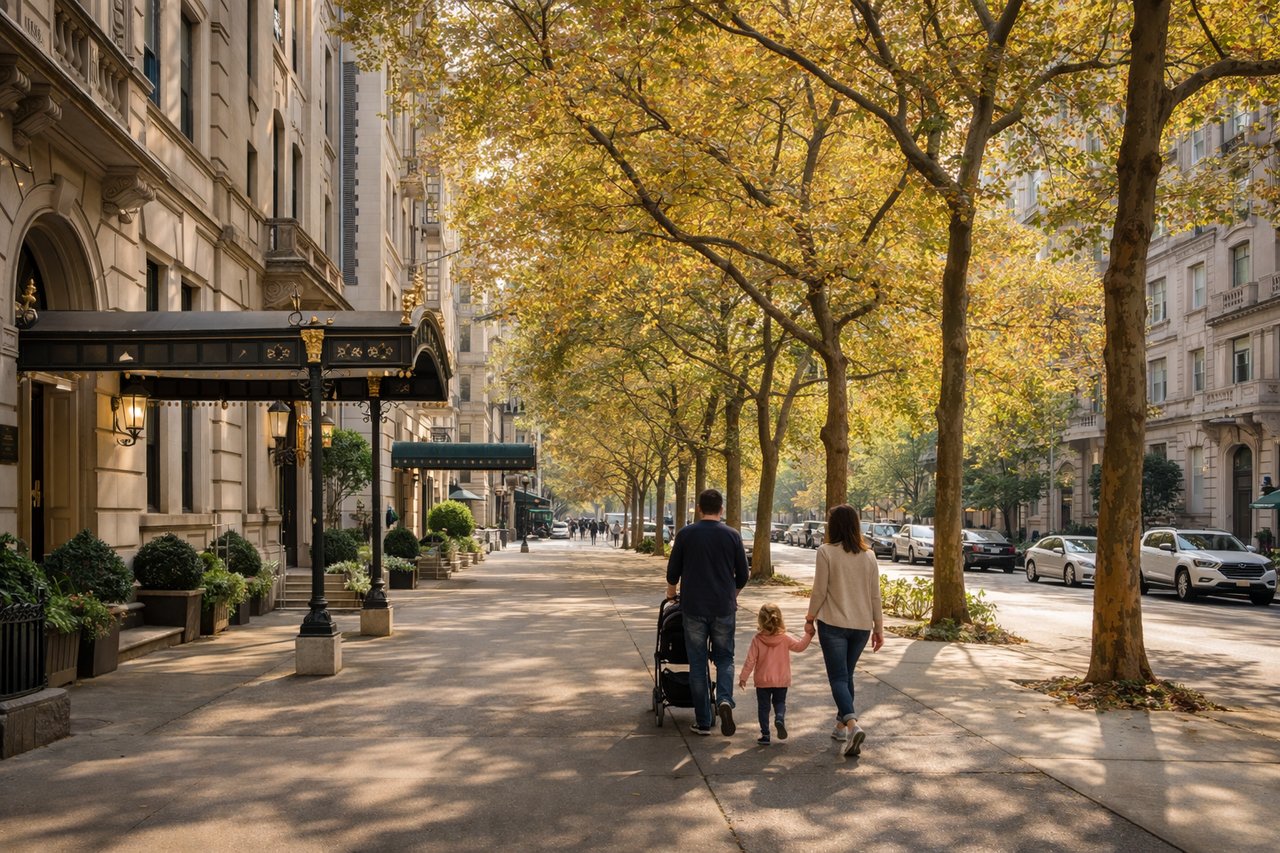
UPPER WEST SIDE: BEST BUILDINGS FOR FAMILIES
The Upper West Side has been Manhattan's preeminent family neighborhood for the better part of a century. The reasons are structural, not sentimental: Central Park and Riverside Park provide year-round green space that no other Manhattan neighborhood can match. The public school system in District 3 includes some of the city's most sought-after elementary schools. The prewar building stock offers the kind of spatial generosity—large rooms, high ceilings, deep closets, windowed kitchens—that families need and that newer construction rarely provides at comparable scale. And the neighborhood's commercial infrastructure, from grocery stores to pediatricians to weekend activities, is calibrated to the daily rhythms of family life in a way that few other Manhattan districts can sustain.
For buyers searching for the right family building on the Upper West Side, the challenge is not finding options. It is identifying the specific combination of space, location, building quality, school zone, and financial structure that aligns with how your family actually lives. This guide addresses each of those variables in detail.
PREWAR CO-OPS: WHERE MOST FAMILIES LAND
The Upper West Side's residential stock is dominated by prewar co-operative apartment buildings—the grand Central Park West towers, the solid brick buildings lining West End Avenue and Riverside Drive, and the classic six and seven configurations that fill the side streets between Columbus and Amsterdam Avenues. For families, these co-ops offer a combination of space and value that is difficult to match elsewhere in Manhattan.
The physical characteristics of a well-maintained prewar co-op are ideally suited to family life. Rooms are proportioned for furniture and activity, not just display. Hallways are wide enough for strollers and scooters. Kitchens, while sometimes in need of renovation, are typically separate from living spaces—a feature that families with young children value more than open-plan enthusiasts might expect. Ceiling heights of 9 to 10 feet are standard, and many prewar buildings offer storage rooms, laundry facilities, and bike rooms that ease the logistical demands of raising children in the city.
Buyers frequently ask: Are Upper West Side co-op boards family-friendly? The overwhelming majority are. Unlike some buildings in other neighborhoods that impose restrictions discouraging families—such as prohibitions on children under a certain age or limitations on the number of occupants—Upper West Side co-ops have long welcomed families as their core demographic. Boards in family buildings are often composed of parents themselves and evaluate applicants with an understanding of the financial realities and lifestyle needs of growing households.
The financial requirements for co-op purchase remain significant. Most Upper West Side co-ops require a minimum down payment of 20 to 25 percent, with many of the more desirable buildings expecting 25 to 50 percent. Post-closing liquidity requirements of one to two years of carrying costs are standard. The New York State Attorney General's guidance on co-op and condo purchases outlines the legal framework and disclosure requirements that govern these transactions.
FULL-SERVICE CONDOS: THE ALTERNATIVE FOR FLEXIBILITY
While co-ops dominate the inventory, the Upper West Side also offers a selection of full-service condominiums—both in newer developments and in converted buildings—that appeal to families seeking ownership flexibility.
Condo ownership eliminates the board approval process, permits subletting without restriction in most buildings, accommodates corporate and trust ownership structures, and provides fee-simple title that simplifies financing and resale. For families who may need to relocate for work, who are purchasing with international financing, or who want the option to rent the apartment during an extended absence, a condo offers structural advantages that co-ops do not.
The trade-off is price. Condos on the Upper West Side trade at a materially higher price per square foot than comparable co-ops, and monthly carrying costs—common charges plus separately billed property taxes—are typically higher as well. Families evaluating the co-op versus condo decision should model total cost of ownership across their expected holding period, factoring in purchase price, closing costs, monthly charges, and the financial implications of each building's specific rules.
Buyers should confirm whether each building has filed for the Cooperative and Condominium Property Tax Abatement, which reduces annual property taxes by up to 28 percent for eligible primary-residence owners. The NYC Department of Finance's Property Tax Benefits page provides detail on all available exemptions and programs. Co-op buyers avoid the NYC Mortgage Recording Tax, a saving of 1.8 to 1.925 percent of the loan amount that can exceed $20,000 on a typical Upper West Side purchase.
SCHOOL ZONES: THE VARIABLE THAT MOVES MARKETS
On the Upper West Side, public school zoning is not a secondary consideration. It is a primary driver of where families buy and what they are willing to pay. The neighborhood falls within NYC Department of Education District 3, which stretches from 59th Street to 122nd Street on the west side of Manhattan and includes some of the city's most competitive elementary schools.
School zones are determined by home address, and the boundaries can shift. A building on one side of a cross street may be zoned for a different school than the building directly across the avenue. For families with school-age children or children approaching kindergarten age, confirming the zoned school before making an offer is not optional—it is foundational. The NYC DOE's Find a School tool allows buyers to enter a specific address and identify the zoned elementary and middle schools.
Buyers often wonder: Does buying in a strong school zone guarantee admission? For zoned elementary schools, yes—children living within the zone have a right to attend their zoned school. However, demand for the most sought-after schools means that the buildings within those zones command premium pricing, and buyers should expect that school-zone value is already reflected in asking prices. An experienced agent can quantify the premium associated with specific school zones and help buyers determine whether the educational value justifies the incremental cost.
WHAT MAKES A BUILDING WORK FOR FAMILIES
Beyond square footage and bedroom count, the characteristics that distinguish a family-appropriate building from one that merely has enough rooms are specific and evaluable.
Laundry facilities matter. Buildings with in-unit washer/dryer hookups or well-maintained basement laundry rooms reduce the logistical burden of a task that families perform constantly. Storage matters. A building with individual storage cages or rooms provides space for strollers, seasonal gear, sports equipment, and the accumulation of possessions that accompanies children. Elevator service matters. A building with multiple elevators and responsive maintenance minimizes the daily friction of moving a family between floors. Outdoor space matters. A building with a courtyard, rooftop terrace, or immediate proximity to a park provides the kind of regular outdoor access that children need and that ground-floor retail cannot substitute.
Staff quality matters as well. A doorman who knows your children by name, a superintendent who responds promptly to maintenance requests, and a management company that keeps the building's finances healthy and its common areas clean all contribute to the daily experience of raising a family in a Manhattan apartment building.
CENTRAL PARK AND RIVERSIDE PARK: THE INFRASTRUCTURE THAT CANNOT BE REPLICATED
The Upper West Side is bounded by two of the city's most significant public parks. Central Park, to the east, provides 843 acres of landscaped green space, playgrounds, ball fields, the Central Park Zoo, and seasonal programming that serves families year-round. Riverside Park, to the west, stretches four miles along the Hudson River from 72nd Street to 158th Street, offering playgrounds, sports facilities, a waterfront esplanade, and the kind of open sky and water views that no interior amenity can replace.
For families, proximity to these parks is not a luxury. It is infrastructure—the kind of permanent public asset that sustains property values, supports daily quality of life, and distinguishes the Upper West Side from neighborhoods where green space is measured in square feet rather than acres. Buildings between Central Park West and Riverside Drive offer families the rare advantage of being within a short walk of both parks simultaneously.
THE HISTORIC DISTRICT: WHAT IT MEANS FOR BUYERS
Much of the Upper West Side sits within the boundaries of the Upper West Side/Central Park West Historic District, designated by the NYC Landmarks Preservation Commission in 1990. This is one of the largest historic districts in Manhattan, encompassing thousands of buildings from 62nd Street to 96th Street between Central Park West and Amsterdam Avenue.
For buyers, the historic district provides long-term value protection by preserving the architectural character and streetscape coherence that define the neighborhood. It also means that exterior work on buildings within the district—window replacement, facade restoration, rooftop additions—requires approval from the Landmarks Preservation Commission. Interior renovations are not subject to LPC review.
Families considering renovation should factor LPC review timelines into their planning, particularly for window replacements or the installation of exterior HVAC units. The regulatory framework is a net positive for property values, but it requires awareness and preparation.
PRICING AND WHAT FAMILIES SHOULD EXPECT
Upper West Side pricing for family-sized apartments—three bedrooms and above—varies significantly by location, building type, and condition. A three-bedroom prewar co-op in a solid but unrennovated building on a side street between Columbus and Amsterdam may trade between $1.2 and $2 million. The same configuration in a prime Central Park West building with park views can exceed $4 million. New-construction condos with three or more bedrooms typically start above $3 million and can reach well beyond $5 million for premium product.
Transaction history for individual properties is searchable through the NYC Department of Finance's ACRIS system, which provides access to deeds, prior sale prices, and mortgage records. An agent who understands the Upper West Side's block-by-block pricing patterns—and how school zones, park proximity, and building quality interact to determine value—provides the kind of granular intelligence that generic market data cannot replicate.
The buyer's guide at danielblatman.com is structured around this kind of building-level, neighborhood-specific analysis. The neighborhood profiles provide current market context for the Upper West Side and adjacent areas.
THE BOTTOM LINE
The Upper West Side earns its reputation as Manhattan's premier family neighborhood not through marketing but through fundamentals: the prewar building stock that provides the space families need, the public school system that provides educational options few Manhattan neighborhoods can match, the two major parks that provide daily outdoor access, and the commercial and cultural infrastructure that supports the rhythms of family life.
Choosing the right building within this neighborhood requires evaluating not just the apartment but the school zone, the building's financial health, the staff quality, the amenity package, and the long-term trajectory of the specific block and building. These are the variables that separate a good family purchase from one that families outgrow or regret.
For buyers navigating this decision, Daniel Blatman provides the neighborhood expertise, building-level intelligence, and financial modeling that Upper West Side family purchases demand.