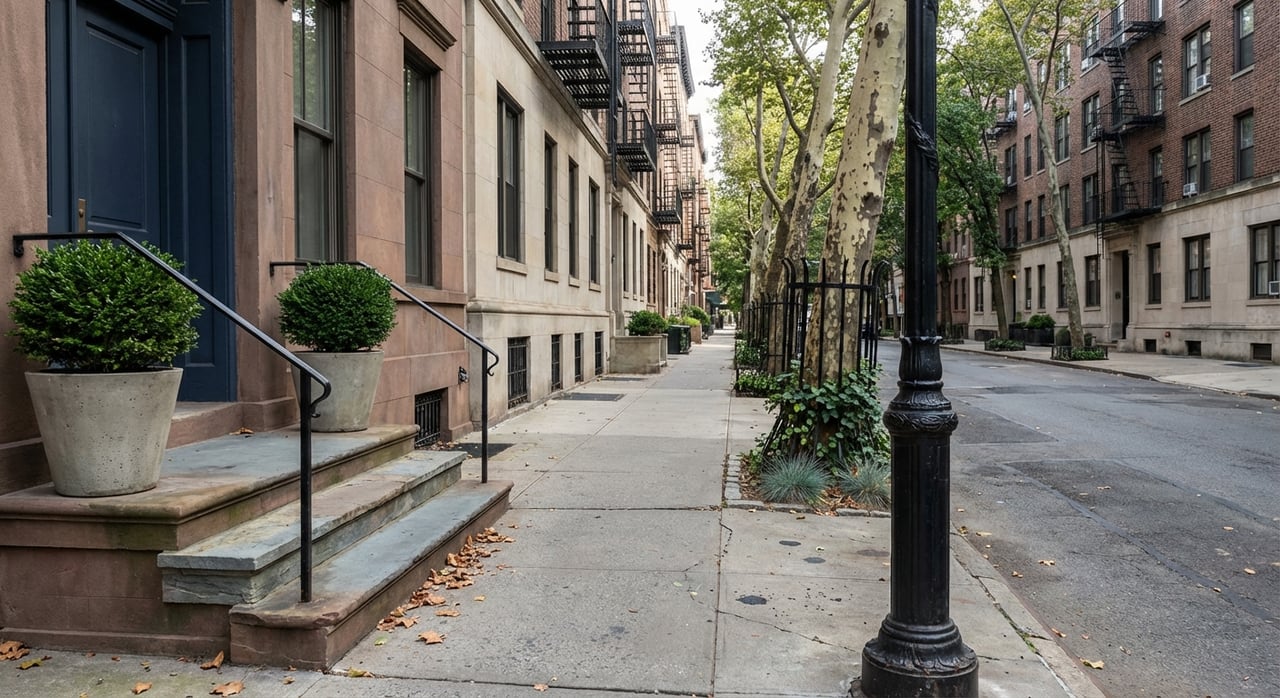
Want quiet, tree-lined streets without giving up museums, parks, and easy subway access? The Upper West Side gives you both: calm, residential blocks just steps from big-city amenities. If you are sizing up the neighborhood for a move, you want a clear picture of housing types, price expectations, and how daily life actually works. This guide gives you a grounded overview, plus practical buyer tips you can use right away. Let’s dive in.
Upper West Side at a glance
The Upper West Side sits between Central Park and the Hudson River, from West 59th Street to West 110th Street, within the area served by Manhattan Community Board 7. You can confirm the footprint and civic resources through the board’s official site at the Manhattan Community Board 7 page. It is a dense, primarily residential district with strong property values and excellent access to transit and daily services.
Average commute times hover around 31 minutes, and many households do not own a car, which speaks to walkability and subway coverage. You can see these commute and transportation patterns in the district’s DataUSA profile. Together, these fundamentals help explain why the neighborhood attracts buyers who want calm blocks and quick citywide connections.
Housing types you will see
Prewar architecture defines much of the Upper West Side. You will tour classic co-op buildings with larger rooms and thick walls, brownstone and townhouse rows on side streets, and a selection of later high-rise condominiums near Lincoln Center and along key corridors. Many buildings sit within historic districts that preserve the look and scale of the streetscape, notably along Central Park West and Riverside Drive, as documented by LandmarkWest and the Historic Districts Council.
Prewar co-ops
Expect gracious layouts, hardwood floors, original millwork, and doorman service in many cases. Maintenance charges can be higher than in some newer condos because of staffing, amenities, and building-scale capital needs. Board approval is standard, and renovations may require extra planning in landmarked contexts.
Townhouses and brownstones
Side streets west of Central Park West and near Riverside Park feature rows of brownstones and historic townhouses. You will find single-family homes, multi-unit buildings, and owner-occupied rentals. These blocks feel residential and quiet while still close to avenues for shopping and transit.
Condominiums
Condo options cluster near Lincoln Square, Columbus Circle, and a few river-adjacent sites. Inventory ranges from 1980s and 1990s towers to recent luxury buildings. If you want a move-in-ready, modern condo with flexible ownership rules, expect focused competition for the best units.
Prices and current market signals
Recent neighborhood snapshots place typical home values in the low-to-mid $1 million range. Exact figures vary by data source and product type, but that band will help you frame budgets and trade-offs.
A bigger driver today is limited new condo supply. Reporting in 2025 highlighted a sharp slowdown in new condominium deliveries on the UWS, which tends to keep competition elevated for renovated resale and truly turnkey product. See the industry analysis on the Habitat Magazine overview of UWS condo pipeline decline for context on scarcity dynamics.
Co-op vs condo strategy
Co-ops make up a large share of older inventory across central Manhattan, and the UWS follows that pattern. Co-ops often cost less up front than newer condos, but they come with board approval, stricter financing and liquidity requirements, and sublet limits. Condos are fewer, generally newer, and allow more flexible ownership structures, which is why they often command a premium.
Decide early whether you are comfortable with the co-op process or you truly need condo flexibility. On the UWS, that decision narrows your search, clarifies your budget, and sets realistic timing for board and closing milestones.
Quick rules of thumb
- If you want space and prewar character: co-ops and townhouses dominate that lane.
- If you need flexible ownership or a pied-à-terre: target condos, but budget for a premium.
- If you need turnkey and modern: act fast on renovated co-ops and newer condos, since inventory is tight.
Daily life: parks and culture
Two linear parks shape daily routines here. Central Park frames the east, and Riverside Park runs along the Hudson with playing fields, courts, playgrounds, and a long waterfront path. The Riverside Park Conservancy details programming and facilities on its about page. Cyclists and runners also benefit from West Side links to the broader waterfront route, with segments connecting into the Hudson River corridor.
Cultural anchors sit right in the neighborhood. The American Museum of Natural History, Lincoln Center, and the New-York Historical Society create a steady mix of daytime and evening activity. Families appreciate the neighborhood’s many playgrounds and institutions like the Children’s Museum of Manhattan on West 83rd Street. Programs and seasonal events add texture without overwhelming residential side streets.
Shopping and dining corridors
You will do most errands on Broadway, Columbus Avenue, and Amsterdam Avenue. These avenues buzz with markets, cafes, pharmacies, and specialty shops. A classic stop is Zabar’s at 80th and Broadway for prepared foods, coffee, and kitchen gear.
Between avenues, side streets feel much quieter and more residential. That pattern lets you choose your balance: live on a calm block and cut over one or two streets to reach everything you need.
Getting around and commute
Transit coverage is a top UWS advantage. The Broadway line serves 1, 2, and 3 trains, and Central Park West stations serve the B and C. Columbus Circle at 59th Street is a major transfer point connecting A, B, C, D, 1, 2, and 3 trains. You can review the network on the MTA’s neighborhood and subway maps.
Average commute times are about 31 minutes across the district, with a high share of residents relying on public transit or walking. The DataUSA profile reflects those patterns, which is one reason buyers often prioritize proximity to a B or C station on Central Park West or a 1 train stop on Broadway. For crosstown trips, many residents use the M79 SBS or other east-west bus routes.
Where to find quiet vs buzz
If you want calm, focus on side streets west of Central Park West and near Riverside Drive. Landmark protections help keep the architecture intact and the streetscape cohesive, as outlined by the Historic Districts Council. If you prefer to step out to restaurants, markets, and live performance, base your search near Broadway, Columbus, or Amsterdam.
Try this quick filter when touring:
- For quiet: tree-lined side streets, prewar co-ops or townhouses, blocks near Riverside Park.
- For convenience: addresses within two blocks of Broadway, Lincoln Center, or Central Park West stations.
- For turnkey: renovated co-ops or newer condos, especially near Lincoln Square and Columbus Circle.
Buyer checklist for UWS tours
Use this list to compare homes apples to apples:
- Building type: co-op or condo, and how that affects financing, subletting, and closing timeline.
- Landmark status: confirmed or likely historic district location, which shapes renovation scope and approval process. Start with resources like the Historic Districts Council.
- Mechanical systems: central HVAC or window A/C, and age of major components.
- Elevators and service: passenger plus service elevators, staffed entry, and package rooms.
- Financials: recent or pending assessments, reserve strength, and capital plans.
- Layout and light: corner exposures, ceiling heights, and bedroom placement for privacy.
- Noise profile: bedroom windows on side streets vs avenue-facing.
- Commute: distance to B/C or 1/2/3 lines and bus routes you will actually use.
- Outdoor access: proximity to Riverside Park or Central Park, dog runs, and playgrounds.
Is the UWS right for you?
If you want a residential feel without sacrificing access to culture, parks, and transit, the Upper West Side checks those boxes. The housing mix skews prewar and co-op heavy, with targeted condo options where you need modern flexibility. With limited new condo supply, preparation and speed matter for the best turnkey properties.
If you are weighing co-op versus condo, mapping blocks for quiet versus convenience, or calibrating value by micro-location, we can help. The Blatman Team pairs neighborhood-level guidance with step-by-step coaching on board packages, financing, valuation, and negotiation. Schedule a personalized consultation and we will tailor a search to your goals.
FAQs
What are the Upper West Side’s boundaries?
- The neighborhood runs from West 59th Street to West 110th Street, between Central Park and the Hudson River, within the area served by Manhattan Community Board 7.
Are Upper West Side side streets actually quiet?
- Many side streets west of Central Park West and near Riverside Drive are residential and tree-lined, with historic protections that help preserve a calm streetscape.
How competitive are UWS condos in 2026?
- New condo deliveries have slowed, so renovated and turnkey condos tend to draw strong interest. Expect focused competition near Lincoln Square and other amenity-rich spots.
What is the typical UWS commute like?
- The area is served by the 1/2/3 and B/C lines with a major hub at Columbus Circle, and average commute times are about 31 minutes districtwide.
What should first-time UWS co-op buyers expect?
- Plan for board approval, documented finances, and clear renovation plans if needed. Co-ops can offer strong value and space, but timelines and rules are more structured than condos.