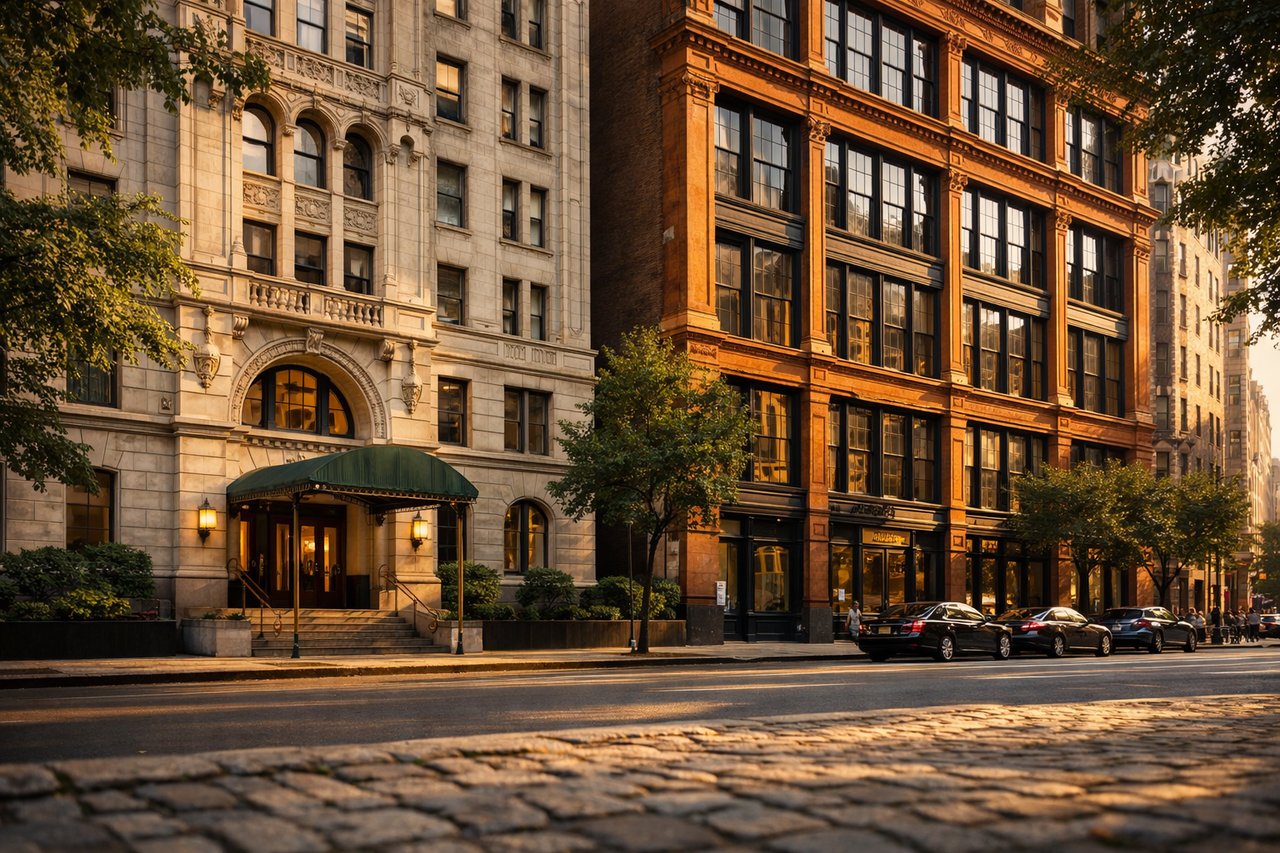
WHAT MAKES A BUILDING ARCHITECTURALLY SIGNIFICANT? WHAT EVERY MANHATTAN BUYER, SELLER, AND INVESTOR NEEDS TO KNOW
In a market where real estate is priced by the block, by the floor, and sometimes by the architect's name on the cornerstone, architectural significance is never just aesthetic opinion. It is a documentable, legally protected, and financially measurable attribute that shapes what a building is worth today and how it performs over decades.
SIGNIFICANCE HAS A LEGAL DEFINITION IN NEW YORK CITY
Architectural significance in Manhattan is not a marketing phrase. It has a formal legal framework administered by the NYC Landmarks Preservation Commission, the largest municipal preservation agency in the United States, which has designated more than 38,000 historic buildings and sites across the five boroughs. A building earns individual landmark status or historic district membership based on its special historical, aesthetic, or architectural value to the city, state, or nation. Once designated, its exterior is legally protected from alteration without LPC review and approval, which means the physical character that created its value is shielded from demolition or material change in perpetuity. For buyers and investors evaluating any Manhattan property with architectural distinction, confirming its designation status with the LPC is a non-negotiable first step in due diligence. Daniel Blatman routinely incorporates landmark status and historic district context into every pricing and negotiation conversation across the submarkets he covers.
THE UPPER EAST SIDE: WHERE AN ARCHITECT'S NAME MOVES MARKETS
No submarket demonstrates the financial value of architectural pedigree more directly than the Upper East Side, where the name Rosario Candela in a listing description functions as a pricing signal that transcends unit size, floor, or current condition. Candela was an Italian-American architect who designed the majority of his landmark projects along Fifth and Park Avenues between the 1920s and early 1940s, and whose limestone buildings, including 740 Park Avenue and 778 Park Avenue, remain the most consistently coveted co-op addresses in the city. His floor plans were designed to persuade wealthy New Yorkers to abandon their private mansions for apartment living: grand entrance galleries, formally separated living and bedroom corridors, dedicated service passages, and ceiling heights that gave each room the volume of a private house. As Corcoran's Inhabit has documented, Candela's buildings have led real estate sales from the 1920s through today and continue to appreciate steadily as the supply of his work remains permanently fixed. Upper East Side home values rose approximately 4 percent in 2025 and are projected to continue on the same trajectory through 2026, with prewar co-ops in prime buildings among the most stable assets in the borough. Reviewing current Upper East Side inventory with attention to building provenance is one of the most productive exercises any buyer in this submarket can complete before making an offer.
TRIBECA: WHERE INDUSTRIAL HISTORY BECAME MANHATTAN'S MOST EXPENSIVE ARCHITECTURE
Tribeca's architectural significance operates on a different logic entirely. The neighborhood's value derives from the conversion of nineteenth-century textile warehouses, spice factories, and commercial loft buildings into residential spaces whose cast-iron facades, timber beams, and oversized industrial windows cannot be replicated anywhere in the city at any price. The neighborhood's most significant buildings are protected by four LPC-designated historic districts covering Tribeca East, West, North, and South, which together preserve the physical character of streets like Franklin, Duane, Worth, and Hudson. That protection has had direct and documented consequences for pricing: median listing prices in Tribeca reached approximately $4.4 million as of late 2025, with buyers explicitly prioritizing architectural pedigree, spatial volume, and long-term value over amenity packages and finishes. According to Q2 2025 market data, Tribeca achieved its highest median sale price since 2019, recording a 43 percent year-over-year growth rate and positioning itself as the second most expensive neighborhood in New York City. Buildings with the strongest architectural provenance drove the top transactions, with full-floor residences in landmark-protected boutique buildings regularly trading above $4,000 per square foot.
WHAT SIGNIFICANCE MEANS FOR RENOVATION, SELLERS, AND AGENTS
Buyers purchasing in architecturally significant buildings should understand from the outset that the regulatory framework protecting those buildings governs renovation work as well. Within LPC-designated landmarks and historic districts, all exterior alterations require a Certificate of Appropriateness before work begins, covering changes as specific as window replacement, masonry repointing, and facade cleaning methods. Interior renovations are generally outside LPC jurisdiction unless the interior itself carries separate designation, but co-op boards in prestigious prewar buildings frequently impose their own alteration agreement standards that are equally detailed. Buyers should request and review the building's alteration agreement and confirm its designation status through the LPC's designations database before closing. Sellers in architecturally significant buildings hold a genuine market advantage, but only when they price against actual comparable sales rather than against the building's reputation. A Candela apartment in poor condition carries the pedigree as a floor, not a ceiling, on its value, and buyers sophisticated enough to pay the premium are sophisticated enough to discount aggressively for deferred maintenance. Agents representing buyers or sellers in either submarket should read the relevant LPC designation report before showing a property. Those reports, publicly available through the commission, contain the architectural histories and significance assessments that make the difference between an informed showing and a superficial one. Sellers seeking a market positioning consultation can start the conversation here.
THE INVESTMENT CASE: SCARCITY, PROTECTION, AND LONG-TERM PERFORMANCE
The investment thesis for architecturally significant Manhattan buildings rests on a straightforward principle: legally protected scarcity produces durable value. There is a fixed supply of Rosario Candela buildings on Park Avenue. There is a fixed supply of nineteenth-century cast-iron warehouses in Tribeca's historic districts. Neither inventory will grow. Demand, sustained by domestic and international buyers who understand what these buildings represent, has held through every market cycle of the past four decades. Manhattan luxury sales reached nearly $12 billion across more than 1,400 contracts in 2025, an 11 percent year-over-year increase, with trophy properties carrying architectural distinction and irreplaceable physical attributes cited as the primary drivers of buyer competition at the upper end of the market. For investors evaluating either the Upper East Side prewar co-op market or Tribeca's landmark loft conversions as long-term positions, the combination of fixed supply, legal protection, and sustained demand from globally mobile capital represents a risk-adjusted return profile that few other residential asset classes can match at comparable price points. Whether you are buying into one of these buildings for the first time, evaluating a listing's true architectural credentials, or positioning a significant property for sale, the decision warrants a broker whose knowledge of both submarkets goes beyond the listing sheet. That conversation starts here.