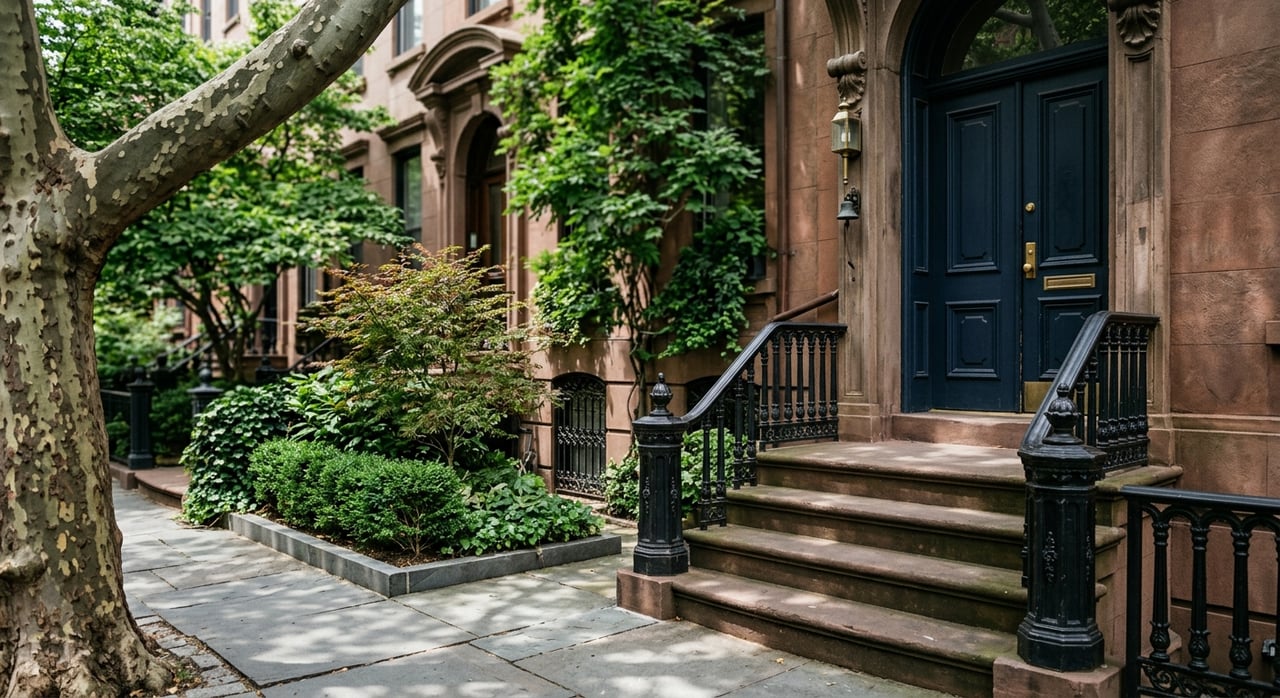
You do not have to go far in Manhattan to find energy, noise, and constant motion. What makes Gramercy stand out is that it offers the opposite feeling in the middle of it all. If you have ever wondered why this neighborhood feels calmer, more private, and more intimate than many nearby areas, the answer comes down to how it was built and how it still functions today. Let’s dive in.
Gramercy Park sets the tone
At the center of the neighborhood is Gramercy Park, a small private square bordered by East 20th and East 21st Streets and Gramercy Park East and West. That detail matters more than it may seem at first.
Because the park is private, it does not operate like a typical Manhattan green space with heavy public traffic passing through all day. City planning materials note that surrounding owners can buy keys for access, which gives the park a shared-courtyard feel. That private-park structure helps shape the area’s quieter, tucked-away identity.
The Landmarks Preservation Commission has also described Gramercy as a unique, quiet enclave with a strong sense of place and human scale. In simple terms, the neighborhood feels composed and contained. That is a big reason people often describe it as village-like.
Historic design keeps the area intimate
Gramercy’s charm is not just about the park. It is also about what surrounds it.
Landmarks materials highlight the district’s 19th-century buildings, shaded streets, and lower, more human-scaled forms around the park. The mix includes early houses, apartment buildings, clubs, and early co-op projects, which creates a streetscape that feels cohesive rather than oversized.
That consistency changes how you experience the neighborhood on foot. Instead of long stretches of glass towers or heavily commercial blocks, you get a setting that feels readable and residential. The preserved architecture helps the area feel grounded and distinct.
The neighborhood still feels residential
Another reason Gramercy reads like a hidden village is that it remains largely residential. Official neighborhood-character materials describe commercial activity as more concentrated along First and Second Avenues.
That means many interior blocks feel quieter than you might expect for such a central location. You are still in Manhattan, but the neighborhood rhythm can feel slower and more settled. For buyers and sellers, that balance is a meaningful part of Gramercy’s appeal.
Small green spaces reinforce the village feeling
Gramercy is not defined by one giant public park nearby. Instead, it benefits from a cluster of smaller open spaces that support everyday city living.
Nearby options include Stuyvesant Square, which spans 3.93 acres, and Madison Square Park, which covers 6.23 acres. There is also Peter’s Field at 0.88 acres, along with Augustus St. Gaudens Playground on Second Avenue between East 19th and East 20th Streets.
This pattern matters because it gives the area a network of smaller, walkable outdoor spaces. Rather than drawing huge waves of visitors into one place, these parks create a series of neighborhood-scale pauses. That adds to the sense that Gramercy is made up of intimate public rooms instead of one major destination.
Gramercy feels hidden, not isolated
One of the most interesting things about Gramercy is that it feels tucked away without being remote. That contrast is a big part of its identity.
Neighborhood-character materials place Gramercy next to Flatiron, Union Square, Rose Hill, Kips Bay, and Stuyvesant Town–Peter Cooper Village. So while the neighborhood can feel insulated on its residential blocks, it also sits close to some of Manhattan’s most active corridors.
This is why Gramercy often appeals to people who want calm without giving up convenience. You can step out into a neighborhood that feels measured and quiet, while still remaining close to shopping, dining, and everyday errands in nearby districts.
Dining is nearby without taking over
The food scene fits Gramercy’s personality well. It is present, polished, and convenient, but it does not overwhelm the neighborhood’s residential feel.
Research highlights nearby dining anchors such as Gramercy Tavern, Novitá, and Carlotto. The Infatuation also describes L’Express as a Gramercy staple for lunch, dinner, drinks, and late nights.
Taken together, that points to a dining environment that feels established and dependable rather than dominated by nightlife. For many buyers, that is part of the draw. You can enjoy strong restaurant options while still coming home to blocks that feel more composed than chaotic.
Transit keeps Gramercy connected
A hidden-village feeling only works in Manhattan if the location still functions well day to day. Gramercy benefits from being well connected even though it often feels quieter than surrounding neighborhoods.
MTA maps show dense transit access around 23rd Street, 28th Street, and the 14 St–Union Sq complex, including multiple subway lines. That service helps explain why the neighborhood can remain calm while still being easy to reach from elsewhere in the city.
For buyers, this can be an especially attractive combination. You get the emotional appeal of a more intimate neighborhood experience, but you do not have to trade away practical access.
Why this matters if you are buying
If you are considering a move to Gramercy, the neighborhood’s appeal is often less about one single feature and more about how several elements work together. Privacy, preservation, walkability, nearby dining, and strong transit all fit into a compact part of Manhattan.
That mix can be especially appealing if you want a home that feels calmer on a daily basis while staying centrally located. Gramercy’s value is tied to that rare balance. It offers a sense of retreat without disconnecting you from the city.
It also helps to look closely at the building types in the area. Because the neighborhood includes historic structures, apartment houses, and co-op properties, your search may involve different ownership structures and building styles within a relatively small footprint. A neighborhood that feels consistent from the sidewalk can still offer meaningful variation from one property to the next.
Why this matters if you are selling
If you own in Gramercy, understanding the neighborhood story can help you position your property more effectively. Buyers are often responding to more than square footage or finishes. They are also reacting to the neighborhood’s emotional logic.
In Gramercy, that logic is clear. The area feels private, preserved, and livable in a way that stands out in Manhattan. When a listing communicates that lifestyle accurately, it can connect more directly with buyers who already know they want something central but less hectic.
This is one reason neighborhood-level expertise matters. In a place like Gramercy, the selling story is not just about location. It is about explaining why this location feels different from others nearby.
The real reason Gramercy feels like a village
Gramercy is not hidden because it is hard to reach. It feels hidden because it compresses privacy, historic character, green space, dining, and transit into a very small part of Manhattan.
That is what gives the neighborhood its rare identity. The private square at its center, the preserved architecture around it, and the primarily residential character all work together to create a setting that feels smaller in the best possible way.
If you are trying to understand why Gramercy continues to stand apart, that is the answer. It offers a village-like experience not by leaving the city behind, but by shaping city life into something more intimate.
If you are thinking about buying or selling in Gramercy, the right guidance can help you understand how this micro-market really works, from property type and pricing to the nuances that make one block or building feel very different from another. The Blatman Team brings neighborhood-level perspective and tailored advice to help you make a confident move.
FAQs
Why does Gramercy Park make the neighborhood feel private?
- Gramercy Park is a private square, and city planning materials note that surrounding owners can buy keys for access, which creates a shared-courtyard feeling instead of a heavily trafficked public-park atmosphere.
What makes Gramercy feel different from nearby Manhattan neighborhoods?
- The neighborhood combines a private park, preserved historic architecture, a largely residential character, nearby small green spaces, and strong transit access in a compact area.
Is Gramercy mostly residential or commercial?
- Official neighborhood-character materials describe Gramercy as primarily residential, with commercial activity more concentrated along First and Second Avenues.
What parks are near Gramercy besides Gramercy Park?
- Nearby open spaces include Stuyvesant Square, Madison Square Park, Peter’s Field, and Augustus St. Gaudens Playground.
Why do buyers often like Gramercy’s location?
- Gramercy can feel calm and tucked away while still sitting near Flatiron, Union Square, Rose Hill, Kips Bay, and Stuyvesant Town–Peter Cooper Village, with convenient access to multiple subway lines nearby.
Why is Gramercy’s architecture part of its appeal?
- Landmarks materials point to the area’s 19th-century buildings, shaded streets, and human-scaled forms, which help create a cohesive neighborhood feel rather than a tall, heavily commercial one.