WHY PHOTOS AND VIDEO MATTER MORE THAN EVER
THE FIRST SHOWING HAPPENS ONLINE
In Manhattan real estate, the first showing of a property no longer takes place in the lobby. It takes place on a screen. Before a buyer ever schedules a tour, contacts a broker, or submits an offer, they have already formed a strong impression of a property based entirely on what they saw in photographs and video. That impression determines whether they pursue the listing further or scroll past it.
This shift in buyer behavior has been building for over a decade and accelerated significantly in the years following 2020, when remote and digital-first property evaluation became standard practice. Today, the visual presentation of a listing is not supplementary to the marketing strategy. It is the marketing strategy. Everything else, the description, the floor plan, the asking price, is evaluated in the context of what the visual media communicates about the property first.
Sellers who recognize this reality and invest accordingly in professional-grade photography and video gain a measurable advantage over sellers who treat listing media as a checkbox rather than a strategic asset. Reviewing active listings through Daniel Blatman's Manhattan property search makes the difference immediately visible. Properties with exceptional visual presentation generate more inquiries, more showings, and more competitive offers than comparable properties with mediocre media, even when the underlying real estate is of similar quality.
WHAT PROFESSIONAL PHOTOGRAPHY ACTUALLY CHANGES
The gap between professional real estate photography and amateur or substandard photography is not subtle. It is immediately apparent to every buyer who looks at a listing, even those who could not articulate precisely what they are responding to. Professional photography communicates space, light, proportion, and quality in ways that smartphone images, regardless of how capable the device is, consistently fail to replicate.
A common question is whether buyers can tell the difference between professional and non-professional listing photography. They can, and they respond to it. Research from the National Association of Realtors has consistently documented that listings with professional photography attract significantly more online views, generate more showing requests, and sell closer to or above asking price than listings without it. In Manhattan, where the stakes of every transaction are measured in millions of dollars, the return on investment for professional photography is among the most asymmetric in the entire marketing budget.
Professional real estate photographers bring specialized equipment, lighting knowledge, and compositional expertise that produce images with accurate color rendering, controlled exposure, and perspectives that represent spaces honestly while presenting them at their absolute best. Wide-angle lenses used correctly communicate the true scale of a room without distorting it into an unrealistic representation. Natural and artificial light are balanced to eliminate the harsh shadows and blown-out windows that characterize non-professional listing images.
THE SPECIFIC DEMANDS OF MANHATTAN INTERIORS
Photographing Manhattan apartments presents specific challenges that general photography experience does not automatically address. New York City apartments, particularly in prewar buildings, often have complex light conditions involving north-facing windows, narrow rooms, and interior spaces that receive limited direct sunlight. These conditions require skilled handling to produce images that are both accurate and compelling.
Sellers often ask whether twilight or dusk exterior shots are worth the additional cost. For buildings with architectural distinction or significant street presence, the answer is almost always yes. A twilight photograph of a handsome prewar facade with warm interior light visible through the windows creates an emotional response that a flat daytime shot of the same building does not. This emotional response is not accidental. It is the deliberate product of professional real estate photography executed at the right moment under the right conditions.
Interior staging also interacts directly with photography quality. A professionally staged space photographed by a skilled real estate photographer produces images that feel aspirational without appearing staged. The viewer sees themselves in the space rather than seeing a decorator's presentation. This psychological subtlety is what separates listing photography that generates emotional engagement from listing photography that merely documents a property.
VIDEO AND VIRTUAL TOURS: WHAT THEY ADD THAT PHOTOGRAPHY CANNOT
Photographs capture moments. Video communicates sequence, scale, and flow in ways that even the best still images cannot replicate. A buyer watching a well-produced video walkthrough of a Manhattan apartment understands the relationship between rooms, the transition from entry to living area to kitchen to bedroom, and the proportional logic of the floor plan in a way that requires imagination rather than direct experience when viewed only through photographs.
Buyers frequently ask whether virtual tours and video walkthroughs actually influence purchase decisions in a meaningful way. In the Manhattan market, where a significant percentage of buyers are relocating from other cities or countries and may not be able to visit a property in person before making an offer, video content is not supplemental. It is the primary vehicle through which a remote or time-constrained buyer evaluates a property and decides whether to move forward. Sellers of properties in this price range who do not invest in professional video are categorically excluding a segment of the most motivated and financially qualified buyers from their potential pool.
Video production quality matters as much as photography quality. A shaky handheld walkthrough with inconsistent lighting and ambient background noise communicates carelessness about the property and, by extension, about the transaction. A professionally produced video with stabilized camera movement, controlled pacing, and careful attention to natural and supplemental lighting communicates exactly the opposite. It communicates that this property and this seller are serious.
HOW AERIAL AND DRONE FOOTAGE ADDS VALUE IN SPECIFIC CONTEXTS
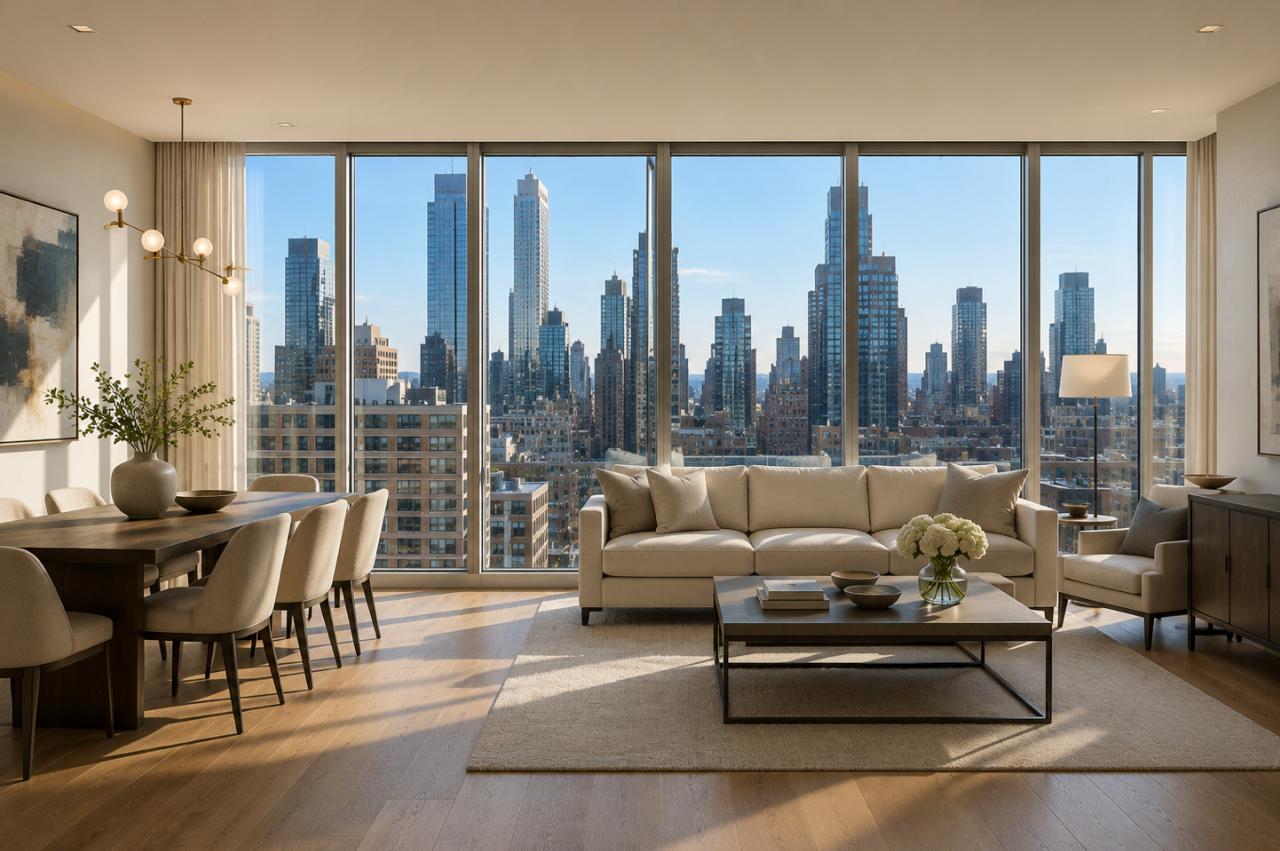
Drone photography and aerial video have become standard tools in Manhattan real estate marketing for properties where the surrounding context is as compelling as the property itself. High-floor units with panoramic skyline views, penthouse properties with roof terraces, and buildings in neighborhoods where the surrounding streetscape and proximity to parks or the waterfront are meaningful selling points all benefit from aerial media that ground-level photography cannot produce.
Sellers often ask whether drone footage is appropriate for all Manhattan listings. It is not. For a mid-floor apartment in a building surrounded by taller structures with limited view potential, aerial footage adds little. For a high-floor unit with unobstructed views of Central Park, the Hudson River, or the Manhattan skyline, drone footage is one of the most powerful visual tools available and can be decisive in attracting buyers for whom view quality is a primary purchase criterion.
The use of drone photography in New York City is subject to Federal Aviation Administration regulations governing unmanned aircraft systems, which restrict flights in certain airspace and require operator certification. Sellers should confirm that their photographer or videographer holds the appropriate FAA Part 107 remote pilot certification before authorizing any drone work, as non-compliant flights create legal and safety risks that responsible sellers should not accept.
THE RELATIONSHIP BETWEEN LISTING MEDIA AND DAYS ON MARKET
The connection between listing media quality and days on market is more direct than many sellers realize. Properties that generate strong early engagement, measured by online views, saved listings, and showing requests in the first week of listing, consistently achieve better pricing outcomes than those that generate weak initial interest and accumulate days on market.
That early engagement is driven almost entirely by listing media. The asking price, the neighborhood, and the building all influence whether a buyer clicks on a listing. What determines whether they schedule a showing, and whether they return to the listing repeatedly in the following days, is the quality and character of the photographs and video they encounter.
Sellers frequently ask whether it is possible to relaunch a listing with better photography if the initial media underperformed. It is possible, but it is not equivalent to getting the launch right the first time. In Manhattan, buyers and brokers pay close attention to listing history, and a property that relaunches with new photography after a slow start has already accumulated visibility and buyer awareness under its original presentation. The relaunch can improve engagement, but it cannot fully recreate the momentum of a first impression executed at the highest level.
Understanding how early engagement drives eventual pricing is part of the broader context of Manhattan real estate market trends that informed sellers track throughout the marketing process. The first ten days of a listing's public exposure are typically the most consequential, and the visual media shapes every impression formed during that window.
WHAT SELLERS SHOULD DEMAND FROM THEIR LISTING MEDIA
Given the stakes of listing media in a Manhattan transaction, sellers should approach this element of the marketing process with clear expectations and specific standards. A professional photography session for a Manhattan apartment should include a defined number of edited final images appropriate to the property's size, delivered in both web-optimized and high-resolution formats suitable for print marketing. The images should accurately represent the space while presenting it at its very best, with attention to natural light, staging, and composition.
Video content should include a professionally produced walkthrough that introduces the property with intention and moves through it at a pace that allows viewers to form a genuine spatial understanding. For properties with significant view components or outdoor spaces, the video should capture those elements with the same production quality applied to the interior. A voiceover or music track, when used, should complement rather than distract from the visual content.
Sellers considering their options for listing representation should confirm before engaging any broker what their listing media package includes, who produces it, and what the production quality standard is. A broker who treats photography as a cost center to be minimized rather than an investment in the listing's success is a broker whose approach to marketing will likely reflect the same priorities throughout the campaign.
Through Daniel Blatman's NYC real estate expertise, sellers receive listing media that reflects the quality of the properties being represented and the sophistication of the buyers being targeted. In a market where the first showing happens on a screen, the visual presentation of a Manhattan property is not a detail. It is the foundation of the entire sales effort.
STAGING AND ITS RELATIONSHIP TO VISUAL PRESENTATION
No discussion of listing photography and video is complete without addressing staging, because the two are inseparable in their effect on buyer perception. A professionally staged space gives the photographer and videographer the raw material they need to produce exceptional content. An unstaged, cluttered, or poorly furnished space constrains what even the most skilled photographer can produce.
Staging in Manhattan real estate ranges from light staging, which involves decluttering, repositioning existing furniture, and adding curated accessories, to full vacant staging, where a professionally furnished environment is installed in an empty apartment to help buyers visualize how the space functions with furniture in place. For vacant properties in particular, professional staging is nearly always worth the investment. Buyers consistently respond more strongly to a furnished space than to empty rooms, even when they are intellectually aware that the furniture will not be included in the sale.
A common question is how to evaluate whether the cost of professional staging is justified by the expected return. The answer is to consider what a single additional offer, or a single bid at a higher price point, would be worth relative to the staging investment. In Manhattan, where purchase prices are measured in millions, the differential between one competitive offer and two, or between an offer ten thousand dollars below asking and one at asking, far exceeds the cost of even a full professional staging engagement. Sellers who view staging as an expense rather than an investment in outcome are making a calculation that consistently underserves their own interests.