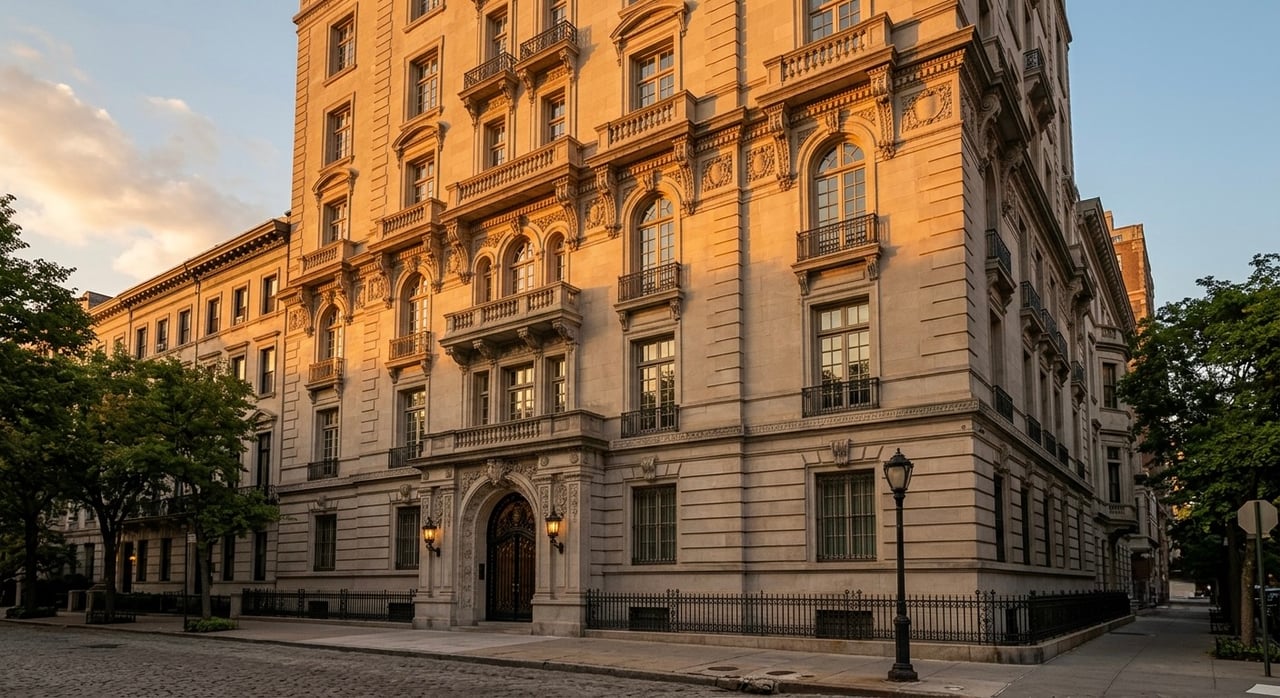
WHY SOME BUILDINGS ALWAYS SELL AT A PREMIUM
In Manhattan real estate, the difference between a building that commands a persistent pricing premium and one that trades at market is not primarily a function of price point. Some of the most expensive buildings in the borough do not consistently sell at premiums relative to their peers. And some buildings at more accessible price points maintain premiums that have proven durable through multiple market cycles. Understanding what actually creates that durability is how buyers identify the acquisitions that hold value best and sellers understand what they are actually selling.
THE DISTINCTION BETWEEN EXPENSIVE AND PREMIUM
Expensive and premium are not the same thing in Manhattan real estate, and conflating them is one of the most common evaluation errors buyers make. An expensive building is one where the price per square foot is high. A premium building is one where the price per square foot is consistently above what comparable buildings in the same neighborhood and market segment achieve, and where that differential has been sustained through market cycles rather than reflecting a temporary demand spike.
The premium designation means something specific in the transactional record. It means that buyers who have purchased in the building over time have consistently paid more than they would have paid for a comparable unit in an adjacent building, and that the buyers who have subsequently purchased from them have been willing to pay a similar premium. This recursive premium, where each generation of buyers validates the premium paid by the generation before them, is what creates the durability that distinguishes a genuinely premium building from one that simply had a strong market period.
Buyers evaluating premium buildings through buying a condo in Manhattan who anchor their assessment to this definition rather than to raw price level will identify the actual premium buildings in their target market with much greater accuracy than those who equate premium with expensive.
ARCHITECTURAL DISTINCTION AS A DURABLE VALUE DRIVER
The most consistent predictor of durable building premiums in Manhattan is genuine architectural distinction. This is not the same as impressive marketing, striking renderings, or a famous architectural firm's name attached to the project. It is the physical characteristic of a building that makes it immediately recognizable as architecturally significant, that produces spaces buyers want to inhabit for reasons that extend beyond the square footage count, and that creates a form of product scarcity that no amount of new development can address because the building itself cannot be reproduced.
The landmark prewar buildings of Manhattan's established residential neighborhoods represent the clearest expression of this principle. Buildings of this type, whose architectural character, craftsmanship, ceiling heights, room proportions, and exterior detailing reflect the construction standards and aesthetic ambitions of their era, command premiums because no new building can replicate what they are. The ceiling heights cannot be rebuilt at current construction costs. The carved limestone detailing cannot be cost-effectively reproduced. The depth of the facade reveals and the quality of the window surrounds reflect a standard of craft that modern construction economics simply do not support.
This architectural irreproducibility is the most structurally durable form of scarcity in real estate because it does not depend on regulatory restrictions or geographic constraints that can change. It is inherent to the physical fabric of the building itself and cannot be addressed by any developer regardless of their ambition or capital.
THE ROLE OF BUILDING PRESTIGE AND ADDRESS
Beyond architecture, certain Manhattan buildings command premiums through the prestige attached to their specific address, the historical associations that have accumulated around the building over decades, and the cultural significance that has made them reference points in the city's residential landscape. This prestige premium is real but more complex than the architectural premium because it depends on the sustained recognition of a value that is partly cultural and therefore subject to shifts in how culture frames and values different buildings and addresses over time.
Address prestige in Manhattan is most durably anchored to buildings where the architectural distinction, the ownership community, and the building's operational quality have reinforced each other over decades. A building whose prestige rests primarily on its address and historical associations, without being supported by genuine architectural quality and excellent ongoing management, is more vulnerable to prestige erosion than one where all three factors are aligned.
A common question is whether the prestige of a specific address or building is something that new buyers can still access, or whether the premium has already been fully reflected in current pricing. The answer is that the premium is already reflected in the current pricing, which is what makes the building premium. The buyer who purchases at the premium price is paying for the building's demonstrated quality and its track record of sustained buyer demand, not for an opportunity to arbitrage an underrecognized value. The case for purchasing at the premium is that the building's structural characteristics make the premium likely to persist, not that it represents a discount to intrinsic value.
MANAGEMENT QUALITY AND ITS COMPOUNDING EFFECT ON VALUE
Among all the operational factors that contribute to a building's premium, management quality is the one that most directly compounds over time. A building that has been managed with genuine excellence for decades, where capital has been deployed proactively rather than reactively, where the physical plant has been maintained to a standard that preserves the building's original character, and where the resident community has been curated through a selective ownership process, develops a physical and cultural condition that cannot be replicated by a few years of improved management in a building that was previously neglected.
This management quality premium is most visible at the building-level comparison stage of due diligence, when buyers review the reserve fund history, the board meeting minutes, the capital improvement record, and the physical condition of the common areas and mechanical systems. A building where these records reflect decades of thoughtful, consistent stewardship looks materially different from one where management quality has been uneven, and that difference is reflected in the physical condition of the building, the satisfaction of its residents, and the consistency of its pricing premium through market cycles.
Building management standards in New York City are subject to oversight from the New York City Department of Buildings, which maintains records of permits, violations, and compliance history that allow buyers to assess a building's maintenance track record independently of what management or the seller represents.
THE RESIDENT COMMUNITY AND OWNERSHIP CULTURE
A premium building is not only a physical asset. It is a community, and the character of that community, the long-term ownership profile of its residents, the governance culture of its board, and the shared commitment to the building's standards, contributes to its premium in ways that are difficult to quantify but clearly visible in the transactional record.
Buildings where the majority of units are owned by long-term residents who have a deep personal investment in the building's quality and character tend to produce governance decisions that prioritize the building's long-term interests over short-term cost minimization. They invest appropriately in capital maintenance before problems become crises. They maintain admission standards that ensure new residents share the same commitment to the building's quality. And they create a social fabric that makes the building an attractive place to live independent of its physical characteristics.
This ownership culture is one of the most difficult building characteristics to assess from outside the building but one of the most consequential for long-term value. The board meeting minutes that buyers' attorneys review during due diligence provide the clearest window into ownership culture, revealing how the board has balanced short-term cost concerns against long-term building quality and how decisions have been made when the interests of individual residents diverged from the building's collective interest.
HOW PREMIUM BUILDINGS PERFORM IN MARKET DOWNTURNS
The most compelling evidence for the durability of a building's premium is how it performs during periods when the broader Manhattan market is under pressure. Premium buildings, as defined here, characteristically experience less price volatility than the market average during corrections and recover more quickly when conditions improve. This pattern reflects the concentration of owner-occupants with long holding horizons, who are less likely to be distressed sellers, and the depth of the qualified buyer pool that these buildings attract, which sustains competitive demand even when broader market activity is reduced.
A common question is whether this downturn resilience makes premium buildings safer investments than market-rate buildings. In a relative sense, yes. A buyer who purchases in a premium building at a given market point is generally better protected against adverse market timing than a buyer who purchases at a comparable price in a market-rate building. The premium reflects real characteristics that sustain demand across conditions, and those characteristics do not disappear when external conditions shift.
This is not an argument for paying unlimited premiums for any building with a strong reputation. It is an argument for understanding that the pricing premium associated with genuinely premium buildings reflects real structural characteristics that have been validated by decades of transaction data, and that buyers who understand those characteristics can evaluate whether a specific building's premium is justified by its fundamentals or inflated by its marketing.
IDENTIFYING PREMIUM BUILDINGS IN THE CURRENT MARKET
The practical question for buyers who want to identify and purchase in genuine premium buildings is how to distinguish them from buildings that have the marketing of premium buildings without the structural characteristics that create durable premiums.
The most reliable method is to examine the building's historical transaction data across multiple market cycles, comparing its pricing performance against peer buildings in the same neighborhood and price tier during both strong and weak market periods. A building that has maintained its relative premium through at least one full market cycle, achieving above-peer pricing at the peak, holding value better than peers during the correction, and recovering pricing faster than peers in the subsequent recovery, has demonstrated the durability that defines a genuine premium building.
Transaction data for Manhattan properties across multiple market cycles is publicly accessible through the New York City Department of Finance's ACRIS system, which records every sale and allows buyers to construct an accurate historical pricing picture for any building under consideration. Supplementing this public data with the current market intelligence available through Manhattan real estate market trends allows buyers to evaluate both the historical record and the current positioning of any building relative to its peers.
For buyers who want to apply this analysis to specific buildings under active consideration, the building-level market knowledge available through Daniel Blatman's NYC real estate expertise provides the context that transforms transaction data into actionable acquisition intelligence. Some buildings always sell at a premium for reasons that are visible in their architecture, their management, their community, and their history. The work of buying well in Manhattan is finding those buildings before the purchase price is committed.